
Forget Password

View News
Workplace Predation: A Crisis of Safety
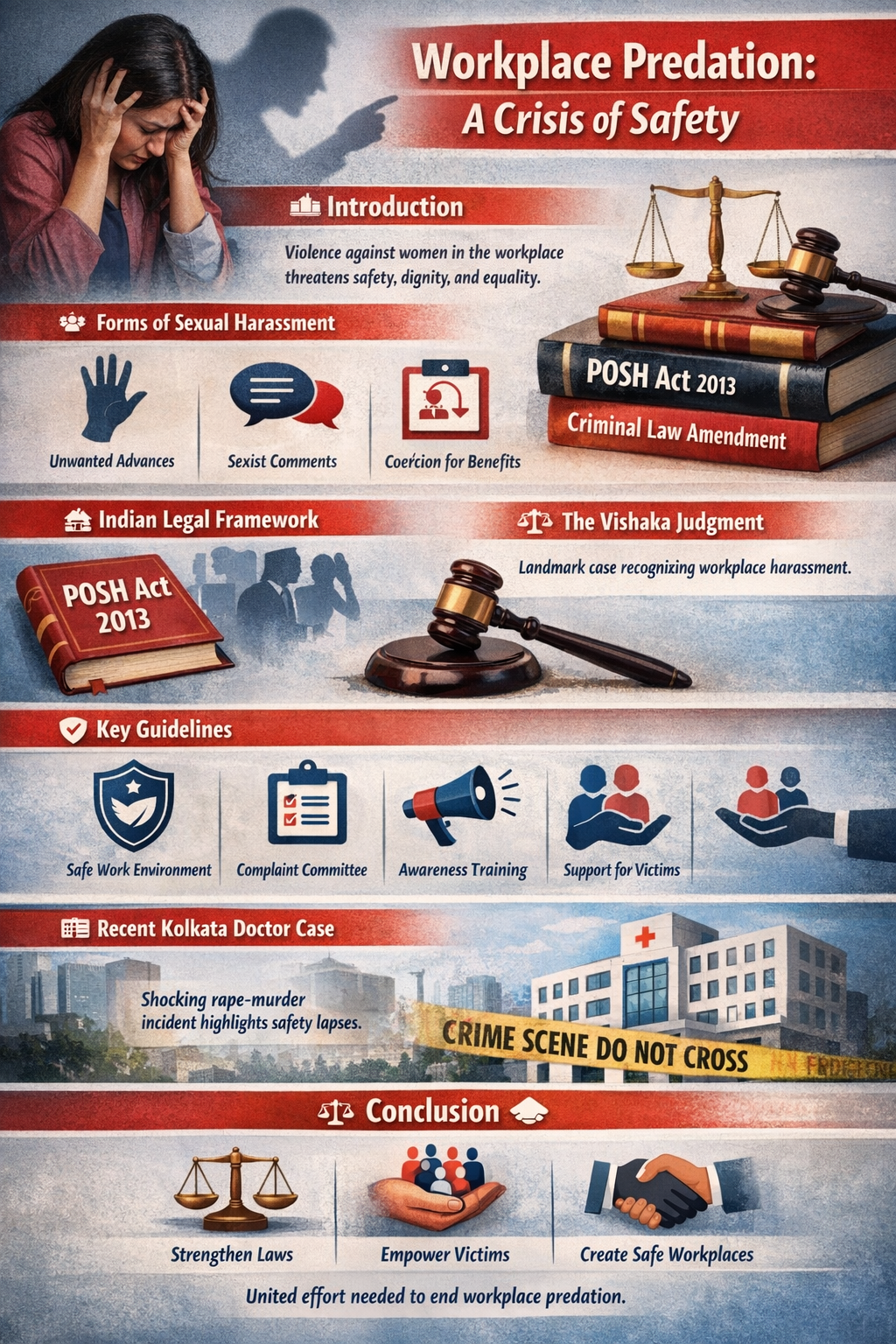
Workplace Predation: A Crisis of Safety
1. Introduction
Workplace predation, particularly in the form of gender-based violence, remains one of the most pressing concerns in modern employment structures. The United Nations defines violence against women as any act of gender-based violence that results in, or is likely to result in, physical, sexual, or psychological harm or suffering, including threats, coercion, or arbitrary deprivation of liberty, whether occurring in public or private life. This broad definition encapsulates various forms of abuse, including intimate partner violence, sexual assault, and workplace sexual harassment.
1.1 Gender Equality and Equity
Gender equality refers to the equal treatment of individuals irrespective of gender, ensuring equal access to opportunities, resources, and rights across societal, economic, and legal frameworks. It also emphasizes that differences in needs, aspirations, and behaviors between genders must be acknowledged and respected without reinforcing discriminatory stereotypes.
Gender equity, on the other hand, involves fairness in the distribution of resources and responsibilities, often requiring gender-specific policies and interventions to correct historical imbalances. Achieving true equality frequently necessitates targeted measures to uplift marginalized groups and eliminate systemic disparities.
1.2 Gender-Based Discrimination
Gender-based discrimination encompasses policies, practices, or behaviors that create unjust and avoidable inequalities between genders. Such discrimination manifests in unequal access to employment opportunities, pay disparities, lack of representation, and vulnerability to exploitation, ultimately affecting social, economic, and health outcomes.
2. Workplace Sexual Harassment
Workplace sexual harassment is a critical manifestation of workplace predation. It includes any unwelcome conduct of a sexual nature that creates an intimidating, hostile, or offensive working environment. Importantly, such conduct is not confined to the physical workplace but extends to work-related settings such as meetings, conferences, business trips, and social gatherings.
2.1 Forms of Sexual Harassment
Workplace sexual harassment can be broadly categorized into the following forms:
-
Unwelcome Sexual Attention: Includes inappropriate comments, advances, or gestures of a sexual nature.
-
Sexist Hostility: Non-sexual but gender-based derogatory remarks or behavior that demean an individual.
-
Sexual Coercion: Situations where employment benefits are conditioned upon sexual favors, often referred to as “quid pro quo” harassment.
Additionally, actions such as sexually suggestive jokes, intrusive questions about personal life, or sharing explicit content also fall within the ambit of harassment.
3. Indian Legal Framework on Workplace Sexual Harassment
India has developed a comprehensive legal framework to address workplace sexual harassment, primarily through the Sexual Harassment of Women at Workplace (Prevention, Prohibition and Redressal) Act, 2013 (POSH Act).
3.1 POSH Act, 2013
The POSH Act was enacted by the Ministry of Women and Child Development to provide protection against sexual harassment and ensure a safe working environment for women. It applies to all workplaces, both organized and unorganized, and covers women irrespective of their employment status or age.
The Act is supported by the Sexual Harassment of Women at Workplace Rules, 2013, which prescribe procedural aspects such as complaint mechanisms and inquiry processes.
3.2 Criminal Law Amendments
The Criminal Law (Amendment) Act, 2013 strengthened criminal provisions by explicitly recognizing offences such as stalking, voyeurism, and sexual harassment under the Indian Penal Code. These provisions complement the POSH Act by addressing the criminal dimensions of such conduct.
3.3 Objectives of the POSH Act
The primary objectives of the POSH Act include:
-
Prevention of sexual harassment at the workplace
-
Prohibition of such conduct through strict policies
-
Redressal of complaints through formal mechanisms
Despite its comprehensive nature, effective implementation remains a challenge due to lack of awareness, institutional gaps, and cultural barriers.
4. The Vishaka Judgment: A Landmark Development
A significant milestone in India’s legal journey against workplace harassment is the Vishaka v. State of Rajasthanjudgment.
4.1 Background
The case arose from the brutal gang rape of Bhanwari Devi, a social worker who attempted to prevent child marriage in Rajasthan. The incident exposed the absence of legal safeguards for working women and highlighted systemic failures in addressing such crimes.
4.2 Judicial Intervention
In response, the Supreme Court of India recognized workplace sexual harassment as a violation of fundamental rights under Articles 14, 15, and 21 of the Constitution. The Court relied upon the Convention on the Elimination of All Forms of Discrimination Against Women, an international treaty ratified by India, to formulate binding guidelines.
These guidelines, issued under Article 32, were treated as law until formal legislation was enacted.
5. Key Features of the Vishaka Guidelines
5.1 Definition of Sexual Harassment
The guidelines provided an expansive definition, including:
-
Physical contact and advances
-
Demand or request for sexual favors
-
Sexually colored remarks
-
Display of pornography
-
Any other unwelcome verbal, non-verbal, or physical conduct
5.2 Duty to Provide a Safe Working Environment
Employers are obligated to ensure a safe and secure workplace by implementing preventive measures and taking disciplinary action against offenders.
5.3 Employer’s Obligation to Initiate Action
Where harassment amounts to a criminal offence, employers must initiate legal proceedings and ensure that victims and witnesses are protected from retaliation.
5.4 Establishment of Complaint Committees
Organizations are required to constitute complaint redressal committees to handle grievances in a fair and time-bound manner.
5.5 Assistance to Victims
Employers must support employees facing harassment, including cases involving third parties, ensuring access to justice and institutional backing.
5.6 Awareness and Sensitization
Employers must actively promote awareness through training programs, workshops, and internal communication regarding rights and remedies.
5.7 Role of Government
The guidelines emphasized the responsibility of the State to enact comprehensive legislation, leading to the eventual enactment of the POSH Act in 2013.
6. Contemporary Challenges: The Kolkata Doctor Case
A recent incident in Kolkata involving the brutal rape and murder of a postgraduate doctor within a hospital premises has reignited national concern over workplace safety.
The Supreme Court of India, taking suo motu cognizance, expressed serious concern over institutional failures and procedural lapses, including delays in filing the FIR. The Court directed the formation of a task force to recommend safety measures for medical professionals and mandated the Central Bureau of Investigation to submit a status report.
The case underscores a critical gap in existing laws—while legal provisions exist, institutional safety standards and their enforcement remain inadequate.
7. Conclusion
Workplace predation is a deeply entrenched issue that undermines the dignity, safety, and fundamental rights of individuals. It is not merely a legal concern but a societal crisis requiring urgent and collective action.
Addressing this issue necessitates a multi-dimensional approach. Organizations must cultivate a culture of respect, inclusivity, and zero tolerance towards harassment. Robust internal policies, effective complaint mechanisms, and victim support systems are essential to ensure accountability and justice. Simultaneously, employees must be educated about their rights and encouraged to report misconduct without fear of retaliation.
From a regulatory perspective, there is a need to strengthen enforcement mechanisms and bridge gaps in institutional safety standards. Laws alone cannot eradicate workplace predation unless supported by proactive implementation and cultural transformation.
Ultimately, creating a safe workplace is not an aspirational goal but a fundamental obligation. A workplace free from fear, harassment, and discrimination is essential for both individual dignity and organizational integrity.
Unlock the Potential of Legal Expertise with LegalMantra.net – Your Trusted Legal Consultancy Partner
Disclaimer
Every effort has been made to ensure accuracy in this material. However, inadvertent errors or omissions may occur. Any discrepancies brought to the author’s notice will be rectified in subsequent editions. The author shall not be liable for any direct, indirect, incidental, or consequential damages arising from the use of this material. This article is based on various sources including statutory enactments, judicial decisions, academic research papers, professional journals, and publicly available legal materials.
Prerna Yadav