
Forget Password

View News
When Silence is Risky: SEBI’s Clear Message to Independent Directors—Speak, Record, and Act
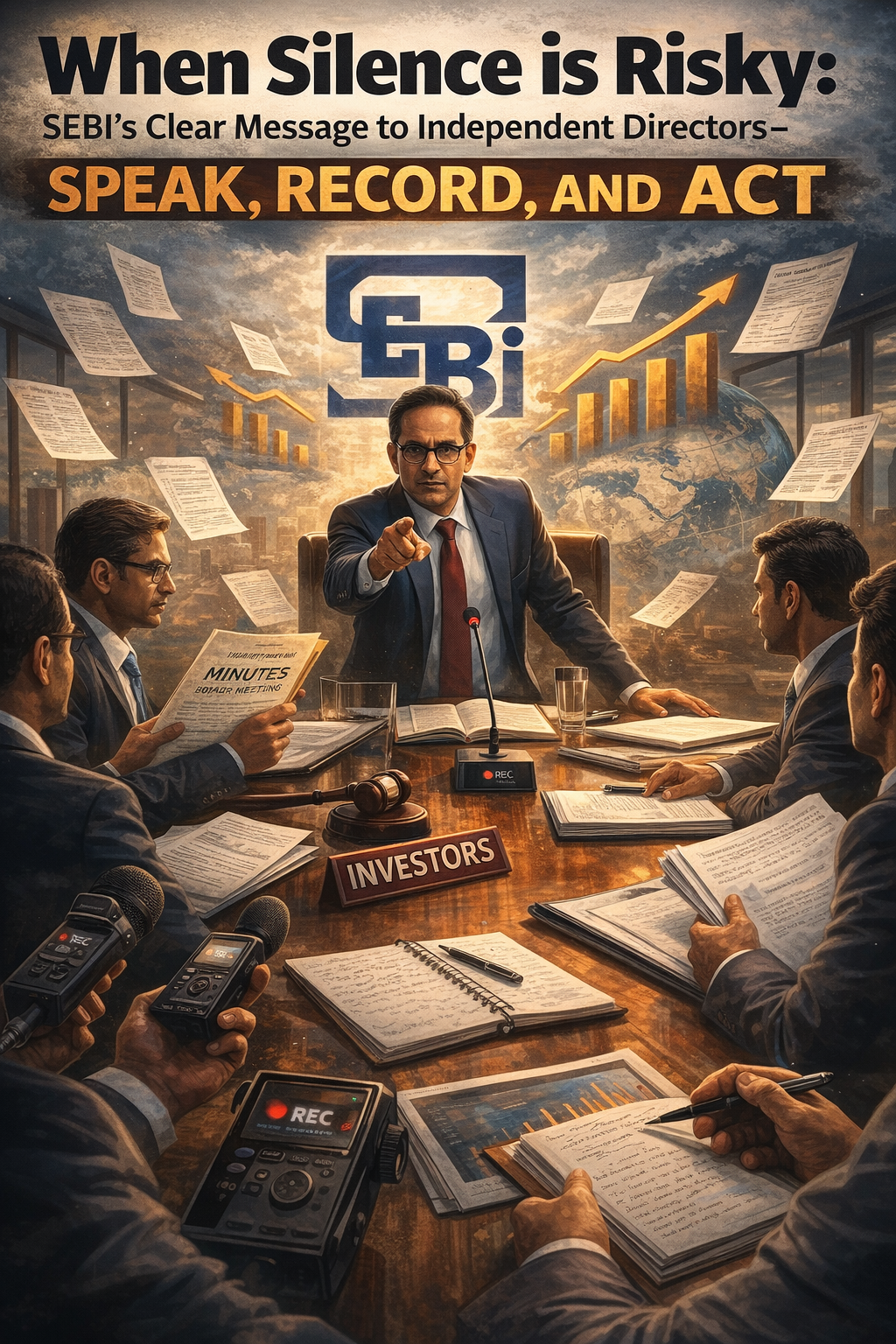
When Silence is Risky: SEBI’s Clear Message to Independent Directors—Speak, Record, and Act
Corporate boardrooms in India are no longer quiet, ceremonial spaces where decisions are merely endorsed—they are rapidly becoming arenas of accountability, scrutiny, and responsibility. In this evolving landscape, independent directors are at the center of attention. Recent regulatory signals from the Securities and Exchange Board of India (SEBI) carry a sharp and unmistakable message: being present is not enough—being vocal, responsible, and documented is essential.
What makes this shift particularly compelling is that SEBI is not just focusing on what decisions are taken, but how they are taken—and more importantly, how they are recorded. The spotlight is now firmly on the conduct of independent directors inside boardrooms, especially in situations involving ethical dilemmas or potential governance lapses.
The New Reality: Passive Directors Are No Longer Safe
For years, independent directors were often perceived as watchdogs who occasionally barked but rarely bit. That perception is changing. Today, regulators expect them to act as active guardians of corporate integrity. If something feels off—whether it is a questionable transaction, a governance gap, or an ethical concern—remaining silent is no longer an option.
SEBI’s stance makes it clear that independent directors must ask tough questions, challenge management when required, and most importantly, ensure that their concerns are formally recorded. Because in today’s regulatory environment, what is not written is assumed to have not existed.
Minutes of Meeting: From Formality to Powerful Evidence
One of the most striking takeaways from recent developments is the elevated importance of board meeting minutes. Traditionally treated as a routine compliance document, minutes have now become a critical piece of legal evidence.
Imagine a scenario where a decision later comes under regulatory scrutiny. If an independent director had reservations but failed to ensure that those concerns were documented, it could appear as if they were in full agreement with the decision. This is precisely why SEBI has emphasized that any ethical concerns or disagreements must be explicitly captured in the minutes.
In simple terms, boardroom discussions without proper recording are like conversations that never happened—at least in the eyes of the law.
From Independent to Accountable: A Shift in Role
The role of independent directors is undergoing a subtle but powerful transformation. They are no longer just “independent” in name—they are now expected to be accountable in action. This includes acting as protectors of minority shareholders, who often rely entirely on the board for fair treatment.
In many cases, minority shareholders do not have the power to influence decisions. Independent directors, therefore, become their voice in the boardroom. SEBI’s observations reinforce that this responsibility is not symbolic—it is real, enforceable, and increasingly scrutinized.
No More Guesswork: Decisions Must Be Evidence-Based
Another important shift is the growing insistence on evidence-backed decision-making. Gone are the days when decisions could be justified through informal discussions or management assurances. Today, every significant decision must stand on the foundation of proper documentation, analysis, and reasoning.
SEBI has made it clear that vague statements, unsupported concerns, or casual observations will not suffice. Independent directors are expected to rely on concrete evidence, demand proper records, and ensure that their views are backed by facts. This not only strengthens governance but also protects directors from future liabilities.
Changing Boardroom Culture: Encouraging Dissent
Perhaps the most interesting outcome of this regulatory shift is the cultural change it is likely to bring within organizations. Traditionally, dissent in boardrooms was often discouraged, either explicitly or implicitly. However, the new governance environment encourages constructive disagreement.
A healthy boardroom is no longer one where everyone agrees—it is one where different perspectives are discussed, debated, and documented. Independent directors must feel empowered to express dissent, and companies must create an environment where such dissent is valued rather than suppressed.
The Bigger Picture: Trust, Transparency, and Governance
At its core, SEBI’s message is about building trust. Investors, especially in listed companies, rely heavily on the integrity of the board. When independent directors actively engage, question decisions, and ensure transparency, it strengthens investor confidence and enhances the credibility of the organization.
This is not just about avoiding penalties or regulatory action—it is about creating a governance framework that is robust, transparent, and future-ready.
Conclusion: The Era of Responsible Directorship
The evolving stance of the Securities and Exchange Board of India marks the beginning of a new era in corporate governance—an era where independent directors are expected to be vigilant, vocal, and visibly responsible.
The message is simple yet powerful: Do not just attend board meetings—participate, question, and record. Because in today’s corporate world, silence is not neutrality—it can be a liability.
For independent directors, this is both a challenge and an opportunity. A challenge to rise above passive roles, and an opportunity to truly shape the governance standards of Indian corporate India.
Unlock the Potential of Legal Expertise with LegalMantra.net – Your Trusted Legal Consultancy Partner
Disclaimer
Every effort has been made to ensure accuracy in this material. However, inadvertent errors or omissions may occur. Any discrepancies brought to the author’s notice will be rectified in subsequent editions. The author shall not be liable for any direct, indirect, incidental, or consequential damages arising from the use of this material. This article is based on various sources including statutory enactments, judicial decisions, academic research papers, professional journals, and publicly available legal materials.
Anshul Goel
LegalMantra.net Team