
Forget Password

View News
Understanding Indian Citizenship Laws: A Comprehensive Legal Analysis
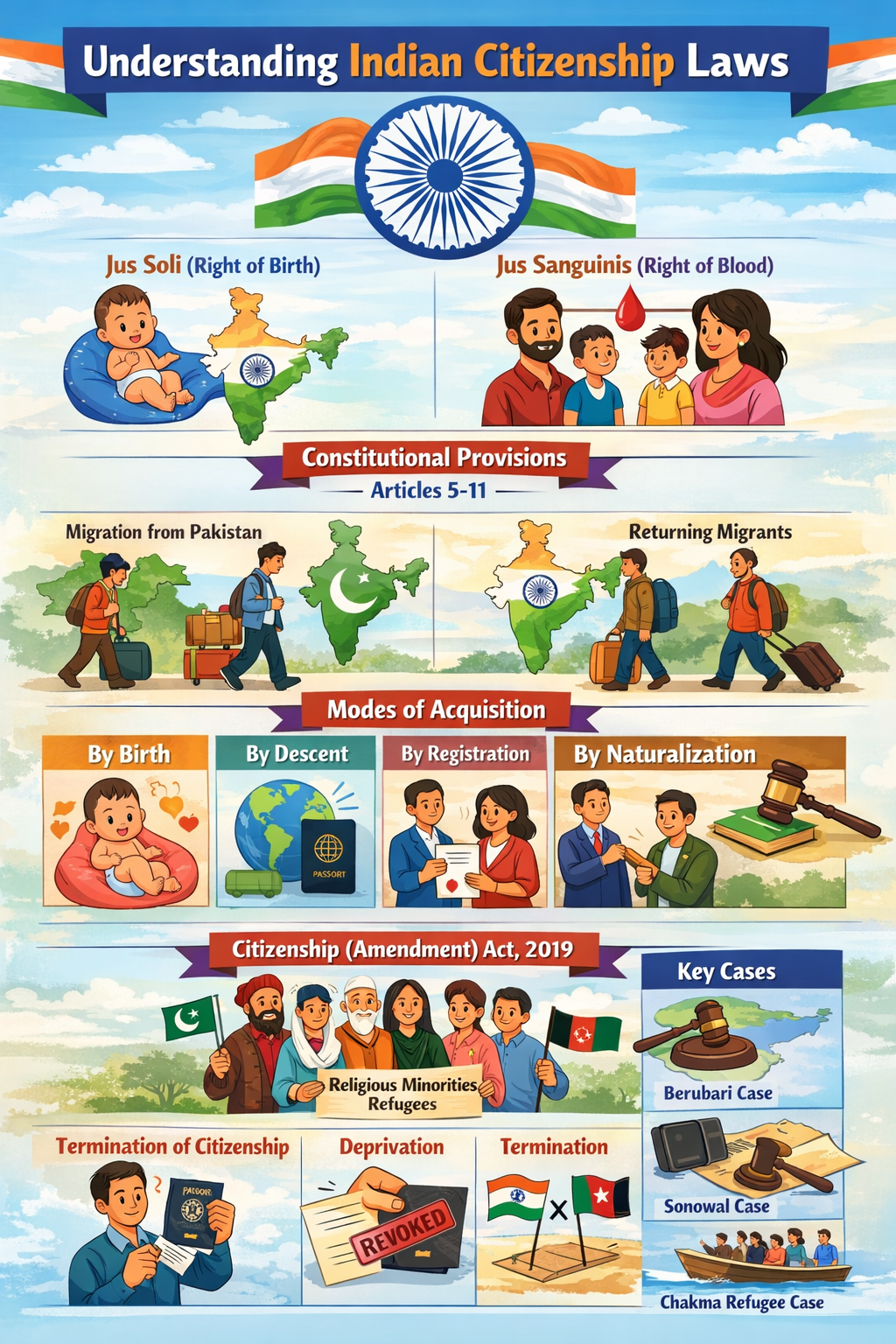
Understanding Indian Citizenship Laws: A Comprehensive Legal Analysis
Introduction
Citizenship represents the legal bond between an individual and the State, signifying allegiance, rights, and duties. In the Indian context, citizenship determines full membership in the political community and entitles individuals to civil and political rights guaranteed under the Constitution. At the same time, it inherently excludes non-citizens, thereby functioning as both an inclusive and exclusive legal concept.
Globally, citizenship is primarily governed by two principles: jus soli (citizenship by place of birth) and jus sanguinis(citizenship by descent or blood relation). India initially adopted a liberal approach leaning toward jus soli, influenced by the recommendations of the Motilal Nehru Committee (1928) and the inclusive ethos of the Constituent Assembly. However, over time, this approach has gradually shifted toward a more restrictive framework incorporating elements of jus sanguinis, particularly in response to concerns such as illegal migration.
Constitutional Framework of Citizenship
The Constitution of India lays down the foundational provisions relating to citizenship in Part II, encompassing Articles 5 to 11. These provisions came into force on November 26, 1949, the date of adoption of the Constitution, reflecting the urgency of determining citizenship in the backdrop of partition.
Article 5: Citizenship at the Commencement of the Constitution
Article 5 provides that any person domiciled in India at the commencement of the Constitution would be deemed a citizen if they were either born in India, had either parent born in India, or had been ordinarily resident in India for at least five years preceding such commencement.
For instance, a person residing in India since 1944 with no foreign allegiance would automatically qualify as a citizen under this provision.
Article 6: Rights of Migrants from Pakistan
Article 6 addresses individuals who migrated from Pakistan to India during partition. Those who migrated before July 19, 1949, were granted automatic citizenship, whereas those who migrated after this date were required to register themselves.
This distinction reflects the administrative need to regulate post-partition migration flows.
Article 7: Rights of Migrants to Pakistan
Article 7 deals with individuals who migrated to Pakistan after March 1, 1947, but later returned to India. Such individuals were not automatically entitled to citizenship unless they returned under a valid permit for resettlement.
This provision ensured that allegiance to the Indian State remained clear and deliberate.
Article 8: Citizenship for Persons of Indian Origin Abroad
Article 8 extends citizenship rights to persons of Indian origin residing outside India. Such individuals could acquire citizenship by registering themselves at Indian diplomatic missions abroad.
For example, a person of Indian origin living in Kenya could apply for Indian citizenship through the Indian High Commission.
Articles 9, 10, and 11
Article 9 prohibits dual citizenship by stating that any person voluntarily acquiring citizenship of another country ceases to be an Indian citizen. Article 10 ensures continuity of citizenship subject to parliamentary law, while Article 11 empowers Parliament to regulate citizenship through legislation.
The Citizenship Act, 1955: Modes of Acquisition
The Citizenship Act, 1955 operationalizes constitutional provisions and provides four primary modes of acquiring Indian citizenship: by birth, descent, registration, and naturalization.
Citizenship by Birth
Citizenship by birth has undergone significant transformation over time. Initially, any person born in India between January 26, 1950, and July 1, 1987, was automatically a citizen irrespective of parental nationality. This reflected a pure jus soli approach.
However, between July 1, 1987, and December 3, 2004, citizenship was granted only if at least one parent was an Indian citizen. After December 3, 2004, the law became stricter, requiring that one parent be a citizen and the other not be an illegal migrant.
For example, a child born in India in 2005 to one Indian parent and one illegal migrant would not qualify for citizenship.
Citizenship by Registration
Citizenship by registration is available to certain categories of individuals, including persons of Indian origin residing in India for seven years, spouses of Indian citizens, and minor children of Indian citizens.
For instance, a foreign national married to an Indian citizen and residing in India for the prescribed period can apply for citizenship through registration.
Citizenship by Descent
Citizenship by descent applies to individuals born outside India. The law has evolved to include both parents instead of just the father and now requires registration at an Indian consulate for children born after December 3, 2004.
For example, a child born in the United States to Indian parents must have their birth registered at the Indian consulate to claim Indian citizenship.
Citizenship by Naturalization
Naturalization is granted to foreign nationals who fulfill residency requirements, typically involving 12 years of residence in India. The applicant must also satisfy conditions relating to good character and intention to reside in India.
An example would be a foreign entrepreneur who has lived and conducted business in India for over a decade and seeks Indian citizenship.
Termination of Citizenship
The Citizenship Act provides for three modes of termination: renunciation, termination, and deprivation.
Renunciation occurs when a person voluntarily gives up Indian citizenship, often after acquiring foreign citizenship. Termination is automatic when a person acquires foreign citizenship voluntarily. Deprivation is a punitive measure exercised by the government in cases such as fraud or disloyalty, and it applies primarily to those who acquired citizenship through registration or naturalization.
Legislative Amendments and Policy Shifts
Over time, amendments to the Citizenship Act have significantly altered the framework of citizenship.
1986 Amendment
The 1986 amendment restricted citizenship by birth by introducing the requirement of at least one Indian parent, thereby diluting the earlier jus soli principle.
2003 Amendment
The 2003 amendment further tightened citizenship laws by excluding children of illegal migrants from citizenship eligibility. It also introduced the concept of the National Register of Citizens (NRC).
2005 and 2015 Amendments
These amendments introduced provisions relating to Overseas Citizenship of India (OCI) and Person of Indian Origin (PIO), facilitating easier access to benefits for the Indian diaspora without granting full citizenship.
Citizenship (Amendment) Act, 2019
The Citizenship (Amendment) Act, 2019 marked a significant shift by granting citizenship eligibility to members of six religious communities—Hindus, Sikhs, Buddhists, Jains, Parsis, and Christians—from Pakistan, Bangladesh, and Afghanistan who entered India before December 31, 2014. It also reduced the residency requirement for naturalization from eleven years to five years for these groups.
This amendment has been subject to intense debate, particularly regarding its compatibility with the secular principles of the Constitution.
Judicial Interpretation and Case Laws
Judicial decisions have played a crucial role in shaping citizenship law in India.
In Berubari Union Case (1960), the Supreme Court clarified issues related to citizenship and territorial cession, holding that Parliament has the power to alter territory but must follow constitutional procedures.
In Sarbananda Sonowal v. Union of India (2005), the Supreme Court struck down the Illegal Migrants (Determination by Tribunals) Act, holding that it failed to effectively address illegal migration and posed a threat to national security.
In State of Arunachal Pradesh v. Khudiram Chakma (1994), the Court dealt with the rights of Chakma refugees and emphasized the importance of legal procedures in determining citizenship.
These cases demonstrate the judiciary’s role in balancing national security concerns with constitutional protections.
Critical Analysis and Contemporary Issues
The evolution of Indian citizenship law reflects a shift from an inclusive to a more regulated and restrictive regime. While earlier provisions emphasized inclusivity and nation-building, later amendments have focused on national security and demographic concerns.
The Citizenship (Amendment) Act, 2019 has raised constitutional questions, particularly regarding equality under Article 14 and secularism as part of the basic structure doctrine. Critics argue that religion-based classification undermines constitutional values, while proponents justify it as a humanitarian measure for persecuted minorities.
Additionally, the implementation of the NRC has generated concerns about statelessness and procedural fairness, especially for marginalized communities.
Conclusion
Indian citizenship law is a dynamic and evolving field shaped by historical events, legislative amendments, and judicial interpretation. While the Constitution laid a broad and inclusive foundation, subsequent developments have introduced restrictions reflecting changing socio-political realities.
As India continues to balance its commitment to secularism, equality, and national security, citizenship laws remain central to debates on identity, rights, and belonging. A nuanced approach that aligns legal provisions with constitutional morality and humanitarian considerations is essential for maintaining the integrity of the Indian democratic framework.
Unlock the Potential of Legal Expertise with LegalMantra.net – Your Trusted Legal Consultancy Partner
Disclaimer
Every effort has been made to ensure accuracy in this material. However, inadvertent errors or omissions may occur. Any discrepancies brought to the author’s notice will be rectified in subsequent editions. The author shall not be liable for any direct, indirect, incidental, or consequential damages arising from the use of this material. This article is based on various sources including statutory enactments, judicial decisions, academic research papers, professional journals, and publicly available legal materials.
Prerna Yadav
LegalMantra.net Team