
Forget Password

View News
Transforming IPO Disclosures Through Simplification and Digital Integration
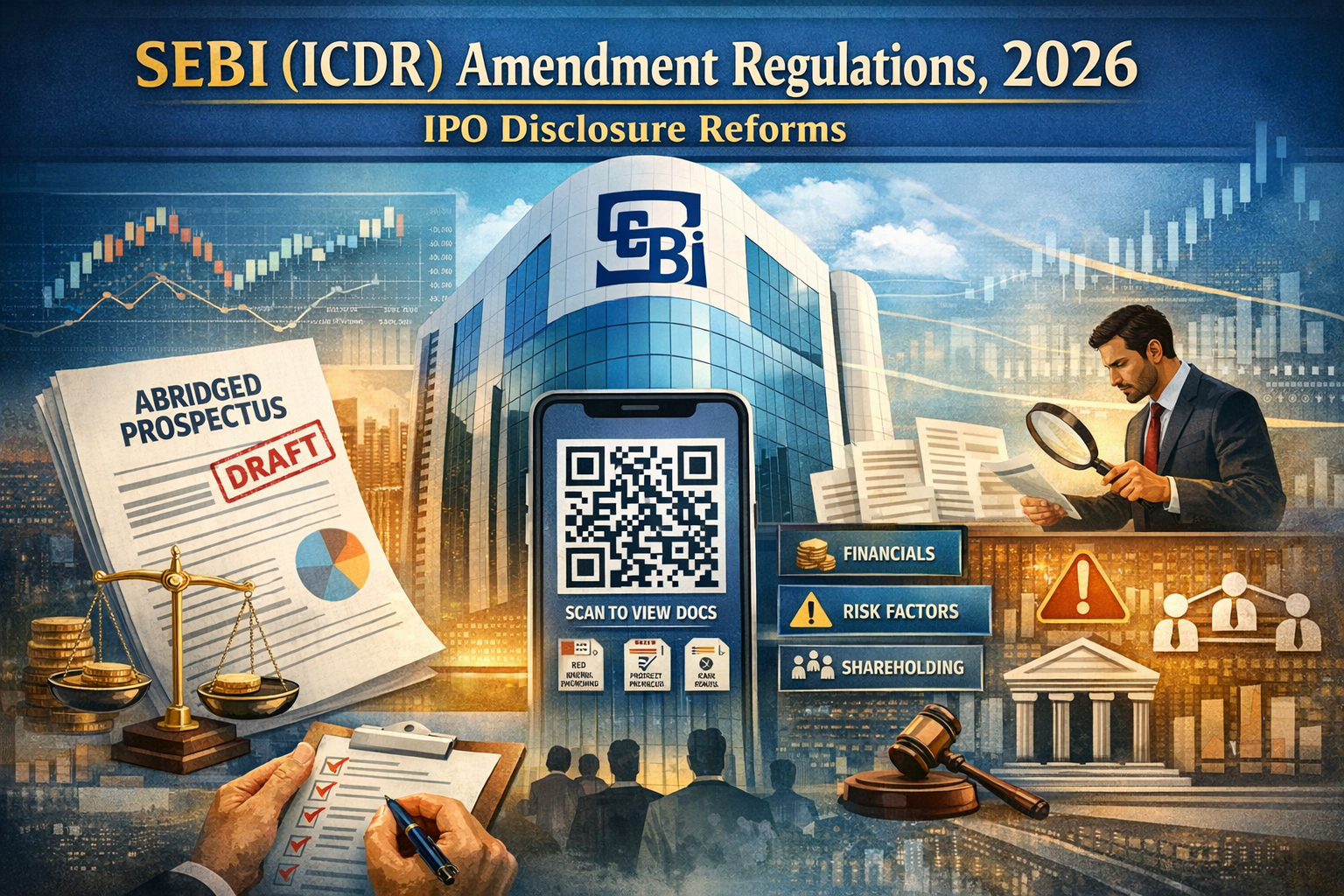
SEBI (ICDR) (Amendment) Regulations, 2026: Transforming IPO Disclosures Through Simplification and Digital Integration
1. Introduction
The Securities and Exchange Board of India (SEBI), through its notification dated 16th March 2026, has introduced significant amendments to the SEBI ICDR Regulations 2018. These amendments represent a progressive step towards enhancing transparency, improving investor accessibility, and modernizing disclosure mechanisms in India’s capital markets. While the earlier framework under the ICDR Regulations, 2018 focused on comprehensive disclosures, the present amendment emphasizes concise, structured, and digitally accessible information, particularly in the context of public issues such as Initial Public Offerings (IPOs), Further Public Offerings (FPOs), and rights issues.
The amendment reflects SEBI’s broader regulatory intent to align Indian disclosure practices with global standards by prioritizing clarity, comparability, and ease of understanding for investors, especially retail participants who often face challenges in interpreting voluminous offer documents.
2. Conceptual Shift: From Lengthy Disclosures to Structured Abridgement
A significant conceptual shift introduced by the amendment lies in the elevation of the abridged prospectus from a supplementary document to a central disclosure instrument. The insertion of provisions mandating the preparation and submission of a “draft abridged prospectus” alongside the draft offer document marks a transformative development. This approach ensures that a summarized yet comprehensive version of the offer is available at every stage of the issue process.
The regulatory framework now requires issuers to maintain consistency between the draft red herring prospectus (DRHP), the red herring prospectus (RHP), and the abridged prospectus. This synchronization not only enhances transparency but also ensures that investors are not misled by selective or incomplete disclosures. The abridged prospectus is no longer a mere extract but a carefully curated document with standardized content and presentation.
3. Amendment to Regulation 17: Strengthening Lock-in Compliance Mechanism
One of the notable amendments has been introduced in Regulation 17, which deals with the lock-in requirements of specified securities. The insertion of sub-regulation (2) provides that in cases where the lock-in cannot be technically created, depositories shall mark such securities as “non-transferable” upon receiving instructions from the issuer.
This provision addresses practical challenges in implementing lock-in restrictions within the depository system. For instance, where system limitations prevent the tagging of securities under a lock-in category, the alternative mechanism of marking them as non-transferable ensures that the regulatory objective of restricting transferability is still achieved. Institutions such as National Securities Depository Limited and Central Depository Services Limited play a crucial role in operationalizing this requirement. The amendment thus reinforces compliance while accommodating technological constraints.
4. Integration of Draft Abridged Prospectus Across Issue Processes
The amendment introduces a consistent requirement across multiple regulations, including Regulations 25, 26, 59C, 123, 124, 246, and 247, mandating the submission and dissemination of the draft abridged prospectus. This integration spans across various types of public issues, thereby ensuring uniformity in disclosure practices.
In practical terms, issuers are now required to submit the draft abridged prospectus simultaneously with the draft offer document and ensure its availability on the websites of the issuer, SEBI, recognized stock exchanges, and lead managers. This multi-channel dissemination enhances accessibility and allows investors to review key information without navigating complex and lengthy documents.
The requirement also extends to subsequent stages of the issue, where the abridged prospectus must accompany the offer document and be filed with regulatory authorities. This continuous presence throughout the lifecycle of the issue underscores its importance as a primary communication tool.
5. Digital Transformation Through QR Code-Based Disclosures
A major technological advancement introduced by the amendment is the replacement of physical abridged prospectus requirements with QR code-based access. Amendments in Regulations 34, 131, and 255 mandate that application forms and related documents must include a QR code and a link providing access to the red herring prospectus, the abridged prospectus, and the price band advertisement.
This shift reflects SEBI’s commitment to promoting a paperless and efficient regulatory environment. By enabling instant access to critical documents through digital means, the amendment significantly enhances investor convenience. For example, an investor can now simply scan a QR code on an application form to access the complete set of disclosure documents on their mobile device, thereby eliminating the need for physical copies.
This digital integration also aligns with broader policy initiatives aimed at leveraging technology to improve governance and accessibility in financial markets.
6. Enhanced Website Hosting and Disclosure Requirements
The amendment further strengthens the requirement for online hosting of offer documents by mandating that such documents must be made available along with the abridged prospectus. This ensures that both detailed and summarized disclosures are accessible in tandem, enabling investors to choose the level of detail they wish to engage with.
By requiring issuers and intermediaries to host these documents on multiple platforms, the amendment reduces the risk of information asymmetry and ensures wider dissemination. It also facilitates regulatory oversight by enabling SEBI and stock exchanges to monitor disclosures more effectively.
7. Overhaul of Schedule VI, Part E: Standardization of Abridged Prospectus
The most significant reform introduced by the amendment is the comprehensive restructuring of Schedule VI, Part E, which governs the disclosures in the abridged prospectus. The inclusion of the draft abridged prospectus within its scope, along with detailed general instructions, establishes a standardized framework for preparing such documents.
The amendment mandates that the front outside cover page of the offer document shall serve as the first page of the abridged prospectus, thereby ensuring uniformity in presentation. It also requires cross-referencing between sections of the abridged prospectus and the corresponding sections in the offer document, thereby enhancing transparency and traceability.
Additionally, the requirement to include QR codes and links for accessing both the draft offer document and the abridged prospectus in all public announcements ensures seamless integration between different disclosure formats. The emphasis on clear, simple, and easily understandable language further reinforces the objective of making disclosures more investor-friendly.
8. Introduction of Annexure I: Structured Disclosure Framework
The substitution of Annexure I introduces a highly structured format for the abridged prospectus, covering key aspects such as business overview, industry summary, promoter details, objects of the issue, shareholding patterns, financial information, key performance indicators, risk factors, and litigation summaries.
The business summary, limited to 500 words, requires issuers to provide a concise yet comprehensive overview of their operations, including products, services, customer base, and geographical presence. Similarly, the industry summary is restricted to 250 words, ensuring that only the most relevant information is presented.
The requirement to disclose pre- and post-offer shareholding patterns in a tabular format enhances transparency regarding ownership dilution and control. Financial disclosures, including key metrics such as revenue, profitability, and earnings per share, provide investors with a snapshot of the company’s financial performance over the past three years.
The inclusion of key performance indicators used in determining the offer price is particularly significant, as it enables investors to assess the valuation rationale. Furthermore, the requirement to disclose the top ten risk factors in a summarized form ensures that investors are aware of the primary risks associated with the investment.
9. Amendments to Part A of Schedule VI
In addition to the changes in Part E, the amendment also modifies Part A of Schedule VI by removing redundant provisions and introducing new disclosure requirements relating to contingent liabilities and related party transactions. These additions enhance the completeness of financial disclosures and provide investors with a better understanding of potential obligations and transactions that may impact the issuer’s financial position.
10. Practical Implications and Regulatory Impact
The amendments have far-reaching implications for various stakeholders in the capital market ecosystem. For issuers, the requirement to prepare a structured and simplified abridged prospectus necessitates greater diligence and coordination among legal, financial, and compliance teams. Merchant bankers are required to ensure consistency and accuracy across multiple disclosure documents, thereby increasing their responsibility in the issue process.
For investors, particularly retail participants, the amendments offer significant benefits by simplifying access to critical information and enabling informed decision-making. The standardized format and use of plain language reduce the complexity associated with traditional offer documents.
From a regulatory perspective, the amendments enhance SEBI’s ability to monitor disclosures and enforce compliance through standardized templates and digital dissemination mechanisms.
11. Critical Evaluation
While the amendments represent a significant step forward in improving disclosure practices, certain challenges remain. The emphasis on brevity and simplification may, in some cases, lead to the omission of nuanced information that could be relevant for sophisticated investors. Additionally, the increased reliance on digital access may pose challenges for individuals with limited technological resources.
However, these concerns are outweighed by the overall benefits of enhanced transparency, accessibility, and efficiency. The amendments strike a balance between comprehensive disclosure and investor convenience, thereby strengthening the integrity of the capital markets.
12. Conclusion
The SEBI (ICDR) (Amendment) Regulations, 2026 mark a pivotal development in the evolution of India’s capital market regulatory framework. By introducing structured abridged disclosures, integrating digital access mechanisms, and standardizing reporting formats, SEBI has significantly improved the quality and accessibility of information available to investors.
These reforms not only align India’s regulatory practices with global standards but also empower investors to make informed decisions with greater confidence. As the capital markets continue to evolve, such initiatives will play a crucial role in fostering transparency, efficiency, and investor trust.
Disclaimer
Every effort has been made to ensure accuracy in this material. However, inadvertent errors or omissions may occur. Any discrepancies brought to the author’s notice will be rectified in subsequent editions. The author shall not be liable for any direct, indirect, incidental, or consequential damages arising from the use of this material. This article is based on various sources including statutory enactments, judicial decisions, academic research papers, professional journals, and publicly available legal materials.
Mayank Garg