
Forget Password

View News
The Silence of the Crowd: A Legal and Psychological Analysis of Bystander Apathy
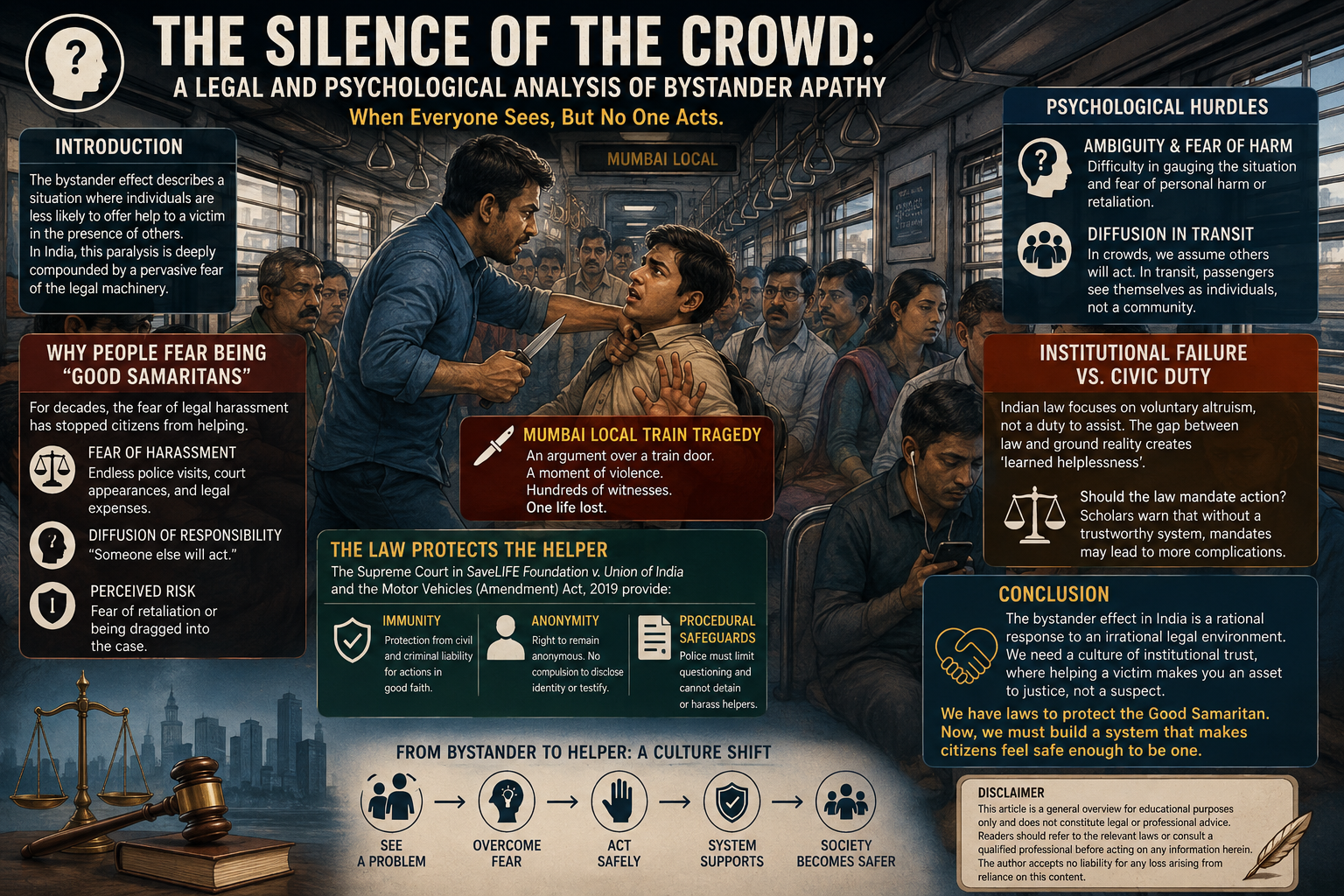
The Silence of the Crowd: A Legal and Psychological Analysis of Bystander Apathy
~Sura Anjana Srimayi
INTRODUCTION
In the complex tapestry of urban life, the "bystander effect" remains one of the most chilling phenomena. It describes a situation where individuals are less likely to offer help to a victim in the presence of others. While social psychology explains this through the "diffusion of responsibility", where each person assumes someone else will act, in the Indian context, this paralysis is deeply compounded by a pervasive fear of the legal machinery. The recent, tragic murder of Mayank Lohar in a Mumbai local train serves as a grim case study of this systemic failure, where an argument over a train door escalated into a fatal stabbing while fellow commuters remained spectators.
Why People Fear Being "Good Samaritans"
For decades, the primary deterrent to intervention in India has been a deep-seated apprehension of procedural harassment. Citizens often perceive the act of helping as a gateway to "getting stuck" in a case—an ordeal involving endless police station visits, grueling cross-examinations in courtrooms, and the burden of legal expenses.
The Indian judiciary has long acknowledged this "civic reflex." In the landmark case SaveLIFE Foundation v. Union of India, the Supreme Court explicitly recognized that the fear of harassment by the police and the legal machinery is the single biggest factor preventing bystanders from intervening. Consequently, the Court mandated the "Good Samaritan Law," which was later reinforced by the Motor Vehicles (Amendment) Act, 2019. These laws provide:
- Immunity: Protection from civil and criminal liability for those who assist in good faith.
- Anonymity: The right of a helper to remain anonymous, ensuring they are not compelled to disclose personal details or testify in court.
- Procedural Safeguards: Instructions to police to limit questioning to one round and to avoid detaining helpers.
Despite these robust protections, a massive gap remains between the "letter of the law" and "ground reality." The public perception that the legal system is cumbersome remains largely unchanged, leading to what many experts call "learned helplessness."
The Mumbai Local Train Tragedy: A Failure of Intervention
The murder of Mayank Lohar, a 22-year-old salesman commuting in a Mumbai local train, highlights the fragility of public safety. An argument over an open train door turned fatal when the accused pulled a knife and stabbed Lohar. In such a high-density environment, the Mumbai suburban railway, the presence of hundreds of witnesses should theoretically be a deterrent to crime. However, the outcome was one of isolation for the victim.
This tragedy underscores two specific psychological and legal hurdles:
- Ambiguity and Fear of Harm: Bystanders often struggle to interpret the severity of an incident or fear personal retaliation. In the case of a knife attack, the immediate threat of physical harm outweighs the abstract sense of civic duty.
- Diffusion in Transit: In public transport, passengers often adopt a "tunnel vision" approach, viewing their journey as a private, transitory space rather than a community environment. This, coupled with the lack of immediate, visible security, leads to a total breakdown of collective responsibility.
Institutional Failure vs. Civic Duty
While the law has moved toward protecting the Good Samaritan, it has struggled to mandate the "duty to assist." Unlike some jurisdictions in the US or Europe that impose a narrow duty to report or assist when safe, Indian law remains focused on voluntary altruism. The debate persists: Should the law do more than just protect? Should it mandate action?
Most legal scholars argue that mandating rescue could lead to further complications, given the systemic issues within Indian police investigations. If the system cannot guarantee that a helper will be treated with dignity, then even the most well-intentioned legal mandates will remain "paperwork" rather than a true societal shift.
CONCLUSION
The bystander effect in India is not merely a failure of human empathy; it is a rational response to an irrational legal environment. To transform the "bystander" into a "helper," India requires more than just judicial guidelines. It demands a culture of institutional trust. When an individual helps a victim, they should be treated as an asset to the justice system, not as a suspicious person to be interrogated.
Until the state creates a mechanism where reporting a crime or helping a victim is a seamless, harassment-free process, the tragedy in the Mumbai local train will likely remain a precursor to future events. We have successfully enacted laws to protect the Good Samaritan, but we are yet to build the institutional environment that makes citizens feel safe enough to be one.
Disclaimer
This article summarizes the exemption provisions relating to the online proficiency self-assessment test for independent directors under the applicable Companies Act rules. It is intended as a general overview for educational purposes only and does not constitute legal or professional advice. While care has been taken to ensure accuracy, readers should refer to the current text of the relevant rules or consult a qualified professional before acting on any information herein. The author accepts no liability for any loss arising from reliance on this content.