
Forget Password

View News
The Reliability of Witness Testimony: A Detailed Legal Analysis
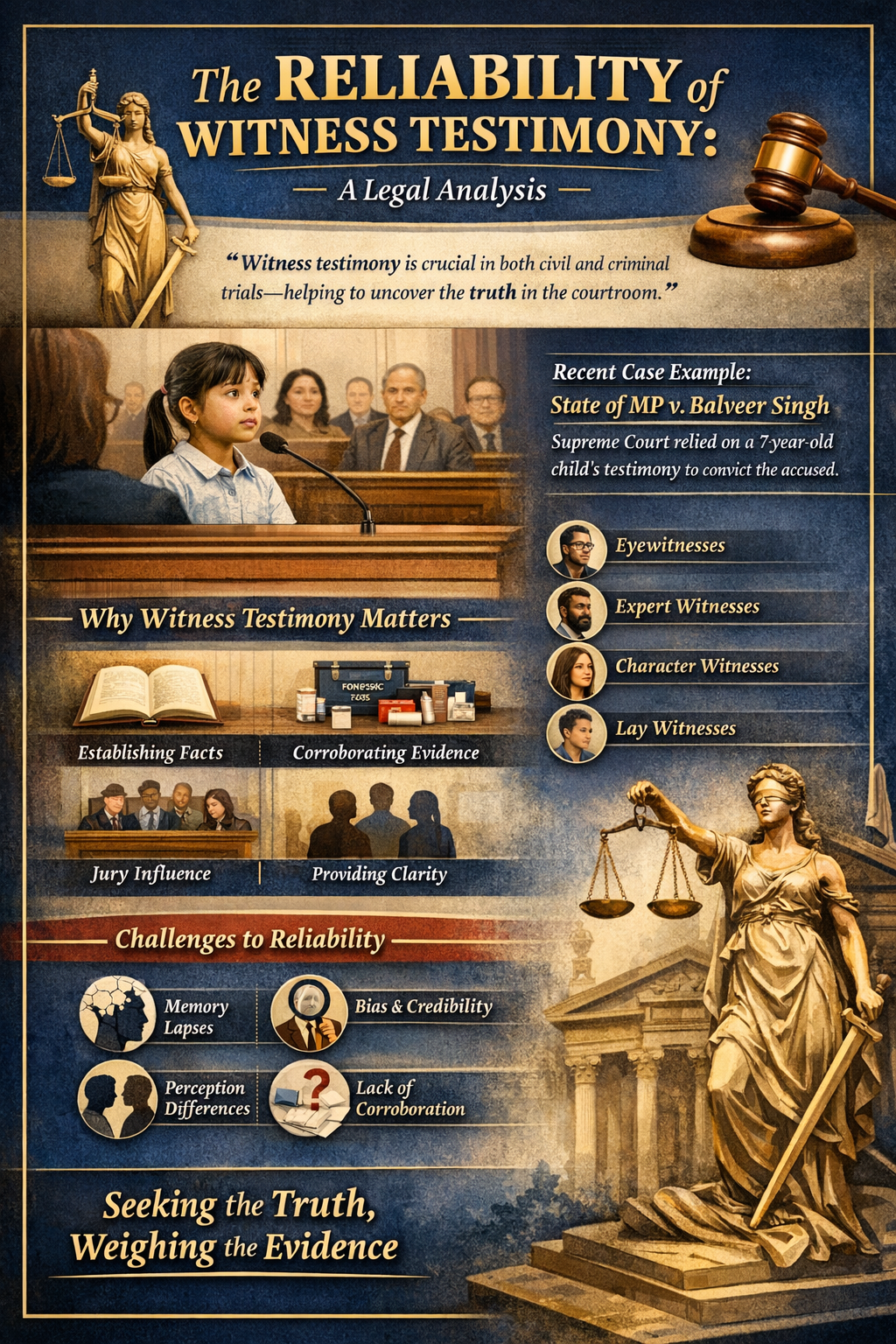
The Reliability of Witness Testimony: A Detailed Legal Analysis
Introduction
Witness testimony forms the backbone of adjudication in both civil and criminal justice systems. Courts are often tasked with reconstructing past events, and in doing so, they rely heavily on the accounts of individuals who claim to have seen, heard, or otherwise experienced the facts in issue. While documentary and scientific evidence have gained prominence in modern litigation, oral testimony continues to play a decisive role, particularly in cases where direct evidence is limited. The significance of such testimony lies not merely in narrating facts but in assisting the court in arriving at the truth.
The Supreme Court of India has consistently emphasized the evidentiary value of witness testimony, most notably in State of MP v. Balveer Singh, where the Court upheld a conviction based on the testimony of a seven-year-old child. The bench, comprising J. B. Pardiwala and Manoj Misra, clarified that the admissibility and reliability of a witness depend on credibility rather than age. This judgment reflects the evolving judicial approach that prioritizes trustworthiness over rigid evidentiary assumptions.
Concept and Legal Framework of Witness Testimony
Witness testimony refers to statements made under oath before a court by individuals possessing relevant knowledge about the facts of a case. Such statements may be oral or written and must be based on either direct observation, personal experience, or expert opinion. The legal foundation governing witness testimony in India is primarily contained in the Indian Evidence Act, 1872, which lays down rules regarding competency, admissibility, and appreciation of evidence.
Under Section 118 of the Act, all persons are competent to testify unless the court considers them incapable of understanding the questions or giving rational answers due to tender age, mental incapacity, or other reasons. This provision reflects the inclusive nature of Indian evidence law, where even children or persons with limited intellectual capacity may testify if they satisfy the test of understanding. Furthermore, the oath administered to witnesses imposes a legal duty to speak the truth, and any deviation may attract penal consequences under perjury laws.
Types of Witnesses and Their Evidentiary Value
Witnesses may be classified into several categories based on the nature of their testimony. Eyewitnesses, who provide first-hand accounts of events, are often considered the most direct source of evidence. However, courts have repeatedly cautioned against placing blind reliance on eyewitness testimony due to the inherent fallibility of human perception and memory. For instance, in criminal trials involving violent crimes, eyewitnesses may be under severe stress, which can impair their ability to accurately recall details such as the identity of the ????? or the sequence of events.
Expert witnesses, on the other hand, provide specialized knowledge that assists the court in understanding technical matters. Their opinions are admissible under Section 45 of the Evidence Act and are particularly relevant in cases involving forensic science, medical negligence, or financial fraud. For example, in a murder case where the cause of death is disputed, a forensic expert’s testimony regarding post-mortem findings can significantly influence the court’s conclusion. Unlike eyewitnesses, expert witnesses do not testify about facts but rather interpret evidence using their expertise.
Character witnesses play a different role by providing insight into the moral standing or reputation of a party. While their testimony does not directly establish the facts in issue, it may influence the court’s perception, especially during sentencing. Lay witnesses, who form the majority in most trials, testify based on their personal observations without any specialized knowledge. Their testimony is confined to facts and does not extend to opinions requiring expertise.
Importance of Witness Testimony in Judicial Decision-Making
The importance of witness testimony lies in its ability to establish and clarify disputed facts. In many cases, particularly those lacking documentary evidence, the court must rely almost entirely on oral testimony to determine what transpired. Witnesses provide a narrative that helps the court reconstruct the sequence of events, identify the parties involved, and assess the surrounding circumstances.
Witness testimony also serves to corroborate other forms of evidence. For instance, if a forensic report indicates the presence of fingerprints at a crime scene, an eyewitness account placing the accused at the same location strengthens the prosecution’s case. Conversely, contradictions between oral testimony and physical evidence may create reasonable doubt, thereby benefiting the accused.
Another crucial aspect is the influence of witness demeanor on judicial perception. Courts often assess not only the content of testimony but also the manner in which it is delivered. Confidence, consistency, and clarity can enhance credibility, while hesitation or inconsistency may raise suspicion. Although Indian courts do not follow a jury system in most cases, judges still consider the overall impression created by a witness while evaluating evidence.
Challenges and Limitations in Witness Testimony
Despite its importance, witness testimony is fraught with challenges that can affect its reliability. One of the primary concerns is the unreliability of human memory. Psychological studies have demonstrated that memory is not a perfect record of past events but is instead reconstructive in nature. Witnesses may forget details, confuse timelines, or unintentionally incorporate external information into their recollection. This is particularly evident in cases where there is a significant time gap between the occurrence of the event and the recording of testimony.
Bias and personal interest also pose significant challenges. A witness may consciously or unconsciously favor one party due to personal relationships, financial interests, or emotional involvement. For example, in family disputes or cases involving close acquaintances, witnesses may exaggerate or suppress facts to support a particular narrative. Courts, therefore, subject such testimony to rigorous scrutiny, especially during cross-examination.
Differences in perception further complicate matters. Two individuals witnessing the same incident may provide entirely different accounts due to variations in perspective, environmental conditions, or individual interpretation. For instance, in a road accident case, one witness may perceive the ????? as driving recklessly, while another may attribute the accident to external factors such as poor road conditions.
The absence of corroboration is another limitation. While the law does not mandate multiple witnesses for proving a fact, courts generally prefer corroborative evidence to ensure reliability. A solitary witness may suffice if found credible, but the burden of establishing such credibility is significantly higher.
Judicial Approach and Evolving Standards
Indian courts have developed nuanced principles for evaluating witness testimony. The emphasis is placed on quality rather than quantity, meaning that a single credible witness can form the basis of conviction. Minor inconsistencies are often ignored, as they are considered natural and indicative of truthful testimony, whereas material contradictions may lead to rejection.
The judiciary has also shown a progressive approach in accepting testimonies of vulnerable witnesses, including children and victims of sexual offences. In the case of State of MP v. Balveer Singh, the Supreme Court reiterated that the only requirement for accepting a child’s testimony is that it must be reliable and free from tutoring. This reflects a shift from earlier skepticism toward a more balanced and pragmatic approach.
Illustrative Example
Consider a hypothetical murder case where the prosecution relies primarily on the testimony of a neighbor who claims to have seen the accused entering the victim’s house shortly before the incident. The defense challenges the testimony by pointing out inconsistencies in the witness’s statement regarding the time of entry. However, if the witness’s account is supported by call records, forensic evidence, and recovery of the weapon, the court is likely to accept the testimony despite minor discrepancies. On the other hand, if the witness’s statement stands alone without any corroboration and contains significant contradictions, the court may deem it unreliable and extend the benefit of doubt to the accused.
Conclusion
Witness testimony remains an indispensable component of the legal process, providing courts with critical insights into disputed facts. However, its reliability depends on multiple factors, including the credibility of the witness, consistency of statements, and corroboration with other evidence. While the legal system recognizes the limitations of human perception and memory, it also acknowledges the indispensable role of witnesses in uncovering the truth.
The judicial approach, therefore, strikes a careful balance by neither accepting testimony at face value nor discarding it outright. Instead, courts undertake a meticulous evaluation of all surrounding circumstances to determine its probative value. In doing so, they ensure that justice is not compromised while maintaining the integrity of the evidentiary process.
Unlock the Potential of Legal Expertise with LegalMantra.net – Your Trusted Legal Consultancy Partner
Disclaimer
Every effort has been made to ensure accuracy in this material. However, inadvertent errors or omissions may occur. Any discrepancies brought to the author’s notice will be rectified in subsequent editions. The author shall not be liable for any direct, indirect, incidental, or consequential damages arising from the use of this material. This article is based on various sources including statutory enactments, judicial decisions, academic research papers, professional journals, and publicly available legal materials.
Prerna Yadav
LegalMantra.net Team