
Forget Password

View News
The Regulatory Landscape of NGOs and Non-Profits in India
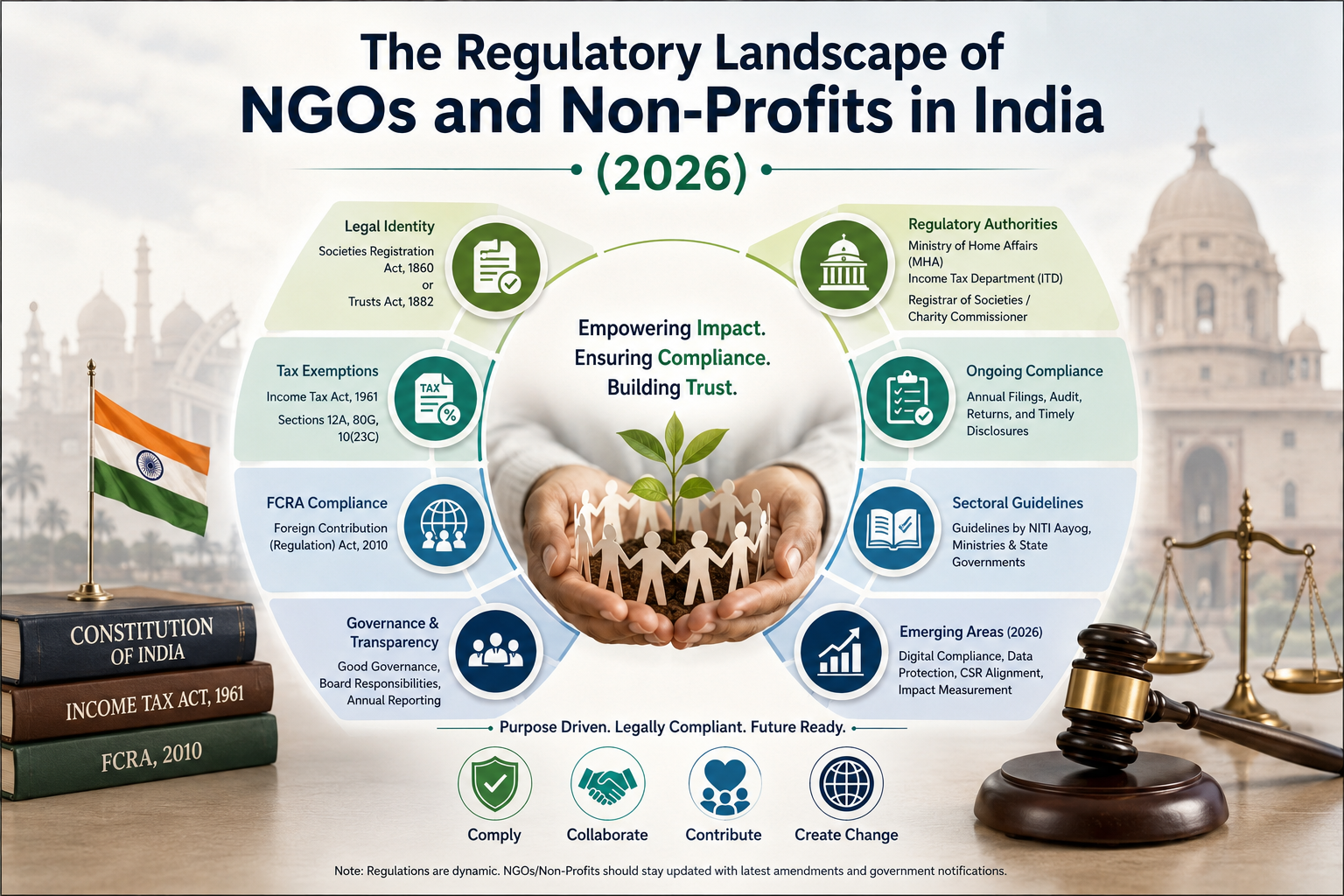
The Regulatory Landscape of NGOs and Non-Profits in India (2026)
~Sura Anjana Srimayi
INTRODUCTION
In the Indian socio-economic framework, Non-Governmental Organizations (NGOs) and Non-Profit Organizations (NPOs) serve as essential bridges between policy and grassroots implementation. As of June 2026, the sector is defined by a highly structured and increasingly granular legal environment. While "NGO" and "NPO" are often used interchangeably in common parlance, with NGOs typically focused on systemic advocacy and NPOs on direct community service, they are governed by the same foundational legal principles.
The current regulatory architecture is designed to balance the promotion of social welfare with stringent oversight, particularly regarding financial transparency, foreign funding, and operational accountability.
I. Legal Structures for Registration
An organization seeking to operate as a non-profit in India must choose one of three primary legal forms, each governed by distinct legislation:
- Public Charitable Trusts: Governed by the Indian Trusts Act, 1882, or specific state-level laws like the Maharashtra Public Trusts Act, 1950. This structure is traditionally favored for managing assets like land or buildings dedicated to charitable causes.
- Societies: Registered under the Societies Registration Act, 1860, this structure is ideal for membership-based associations. It requires a minimum of seven members and is commonly used for community, cultural, and educational groups.
- Section 8 Companies: Incorporated under the Companies Act, 2013, these are formally structured as "non-profit companies." They are highly favored for their transparent governance and professional corporate structure, making them increasingly popular for NGOs that engage in large-scale social impact projects.
II. The Compliance Framework: 2026 Updates
The regulatory environment in 2026 has become significantly more rigorous. NGOs must navigate a complex web of registrations and annual filings to maintain their "charitable" status.
1. Foreign Contribution Regulation Act (FCRA)
The FCRA regime underwent major amendments effective June 2026. The Ministry of Home Affairs has implemented a granular approach to foreign funding:
- Purpose and Geography Restrictions: NGOs must now explicitly define the purpose (categorized into Religious, Social, Economic, Cultural, and Educational) and the specific State/Union Territory of their operations.
- Enhanced Disclosure: Organizations must report their social media handles, websites, and details of ultimate donors.
- Utilization Benchmarks: NGOs failing to utilize at least Rs. 10 lakh over the previous two financial years in their approved area face risks of registration cancellation.
2. Income Tax Compliance
The Income Tax Act, 2025 (which came into force on April 1, 2026) maintains the principles of tax exemption for "Registered Non-Profit Organisations." Key requirements include:
- Section 12AB Registration: Mandatory for income tax exemptions.
- Section 80G Certification: Essential for allowing donors to claim tax deductions on contributions.
- Audit Mandates: Depending on income levels, NGOs must file Form 10B or 10BB annually.
III. Operational Accountability
Beyond basic registration, modern compliance requires active participation in national digital platforms to ensure transparency:
- NGO Darpan: Managed by NITI Aayog, this portal is critical for any NGO seeking government grants or participating in public policy programs.
- CSR-1 Registration: For organizations seeking to receive Corporate Social Responsibility (CSR) funds from private companies, registration on the MCA (Ministry of Corporate Affairs) portal is a mandatory precursor.
- Audit Requirements: Statutory audits by a Chartered Accountant are a standard requirement for Trusts, Societies, and Section 8 companies to ensure financial integrity and detect irregularities.
IV. Legal Constraints and Ethical Boundaries
The regulatory focus in 2026 emphasizes the separation of social service from political activity. NGOs are prohibited from engaging in "political content" or endorsing candidates for public office. While advocacy for "general public utility" is permissible, the legal threshold for what constitutes "political" versus "charitable" activity is strictly monitored, particularly for organizations receiving foreign contributions.
The legal community and civil society remain in a dynamic dialogue regarding these constraints. While the government maintains that these measures ensure national security and transparency, many civil society groups argue that the increased compliance burden, including additional fees for multi-state registrations and stringent disclosure requirements, can create a "chilling effect" on grassroots activism.
CONCLUSION
Navigating the legal landscape of NGOs and non-profits in India requires a sophisticated understanding of both corporate and charitable law. As of 2026, the era of "light-touch" regulation has effectively ended, replaced by a robust, digital-first compliance regime. For founders and trustees, success in this sector depends not only on the nobility of their mission but on their ability to maintain rigorous adherence to the evolving statutory requirements. By prioritizing transparency and staying current with the frequent updates to the FCRA and Income Tax regimes, non-profits can secure the institutional credibility necessary to drive sustainable social impact.
Disclaimer
Every effort has been made to ensure accuracy in this material. However, inadvertent errors or omissions may occur. Any discrepancies brought to the author’s notice will be rectified in subsequent editions. The author shall not be liable for any direct, indirect, incidental, or consequential damages arising from the use of this material. This article is based on various sources including statutory enactments, judicial decisions, academic research papers, professional journals, and publicly available legal materials.
~Sura Anjana Srimayi