
Forget Password

View News
The New Legal Frontier: Global Trade Law on ESG and Sustainability.
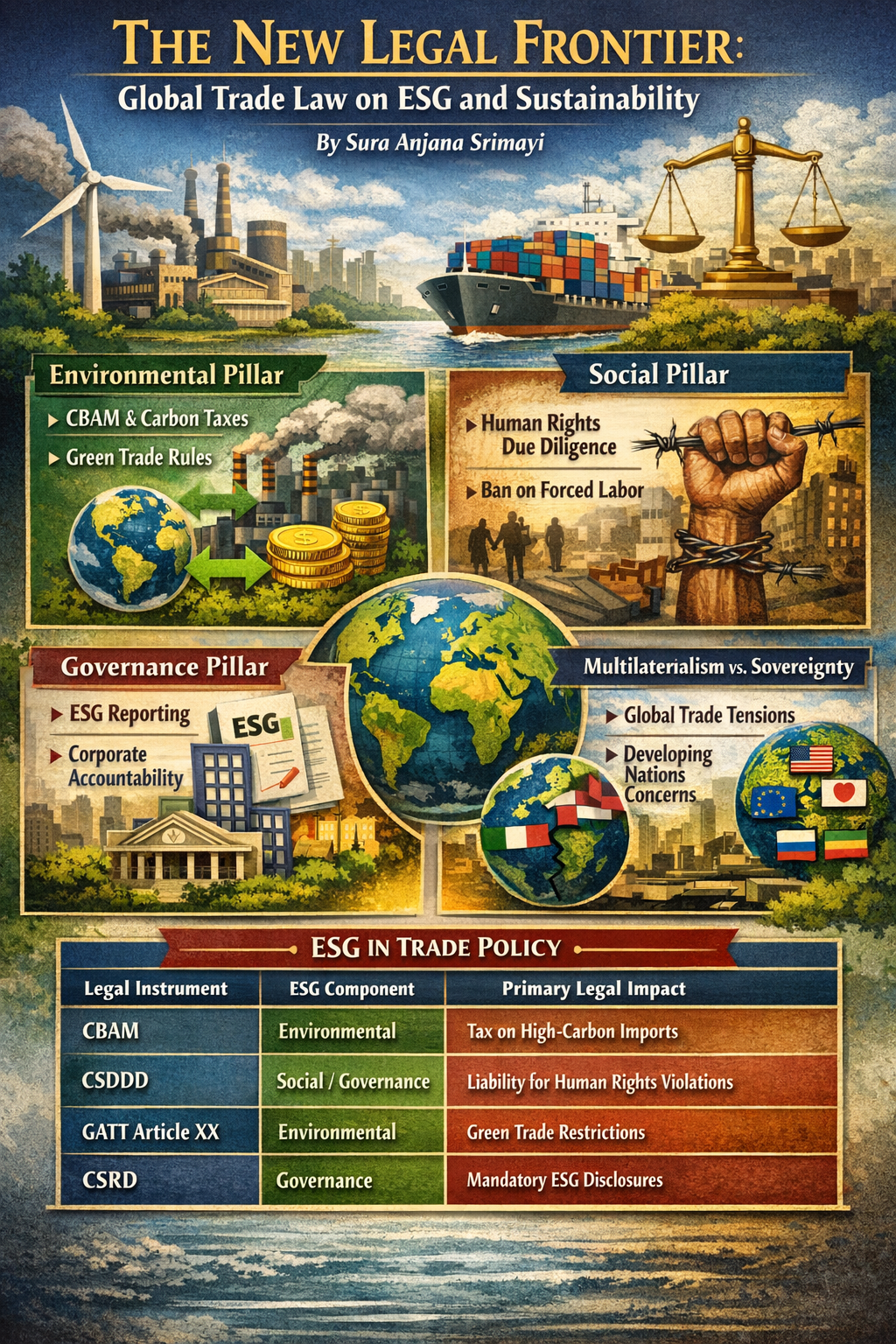
The New Legal Frontier: Global Trade Law on ESG and Sustainability.
~Sura Anjana Srimayi
INTRODUCTION
Since the decades past, international trade law has been regulated by one and one objective that is the liberalization of markets by reduction of tariffs and the removal of non-tariff barriers. By this philosophy of trade-neutrality even the mode of production, whether a good was produced by coal power or by the poor labor conditions, was usually deemed an extraneous matter to determine whether it belonged to the global commerce or not.
Nevertheless, we are now in a new legal horizon. The development of the ESG (Environmental, Social, and Governance) standards has reconstructed the interconnection between sustainability and trade in its basic way. The trade policy is nowadays being exploited as a means to implement climate objectives, secure human rights and corporate responsibility. This change can be estimated as the Hard Law period of sustainability, the period when voluntary corporate social responsibility is being substituted by the compulsory legal frameworks. Sustainable development has ceased to be an optional addition to the trade policy but rather a corner stone of the legal framework which connects the World Trade Organization (WTO) norms and the Paris Agreement and local supply chain laws.
1. The Environmental Pillar (E): The Trade Law Climatic Tool.
The most aggressive force of change in trade policy is at present the ESG aspect Environmental. This is because the legal issue to consider is how to design trade policies to promote the use of green products without contravening the principle of Non-Discrimination of the WTO.
Carbon Border Adjustment Mechanisms (CBAM): The Carbon Border Adjustment Mechanism (CBAM) by the European Union can be considered the most important legal change in this area. CBAM is legally meant to stop the problem of carbon leakage, where companies will relocate production to those nations with weak environmental regulations.
- Legal Mechanism: According to it, importers are compelled to purchase carbon certificates, which are equal to the price of carbon that they would otherwise have paid, had the goods been produced according to the rules of the internal carbon pricing provided by the EU.
- WTO Compatibility: The legal justification of such measures is usually based on GATT Article XX (General Exceptions) to permit countries to implement trade-restrictive measures that are necessary to protect human life, animal life or plant life or health or to conserve exhaustible natural resources.
The Green Subsidies and Trade Disputes.: The legal frontier encompasses also the emergence of the so-called green industrial policy, like the U.S. Inflation Reduction Act (IRA). Although these laws offer colossal subsidies on renewable energy, they usually incorporate a local content feature that is disputable in terms of international trade law, which gives rise to another set of controversies over where environmental protection starts and protectionism starts.
2. The Social Pillar (S): Forced Due Diligence in Supply Chains.
The Social pillar of ESG deals with the labor rights, contemporary slavery, and influence upon the community. The legal trend in this context is that of moving away of soft law (voluntary guidelines) to Mandatory Human Rights Due Diligence .
Supply Chain Laws on Transparency: A number of jurisdictions have introduced legislation where a legal obligation to police up global supply chains is foisted on companies -
- The German Supply Chain Due Diligence Act: Under the law, large corporations are required to pinpoint and report the risks of human rights and the environment in the whole supply chain.
- The EU Corporate Sustainability Due Diligence Directive: A groundbreaking law that establishes the introduction of civil liability to companies that do not respond to the violation of human rights or ecological harm in their international businesses.
Import Bans and Forced Labor: Direct prohibitions are appearing in trade policy as it moves towards integrating some level of Social ESG. As an example, the U.S. Uyghur Forced Labor Prevention Act (UFLPA) establishes a legal presumption that may be overcome, which assumes that goods produced in a particular area are produced under forced labor and thus should not be allowed in. This renders the trade law as a means of enforcing international labour standards.
3. Pillar of Governance (G): Corporate Accountability and Disclosure.
The Governance pillar connects trade with the internal operations of corporate decision-making. This can be done legally by being transparent on the sustainability risks of the companies.
Mandatory ESG Reporting: The trade environment is no longer independent of the securities law. The companies are obligated by the Corporate Sustainability Reporting Directive (CSRD) adopted by the EU, as well as by numerous proposed SEC regulations in the United States, to disclose:
- The effect of climate change on the business model.
- Their total value chain (international shipping and foreign suppliers) emissions.
Anti-Corruption Measures: Governance also entails the legal battle against corruption in global trading which is put into practice by legislation such as the Foreign Corrupt Practices Act.
Fiduciary Duty and Sustainability: Fiduciary Duty is reinterpreted as a critical legal evolution. Courts are becoming increasingly aware that a board of directors must take into legal account long-term ESG risks in order to perform their duties in the "best interest of the companyso long as they do so. Otherwise, failure may result into derivatives suits by shareholders, which makes the corporate governance directly related to the global presence of the company in trade.
4. Comparison: ESG Integration in Trade Policy
|
Legal Instrument |
ESG Component |
Primary Legal Impact |
|
CBAM |
Environmental |
Taxes high-carbon imports to align with climate goals. |
|
CSDDD |
Social / Governance |
Imposes civil liability for supply chain human rights breaches. |
|
GATT Article XX |
Environmental |
Provides the legal "exception" for green trade barriers. |
|
CSRD14 |
Governance15 |
Mandates audited transparency of sustainability data.1 |
5. Problems in the Legal Frontier: Multilateralism vs. Sovereignty.
The incorporation of ESG in the legal framework of trade is not without legal tussles. The third world countries frequently complain that the Green measures of trade are a sort of Green Protectionism.
The Principle of Common but Differentiated Responsibilities (CBDR): Developing countries are not supposed to avert to the same immediate standards as developed countries according to the international environmental laws (the Paris Agreement). Trade measures such as CBAM are however found to impose a legal standard of one size fits all and this results in a conflict between trade law and environmental equity.
Fragmented Regulation: With various countries making varying ESG laws it can be seen that global businesses have to operate in a spaghetti bowl of varying legal demands, which is making trade compliance both costlier and more legally hazardous.
CONCLUSION
The advent of the inclusion of ESG and sustainability as part of the trade policy signifies the conclusion of the siloed approach to law. Environmental goals, social fairness and corporate governance are no longer prerogative concerns; they themselves are the parameters according to which the legality of international trade is currently measured.
The legal system is trying to make sure that international trade does not harm both the planet and its population by integrating the concepts of trade law and climate legislation via the CBAM system and responsible business conduct via the mandatory due diligence mandates. These frameworks will offer the requisite framework of a global economy that is open, sustainable and just as the policy objectives turn into enforceable Hard Law.
"Unlock the Potential of Legal Expertise with LegalMantra.net - Your Trusted Legal Consultancy Partner”
Disclaimer: Every effort has been made to avoid errors or omissions in this material in spite of this, errors may creep in. Any mistake, error or discrepancy noted may be brought to our notice which shall be taken care of in the next edition In no event the author shall be liable for any direct indirect, special or incidental damage resulting from or arising out of or in connection with the use of this information Many sources have been considered including Newspapers, Journals, Bare Acts, Case Materials , Charted Secretary, Research Papers etc