
Forget Password

View News
THE GEOPOLITICAL SHIFT AND ITS LEGAL EFFECTS
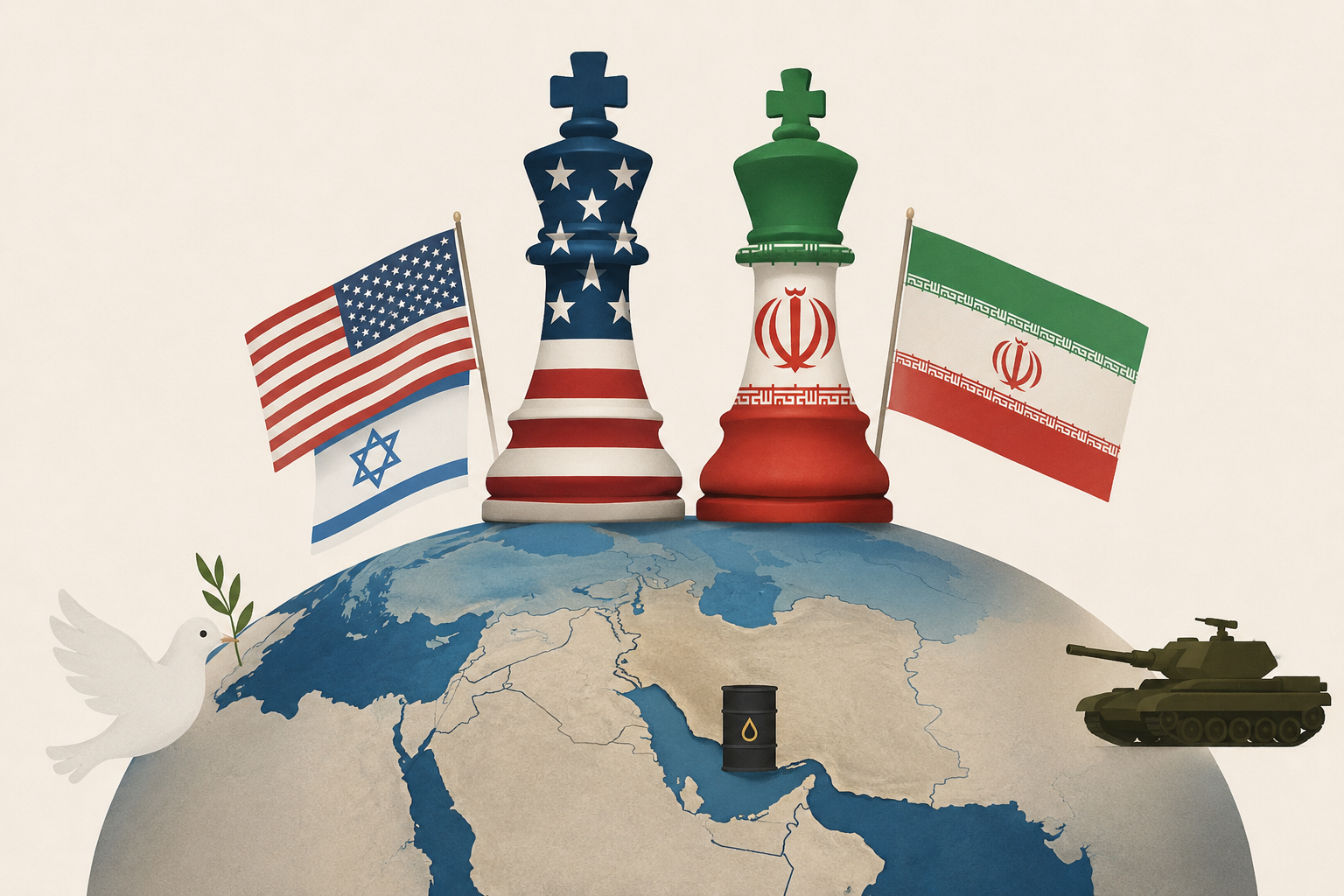
THE GEOPOLITICAL SHIFT AND ITS LEGAL EFFECTS
By Sura Anjana Srimayi
INTRODUCTION
The geopolitical landscape of 2026 has been profoundly transformed by the eruption of a direct military confrontation between the United States–Israel alliance and the Islamic Republic of Iran. What initially appeared to be another phase of strategic hostility in West Asia escalated dramatically on 28 February 2026 with the launch of a coordinated military operation, reportedly codenamed Operation Epic Fury. The strikes targeted critical Iranian military and political infrastructure and allegedly resulted in the assassination of Iran’s Supreme Leader, Ayatollah Ali Khamenei, along with several senior officials.
This conflict has not merely altered regional equations in West Asia; it has shaken the foundations of international law, diplomacy, global trade, and energy security. The war has generated severe economic disruptions across continents and has intensified debates surrounding sovereignty, legality of pre-emptive warfare, and the declining relevance of multilateral institutions.
For India, the crisis is far from a distant geopolitical event. India’s strategic, economic, and human connections with the Gulf region make the conflict a direct challenge to its national interests. The situation threatens India’s energy security, overseas Indian population, trade connectivity projects, and the long-standing foreign policy principle of “Strategic Autonomy.” The developments of 2026 therefore represent not only a military conflict but also a defining legal and diplomatic test for the international order and for India’s foreign policy framework.
I. LEGAL ANALYSIS: THE EROSION OF INTERNATIONAL NORMS
The direct strikes conducted by the United States and Israel against Iranian territory have triggered intense legal scrutiny under international law. The conflict has become a significant example of the growing tension between the doctrine of state sovereignty and the modern interpretation of anticipatory self-defense.
Under Article 2(4) of the Charter of the United Nations, states are prohibited from using force against the territorial integrity or political independence of another sovereign state. The only recognized exceptions are actions authorized by the United Nations Security Council or measures undertaken in self-defense under Article 51 in response to an armed attack.
The United States justified its military operation on the basis of “anticipatory self-defense,” claiming that Iran was preparing an imminent nuclear-capable missile strike against American military assets and allied interests in the region. However, this justification has been heavily criticized by international legal scholars, who argue that the evidence presented by the United States failed to satisfy the established legal standards governing pre-emptive force.
The principle commonly referred to as the Caroline Test, derived from the 1837 Caroline incident, remains one of the most authoritative standards in customary international law regarding anticipatory self-defense. According to this doctrine, the necessity of self-defense must be “instant, overwhelming, leaving no choice of means, and no moment for deliberation.” Critics contend that the United States failed to demonstrate such an immediate and unavoidable threat. In the absence of clear and publicly verifiable evidence, the strikes are widely viewed as inconsistent with the UN Charter and contrary to the principles established after the Nuremberg Trials regarding aggressive warfare.
The alleged assassination of a sitting head of state has further intensified legal controversy. Traditionally, international law strongly discourages targeted political assassinations, particularly outside formally declared war zones. The normalization of such actions threatens diplomatic protections, sovereign equality, and the stability of international relations. Legal commentators fear that if major powers begin justifying assassinations under broad interpretations of self-defense, the distinction between war and peace may become increasingly blurred.
The conflict has also produced constitutional and legal tensions within the United States itself. The American executive branch reportedly initiated large-scale military operations without obtaining a formal declaration of war from Congress. By characterizing the operation as a “limited defensive action,” the administration relied on executive war powers while bypassing the procedural safeguards envisioned under the War Powers Resolution. This has revived longstanding debates regarding the concentration of military authority within the executive branch and the weakening of democratic oversight over war-making decisions.
II. THE CONSEQUENCES OF AMERICAN INTERVENTIONISM
The military intervention has generated consequences extending far beyond Iran and Israel. Rather than stabilizing the region, the conflict has accelerated regional fragmentation and intensified insecurity across West Asia.
One of the most immediate consequences has been the disruption of global energy markets. Iran’s response included aggressive military positioning around the Strait of Hormuz, one of the world’s most critical maritime chokepoints. Nearly one-fifth of global oil supplies pass through this narrow waterway. Even temporary disruptions in the region have historically triggered volatility in international oil prices, and the 2026 conflict has once again demonstrated the fragility of global energy dependence on West Asia.
The escalation has also expanded the conflict into a broader regional confrontation. Iranian-backed groups operating in Lebanon, Iraq, Syria, and Yemen have intensified attacks against American interests and Gulf allies. Countries such as Saudi Arabia and the United Arab Emirates, despite not being direct participants in the initial operation, have become vulnerable targets in the expanding conflict environment. Missile strikes, drone attacks, and cyber warfare have increased across the Gulf region, raising fears of a prolonged multi-front regional war.
Equally concerning is the dangerous precedent established through the targeted elimination of political leadership. International diplomacy has traditionally relied upon the recognition of sovereign equality and the preservation of political channels, even during severe conflicts. The assassination of high-ranking political leaders during ongoing negotiations undermines trust in diplomatic processes and may encourage retaliatory doctrines among rival states. Such actions risk normalizing unilateral military interventions outside internationally accepted legal frameworks.
III. IMPACT ON INDIA: STRATEGIC AND ECONOMIC PRESSURES
India has emerged as one of the countries most deeply affected by the 2026 West Asian crisis. Its geographical proximity to the Gulf region, combined with its dependence on imported energy and extensive diaspora presence, places New Delhi in an exceptionally vulnerable position.
The human dimension of the crisis is particularly significant. More than one crore Indians reside and work across Gulf nations, contributing substantially to India’s remittance economy. Reports of drone strikes, missile attacks, and regional instability have raised serious concerns regarding the safety of Indian citizens in countries such as Kuwait, the United Arab Emirates, Bahrain, and Saudi Arabia. The Ministry of External Affairs has consequently faced mounting pressure to coordinate evacuation planning, emergency assistance, and diplomatic engagement with regional governments.
Economically, the rise in crude oil prices poses a severe challenge for India. As one of the world’s largest importers of petroleum, India remains highly sensitive to disruptions in global energy supply. A sharp increase in crude oil prices directly impacts inflation, transportation costs, industrial production, and the fiscal deficit. With Brent crude prices witnessing substantial increases within days of the conflict, concerns regarding economic slowdown and inflationary pressure have intensified.
The crisis has also jeopardized India’s long-term trade and connectivity ambitions. The India-Middle East-Europe Economic Corridor (IMEC), once projected as a transformative strategic initiative linking India with Europe through Gulf infrastructure and logistics networks, has suffered significant disruption. Instability in maritime routes and the closure or militarization of the Strait of Hormuz have severely affected shipping operations. Indian exporters are now compelled to reroute cargo through longer maritime pathways around the Cape of Good Hope, substantially increasing freight costs and transit durations.
IV. INDIA’S NEUTRALITY AND THE TEST OF STRATEGIC AUTONOMY
India’s response to the conflict reflects the continuing importance of its doctrine of strategic autonomy. Rather than openly aligning with either the United States–Israel bloc or Iran, India has consistently emphasized diplomacy, de-escalation, and peaceful dialogue. However, maintaining neutrality in such a polarized geopolitical environment has become increasingly difficult.
India’s balancing strategy is rooted in practical necessity. Iran remains strategically important for India’s access to Central Asia through the Chabahar Port project, while the United States, Israel, and Gulf monarchies constitute essential defense, technological, and economic partners. Any overt alignment with one side risks damaging relationships with the other. Consequently, India has attempted to preserve diplomatic flexibility by avoiding explicit endorsement or condemnation of military actions.
At the same time, India seeks to maintain its image as a leading voice of the Global South. Many developing nations perceive the military intervention as an example of great-power unilateralism that disregards international legal norms and disproportionately harms economically vulnerable countries through inflation, energy shortages, and trade disruptions. India’s carefully calibrated position therefore reflects not only national interest but also its aspiration to represent broader concerns of developing economies.
Nevertheless, India’s neutrality has not escaped criticism. Opposition voices and certain international observers argue that India’s restrained reaction to the assassination of Iranian leadership amounts to implicit acceptance of the military operation. Diplomatic speculation intensified following Prime Minister Narendra Modi’s visit to Israel shortly before the strikes, with some analysts suggesting that India may have possessed prior strategic awareness of regional developments. Although no evidence has substantiated such claims, the perception itself has complicated India’s role as a neutral mediator.
CONCLUSION
The 2026 West Asian conflict has exposed the fragility of the contemporary international order and the limitations of legal frameworks in restraining major powers. The crisis demonstrates how unilateral military actions, justified under expansive interpretations of self-defense, can destabilize entire regions and undermine long-standing principles of sovereignty, diplomacy, and international cooperation.
For India, the conflict represents one of the most serious foreign policy challenges in recent decades. The country faces simultaneous pressures relating to energy security, economic stability, diaspora protection, and geopolitical balancing. In such circumstances, India’s commitment to the “Madhyam Marg” or the middle path is not merely an ideological preference but a strategic necessity aimed at preserving stability amid escalating global polarization.
The broader consequences of the conflict are likely to extend far beyond the battlefield. The erosion of trust in international institutions, the normalization of targeted political assassinations, and the weakening of multilateral diplomacy may shape global politics for decades to come. The events of 2026 therefore stand not only as a regional crisis but also as a defining moment in the evolution of international law and the future of the global order.
Unlock the Potential of Legal Expertise with LegalMantra.net – Your Trusted Legal Consultancy Partner
Disclaimer
Every effort has been made to ensure accuracy in this material. However, inadvertent errors or omissions may occur. Any discrepancies brought to the author’s notice will be rectified in subsequent editions. The author shall not be liable for any direct, indirect, incidental, or consequential damages arising from the use of this material. This article is based on various sources including statutory enactments, judicial decisions, academic research papers, professional journals, and publicly available legal materials.
Sura Anjana Srimayi
LegalMantra.net Team