
Forget Password

View News
Security Deposits, Moratorium and Set-Off under IBC A Detailed Analysis of Central Transmission Utility of India Ltd Sumit Binani
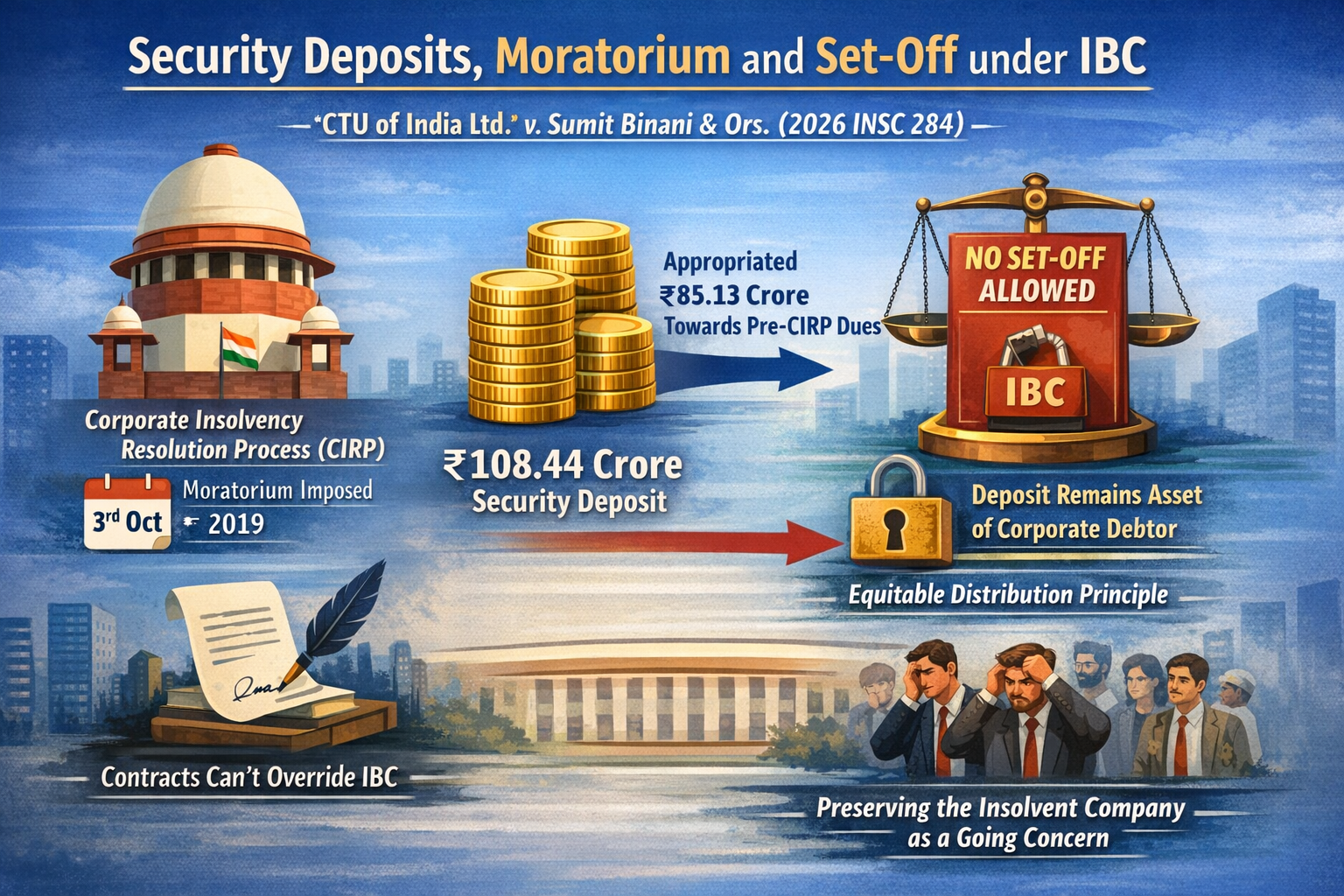
Security Deposits, Moratorium and Set-Off under IBC: A Detailed Analysis of Central Transmission Utility of India Ltd. v. Sumit Binani & Ors. (2026 INSC 284)
1. Introduction
The evolution of insolvency jurisprudence in India under the Insolvency and Bankruptcy Code, 2016 (IBC) has consistently emphasized the supremacy of statutory mechanisms over contractual arrangements. A recent and significant addition to this jurisprudence is the Supreme Court’s decision in Central Transmission Utility of India Limited v. Sumit Binani & Ors. (2026 INSC 284), wherein the Court examined the legality of appropriation of a security deposit during the Corporate Insolvency Resolution Process (CIRP). The judgment addresses a nuanced yet practically crucial issue—whether a creditor can adjust a security deposit towards pre-CIRP dues after the imposition of moratorium. The ruling not only clarifies the position of law but also reinforces the fundamental principles underlying the IBC, particularly the doctrine of equitable distribution and preservation of the corporate debtor as a going concern.
2. Factual Matrix of the Case
The dispute arose in the context of transmission services provided by Central Transmission Utility of India Limited (CTUIL), which had entered into Transmission Service Agreements (TSA) with KSK Mahanadi Power Company Limited (KMPCL). As part of the contractual framework and regulatory requirements, KMPCL had deposited a sum of ?108.44 crore with the appellant as a Payment Security Mechanism (PSM), effectively in lieu of a Letter of Credit (LoC). This deposit was intended to secure timely payment of transmission charges.
The situation became legally contentious when CIRP was initiated against KMPCL on 3 October 2019. After the commencement of CIRP, the appellant appropriated the deposited amount on 28 March 2020 towards outstanding dues. While a portion of ?23.31 crore was adjusted against post-CIRP dues, the remaining ?85.13 crore was appropriated towards pre-CIRP liabilities. This appropriation was challenged by the Resolution Professional before the adjudicating authority, leading to a series of proceedings culminating before the Supreme Court.
An interesting factual nuance in this case is that the deposit was not initially characterized as a “security interest” by the creditor in its claim filings, which later became a critical factor in determining its legal nature and treatment under IBC.
3. Core Legal Issue
The central issue before the Supreme Court was whether a creditor can appropriate a security deposit towards pre-CIRP dues after the commencement of CIRP, particularly in light of the moratorium imposed under Section 14 of the IBC. Closely connected to this issue was the question of whether such appropriation could be justified as a form of set-off or as an enforcement of a security mechanism akin to a bank guarantee or letter of credit.
4. Judicial Findings and Reasoning
The Supreme Court upheld the decisions of the NCLT and NCLAT and ruled unequivocally against the appellant. The Court observed that once CIRP is initiated, the moratorium under Section 14 comes into effect, which prohibits recovery or enforcement actions against the corporate debtor in respect of pre-CIRP dues. The Court emphasized that the security deposit, until validly appropriated, continues to remain the property of the corporate debtor and forms part of its asset pool.
A crucial aspect of the Court’s reasoning was its distinction between a security deposit and instruments such as bank guarantees or letters of credit. While relying on precedents like Himadri Chemicals Industries Ltd. v. Coal Tar Refining Co. and Standard Chartered Bank v. Heavy Engineering Corporation Ltd., the Court reiterated that bank guarantees and LoCs constitute independent contracts and can be invoked irrespective of disputes between the parties. However, the deposit in the present case did not possess such independent contractual character and therefore could not be treated on the same footing.
Another important dimension of the judgment relates to the concept of set-off. The appellant had relied heavily on the decision in Bharti Airtel Ltd. v. Aircel Ltd. to argue that adjustment of mutual claims is permissible under IBC. The Supreme Court, however, clarified that set-off requires mutual and reciprocal obligations between the parties. In the present case, there was no debt owed by the creditor to the corporate debtor; rather, the deposit was merely a security held by the creditor. Consequently, the essential requirement of mutuality was absent, rendering the doctrine of set-off inapplicable.
The Court further observed that permitting such appropriation would undermine the pari passu principle embedded in the IBC framework, as it would allow one operational creditor to recover its dues outside the resolution process, thereby prejudicing the interests of other creditors.
5. Nature and Legal Character of Security Deposit
One of the most significant contributions of this judgment lies in its clarification of the legal character of a security deposit under IBC. The Court held that such a deposit remains an asset of the corporate debtor until it is lawfully appropriated. Importantly, if such appropriation takes place after the commencement of CIRP and relates to pre-CIRP dues, it would be rendered invalid due to the operation of the moratorium.
An interesting takeaway is that even though the deposit was made in lieu of a Letter of Credit pursuant to regulatory directions, the Court refused to elevate its status to that of a financial instrument like a bank guarantee. This reinforces the principle that substance prevails over form in insolvency proceedings.
6. Impact of Filing Claims before Resolution Professional
The conduct of the appellant in filing its claims before the Resolution Professional also played a decisive role in the Court’s reasoning. The appellant had filed multiple claims in Form B for its outstanding dues, including those that were later adjusted from the deposit. The Court noted that once a creditor submits its claim and participates in the CIRP process, it is bound by the mechanism prescribed under the IBC. Any unilateral action to recover dues outside this framework is impermissible.
Interestingly, the appellant did not challenge the partial admission of its claims by the Resolution Professional, which further weakened its position before the Court. This highlights the importance of timely and strategic action by creditors during insolvency proceedings.
7. Practical and Commercial Implications
From a practical standpoint, this judgment has far-reaching implications, especially for infrastructure and power sector companies where security deposits and payment security mechanisms are common. Creditors must now be cautious in structuring such arrangements, ensuring that their rights are enforceable even in the event of insolvency.
Another important implication is the emphasis on timing. The Court noted that if the creditor had appropriated the deposit before the commencement of CIRP, the situation might have been legally sustainable. This underscores the need for creditors to act promptly in enforcing their contractual rights.
A notable insight from this case is that regulatory frameworks, such as those issued by the Central Electricity Regulatory Commission (CERC), cannot override the provisions of the IBC. This reaffirms the overriding effect of Section 238 of the Code.
8. Critical Analysis
The judgment reflects a strict and principled interpretation of the IBC, prioritizing collective insolvency resolution over individual creditor enforcement. While this approach strengthens the insolvency framework, it may pose challenges for operational creditors who rely on security deposits as a risk mitigation tool.
However, the Court’s reasoning is consistent with the broader objective of the IBC, which is to ensure equitable distribution of assets and prevent preferential treatment. By disallowing unilateral appropriation, the Court has reinforced the sanctity of the insolvency process and the role of the Resolution Professional as the central authority in determining claims.
9. Conclusion
In conclusion, the Supreme Court’s decision in Central Transmission Utility of India Ltd. v. Sumit Binani & Ors. marks a significant step in clarifying the treatment of security deposits under the IBC. The ruling establishes that once CIRP is initiated, creditors cannot bypass the statutory framework by appropriating deposits towards pre-CIRP dues. Such actions are barred by the moratorium and are contrary to the fundamental principles of insolvency law.
The judgment serves as a cautionary tale for creditors and highlights the importance of understanding the legal implications of contractual arrangements in the context of insolvency. Ultimately, it reinforces the idea that the IBC is a comprehensive code that prevails over all other mechanisms, ensuring fairness, transparency, and orderly resolution of corporate distress.
Unlock the Potential of Legal Expertise with LegalMantra.net – Your Trusted Legal Consultancy Partner
Disclaimer
Every effort has been made to ensure accuracy in this material. However, inadvertent errors or omissions may occur. Any discrepancies brought to the author’s notice will be rectified in subsequent editions. The author shall not be liable for any direct, indirect, incidental, or consequential damages arising from the use of this material. This article is based on various sources including statutory enactments, judicial decisions, academic research papers, professional journals, and publicly available legal materials.
Anshul Goel
LegalMantra.net Team