
Forget Password

View News
SEBI Settlement Order
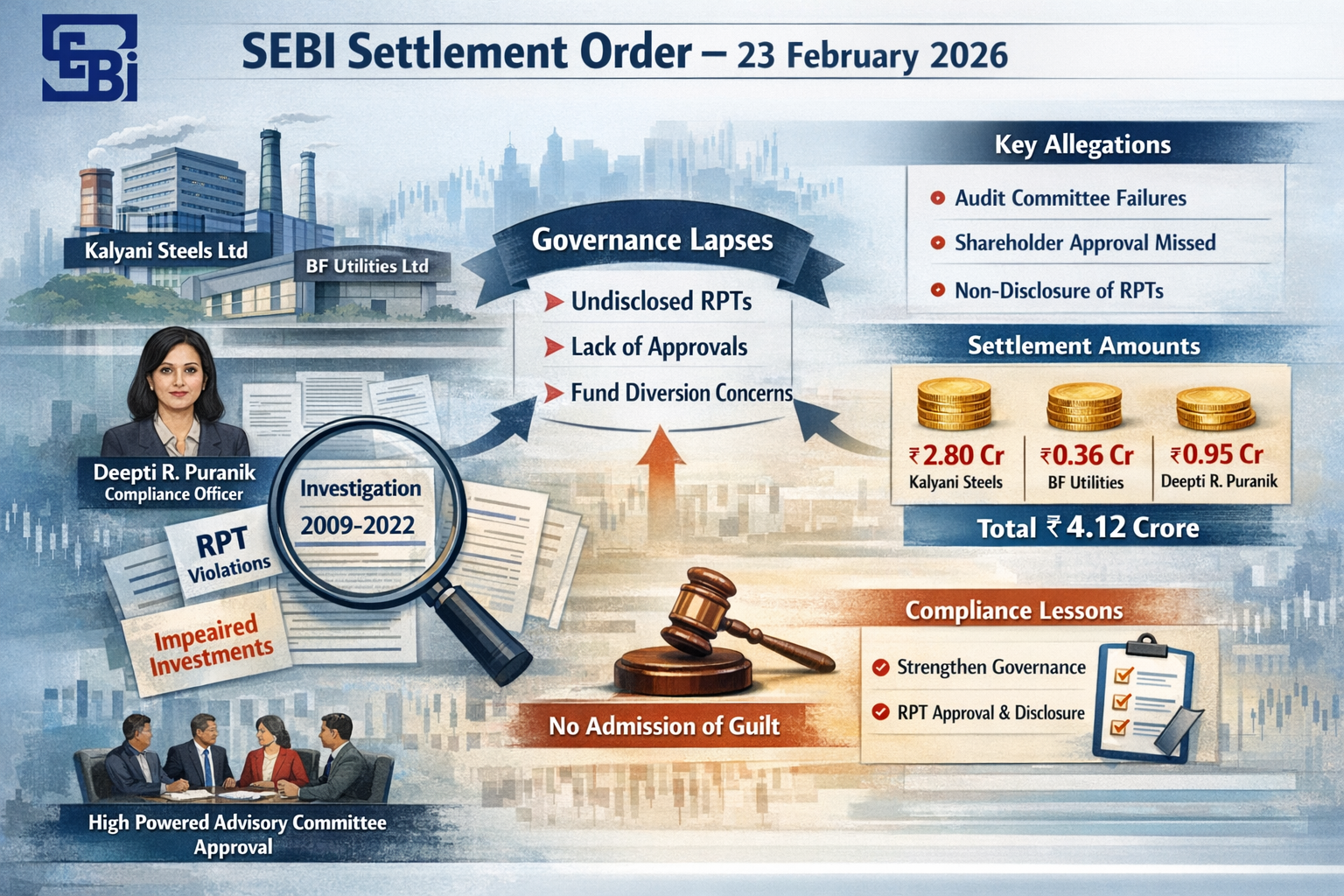
SEBI Settlement Order (23 February 2026): A Comprehensive Analysis of Related Party Transaction Governance Failures
1. Introduction
The Settlement Order dated 23 February 2026 issued by the Securities and Exchange Board of India (SEBI) in the matter of Kalyani Steels Limited represents a significant development in the enforcement of corporate governance norms under Indian securities law. The proceedings also involved BF Utilities Limited and Mrs. Deepti R. Puranik, who served as the Compliance Officer of Kalyani Steels Limited during the relevant period. The matter originated from an examination conducted by the National Stock Exchange of India Limited (NSE), which identified potential irregularities in related party transactions and corporate governance practices.
2. Regulatory Framework and Scope of Examination
The proceedings were initiated under the framework of the SEBI Act, 1992, the Securities Contracts (Regulation) Act, 1956, the SEBI (Prohibition of Fraudulent and Unfair Trade Practices) Regulations, 2003, and the SEBI (Listing Obligations and Disclosure Requirements) Regulations, 2015. In particular, the examination focused on compliance with provisions relating to Related Party Transactions, as contained in Clause 49 of the erstwhile Listing Agreement and Regulation 23 of the LODR Regulations.
The investigation covered a prolonged period from the financial year 2009–10 to 2021–22, thereby indicating that the issues under consideration were not isolated but potentially systemic in nature.
3. Background and Nature of Transactions
The examination conducted by NSE revealed that Kalyani Group companies, including Kalyani Steels Limited, had made substantial investments in certain promoter group entities. These entities were characterised by either negligible operations or negative net worth, raising concerns regarding the commercial rationale behind such investments.
Over time, a significant portion of these investments was impaired, suggesting that the expected economic benefits were not realised. Additionally, the investee entities were found to have engaged in multi-layered financial transactions, including dealings with entities that were potentially indirectly linked, commonly referred to as Potentially Indirectly Linked Entities (PILE). This complex structuring raised regulatory concerns regarding transparency and fund flow integrity.
The investments were structured through various financial instruments such as fully convertible debentures, non-cumulative redeemable preference shares, and trade advances. Many of the investee entities were under common promoter control, had overlapping directorships, and were privately held companies, thereby increasing the risk of conflict of interest and inadequate oversight.
4. Allegations and Compliance Failures
The primary allegations against Kalyani Steels Limited revolved around non-compliance with the procedural and substantive requirements governing related party transactions. It was alleged that the company failed to obtain prior approval of the Audit Committee for certain related party transactions. Furthermore, summaries of such transactions were not consistently placed before the Audit Committee, thereby undermining its supervisory role.
Another significant allegation pertained to the failure to obtain shareholder approval by way of special resolution for material related party transactions, as mandated under the applicable regulatory framework. In addition, the company was alleged to have failed in making timely quarterly disclosures of material related party transactions, thereby compromising transparency.
Similar allegations were levelled against BF Utilities Limited, including failure to obtain Audit Committee approval, absence of shareholder approval for material transactions, and non-compliance with disclosure requirements.
In the case of the Compliance Officer, Mrs. Deepti R. Puranik, the allegations were centred around violation of Regulation 6(2) of the LODR Regulations. It was alleged that she failed to ensure that the company complied with the requirements of obtaining prior approvals and adhering to regulatory norms in respect of related party transactions. The allegations effectively highlighted a lapse in the discharge of duties expected from a Compliance Officer under the securities law framework.
5. Settlement Proceedings and Outcome
The applicants opted to resolve the matter through the settlement mechanism provided under the SEBI (Settlement Proceedings) Regulations, 2018. The settlement was carried out in accordance with Section 15JB of the SEBI Act, 1992 and Section 23JA of the Securities Contracts (Regulation) Act, 1956.
Importantly, the settlement was made without admission or denial of the findings of fact and conclusions of law. The applicants agreed to pay a cumulative settlement amount of approximately ?4.12 crore. Out of this, Kalyani Steels Limited paid ?2,80,22,150, BF Utilities Limited paid ?36,28,050, and Mrs. Deepti R. Puranik paid ?95,55,000.
The settlement terms were approved after due consideration by SEBI’s Internal Committee, the High Powered Advisory Committee, and a panel of Whole-Time Members. The settlement effectively brought the proceedings to a close without a formal adjudication on merits.
6. Analytical Observations
A key observation arising from the settlement order is that the case primarily pertains to corporate governance lapses rather than established fraud. Since the matter was settled prior to adjudication, SEBI did not render a finding on whether the transactions involved fraudulent intent or fund diversion. Nevertheless, the nature and pattern of transactions point towards significant governance deficiencies.
The repeated instances of non-compliance over an extended period indicate the presence of systemic weaknesses within the organization’s governance framework. The pattern of investments in financially weak promoter group entities, followed by substantial impairments, raises legitimate concerns about the decision-making processes and the effectiveness of internal controls.
One of the most notable aspects of the case is the imposition of liability on the Compliance Officer in her individual capacity. The substantial settlement amount paid by the Compliance Officer underscores the expectation of SEBI that such officers play a proactive and vigilant role in ensuring compliance. This development reinforces the principle that Compliance Officers are not merely facilitators but are accountable for ensuring adherence to regulatory requirements.
From a strategic perspective, the decision to opt for settlement reflects a pragmatic approach by the applicants. By settling the matter, they avoided prolonged litigation, mitigated uncertainty, and achieved closure without an adverse finding on record. However, the financial and reputational implications of the settlement remain significant.
7. Regulatory Implications and Lessons for Listed Companies
The settlement order reinforces the strict regulatory stance adopted by SEBI in relation to related party transactions. It underscores that prior approval of the Audit Committee is a mandatory requirement and cannot be treated as a mere procedural formality. Similarly, shareholder approval for material related party transactions is a substantive obligation that must be complied with in letter and spirit.
The case also highlights the importance of robust disclosure practices. Timely and accurate disclosure of related party transactions is essential to maintain transparency and investor confidence. Any lapse in disclosure can attract regulatory scrutiny and penalties.
Further, the order emphasises the need for strong internal governance mechanisms. Listed companies must ensure that their compliance frameworks are adequately designed and effectively implemented to monitor related party transactions, especially those involving promoter group entities.
The role of the Compliance Officer assumes heightened significance in this context. Compliance Officers must adopt a proactive approach, ensure proper documentation, and establish effective communication channels with the Audit Committee and the Board to prevent compliance failures.
8. Conclusion
The SEBI Settlement Order dated 23 February 2026 in the matter of Kalyani Steels Limited serves as an important precedent in the area of corporate governance and related party transaction compliance. While the proceedings were concluded through settlement without an adjudicated finding of guilt, the case highlights serious governance lapses and regulatory concerns.
It underscores SEBI’s increasing focus on scrutinising transactions involving promoter group entities and ensuring that listed companies adhere to high standards of transparency and accountability. The case also sends a strong message regarding the personal responsibility of Compliance Officers in maintaining regulatory compliance.
Ultimately, the order serves as a reminder that compliance with related party transaction norms is not a technical requirement but a fundamental aspect of corporate governance, the breach of which can have significant financial and reputational consequences.
Disclaimer
The contents of this article are based on applicable legal provisions and publicly available information as on the date of writing. While due care has been taken to ensure accuracy, no responsibility is assumed for any errors or omissions. Readers are advised to refer to the relevant laws and seek professional advice before acting on the basis of this information.
From the desk of CS Sharath