
Forget Password

View News
SEBI Fines Suzlon Energy Crore for Misleading Financial Disclosures
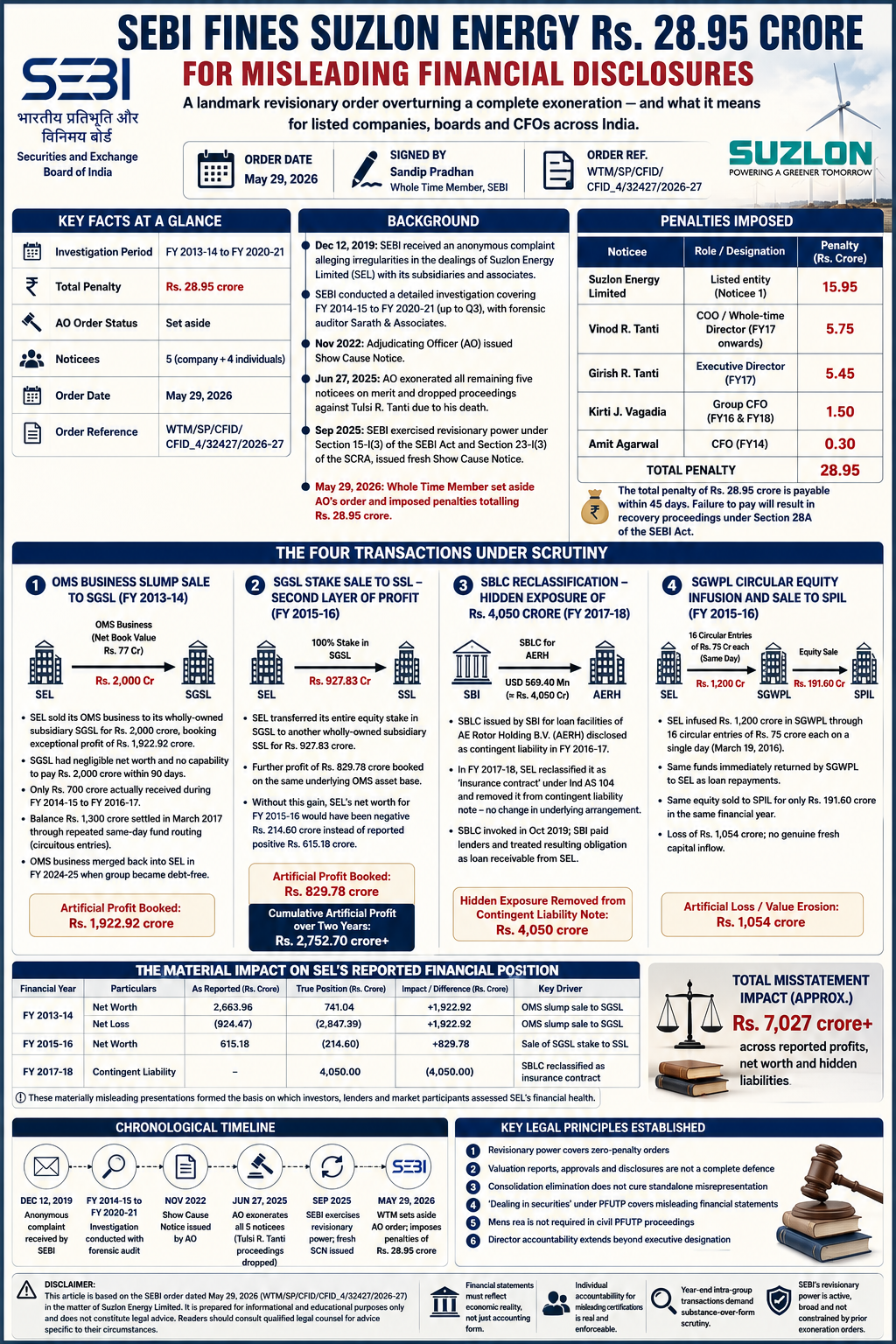
SEBI Fines Suzlon Energy Rs. 28.95 Crore for Misleading Financial Disclosures
A landmark revisionary order overturning a complete exoneration — and what it means for listed companies, boards and CFOs across India.
Order date: May 29, 2026 | Signed by: Sandip Pradhan, Whole Time Member, SEBI | Ref: WTM/SP/CFID/CFID_4/32427/2026-27
Key Facts at a Glance
|
Investigation Period |
FY 2013-14 to FY 2020-21 |
|
Total Penalty |
Rs. 28.95 crore |
|
AO Order Status |
Set aside |
|
Noticees |
5 (company + 4 individuals) |
|
Order Date |
May 29, 2026 |
|
Order Reference |
WTM/SP/CFID/CFID_4/32427/2026-27 |
Background
On December 12, 2019, SEBI received an anonymous complaint alleging irregularities in the dealings of Suzlon Energy Limited (SEL) with its subsidiaries and associates. SEBI conducted a detailed investigation covering FY 2014-15 to FY 2020-21, including the first three quarters of FY 2020-21, with forensic auditor Sarath & Associates also being appointed.
Following investigation, an Adjudicating Officer (AO) issued a Show Cause Notice in November 2022. After hearings and submissions, the AO passed an order dated June 27, 2025 — which dropped proceedings against one noticee (Tulsi R. Tanti) due to his death and exonerated all remaining five noticees on merit.
SEBI then exercised its revisionary power under Section 15-I(3) of the SEBI Act and Section 23-I(3) of the SCRA, issuing a fresh Show Cause Notice in September 2025. After further hearings and written submissions, the Whole Time Member passed the present order on May 29, 2026 — setting aside the AO's order and imposing penalties totalling Rs. 28.95 crore.
The Four Transactions under Scrutiny
The investigation identified four interconnected transaction chains, each of which resulted in materially misleading presentation of SEL's profitability, net worth, leverage, and financial risk in its standalone financial statements.
1. OMS Business Slump Sale to SGSL (FY 2013-14)
SEL sold its Operation & Maintenance Services (OMS) business — with a net book value of approximately Rs. 77 crore — to its wholly-owned subsidiary Suzlon Global Services Limited (SGSL) for Rs. 2,000 crore, booking an exceptional profit of Rs. 1,922.92 crore in FY 2013-14.
SGSL, as on March 31, 2013, had total assets of Rs. 0.04 crore, reserves of Rs. (0.31) crore and nil turnover — it had no demonstrated independent capacity to pay Rs. 2,000 crore within 90 days as required by the agreement.
Of the total consideration, only Rs. 700 crore was actually received in SEL's bank accounts over FY 2014-15 to FY 2016-17. The balance Rs. 1,300 crore was purportedly settled in March 2017 through repeated same-day routing of funds — Rs. 150 crore was cycled six times on March 21, 2017 and Rs. 100 crore was cycled four times on March 22-23, 2017. SEBI found these to be circuitous entries without genuine incremental inflow.
Critically, the OMS business was merged back into SEL in FY 2024-25 when the group became debt-free — negating the stated rationale of global best practice and operational efficiency.
2. SGSL Stake Sale to SSL — Second Layer of Profit (FY 2015-16)
In FY 2015-16, SEL transferred its entire equity stake in SGSL to another wholly-owned subsidiary, Suzlon Structures Limited (SSL), for Rs. 927.83 crore — booking a further profit of Rs. 829.78 crore on the same underlying OMS asset base.
Without this gain, SEL's net worth for FY 2015-16 would have been negative Rs. 214.60 crore instead of the reported positive Rs. 615.18 crore. The SEBI order found that cumulative profits exceeding Rs. 2,700 crore were recognised over two financial years from the same OMS business through successive intra-group transfers, without genuine economic accretion to SEL.
3. SBLC Reclassification — Hidden Exposure of Rs. 4,050 Crore (FY 2017-18)
A Standby Letter of Credit (SBLC) issued by State Bank of India securing loan facilities of AE Rotor Holding B.V. (AERH, a wholly-owned subsidiary) was disclosed as a contingent liability of USD 569.40 million (approximately Rs. 4,050 crore) in FY 2016-17.
In FY 2017-18, SEL reclassified this exposure as an 'insurance contract' under Ind AS 104 and removed it from the contingent liability note — despite no change in the underlying arrangement. The SBLC was invoked in October 2019, SBI made payment to AERH's lenders, and SBI and other lenders treated the resulting obligation as a loan receivable from SEL. SEBI found the reclassification unjustified and the resulting presentation materially misleading.
4. SGWPL Circular Equity Infusion and Sale to SPIL (FY 2015-16)
SEL invested Rs. 1,200 crore in its wholly-owned subsidiary Suzlon Gujarat Wind Park Limited (SGWPL) through sixteen circular entries of Rs. 75 crore each on a single day — March 19, 2016 — with the same funds immediately returned by SGWPL to SEL as loan repayments. There was no genuine fresh capital inflow.
The same equity, shown at Rs. 1,200 crore in SEL's books, was sold to another wholly-owned subsidiary, Suzlon Power Infrastructure Limited (SPIL), for only Rs. 191.60 crore in the same financial year — a loss of Rs. 1,054 crore. SEBI found that the sixteen same-day circular entries merely converted loan exposure into equity exposure without any real economic substance.
The Material Impact on SEL's Reported Financial Position
|
FY 2013-14 Impact Reported net worth: Rs. 2,663.96 crore | True net worth (without OMS): Rs. 741.04 crore Reported net loss: Rs. 924.47 crore | True net loss: Rs. 2,847.39 crore Difference in net worth presentation: Rs. 1,922.92 crore |
|
FY 2015-16 Impact Reported net worth: Rs. 615.18 crore | True net worth (without SGSL gain): Negative Rs. 214.60 crore Second artificial profit booked: Rs. 829.78 crore on same OMS asset base |
|
FY 2017-18 Impact Rs. 4,050 crore contingent exposure (SBLC / AERH) removed from contingent liability note Reclassified as 'insurance contract' — no change in underlying liability structure |
The SEBI order notes that during the period of restructuring and capital raising, SEL issued 1,21,95,69,014 shares at significant premium in FY 2014-15, including to CDR lenders and FCCB holders. The misleading financial statements formed the basis on which investors, lenders and market participants assessed SEL's financial health.
Penalties Imposed
|
Noticee |
Role / Designation |
Penalty Imposed |
|
Suzlon Energy Limited |
Listed entity (Noticee 1) |
Rs. 15.95 crore |
|
Vinod R. Tanti |
COO / Whole-time Director (FY17 onwards) |
Rs. 5.75 crore |
|
Girish R. Tanti |
Executive Director (FY17) |
Rs. 5.45 crore |
|
Kirti J. Vagadia |
Group CFO (FY16 & FY18) |
Rs. 1.50 crore |
|
Amit Agarwal |
CFO (FY14) |
Rs. 0.30 crore |
The total penalty of Rs. 28.95 crore is payable within 45 days of receipt of the order. Failure to pay will result in recovery proceedings under Section 28A of the SEBI Act, including attachment and sale of movable and immovable properties.
Key Legal Principles Established
1. Revisionary power covers zero-penalty orders
Section 15-I(3) of the SEBI Act can be invoked even when the AO has completely exonerated noticees. The word 'enhance' in the provision is wide enough to cover enhancement from zero. An order resulting in complete exoneration remains subject to SEBI's revisionary jurisdiction if it is erroneous to the extent of being against the interests of the securities market. (Following SAT in Samco Securities Ltd. and Madras HC in Bhavani Mills Ltd.)
2. Valuation reports, approvals and disclosures are not a complete defence
The order firmly establishes that board approvals, independent valuations, shareholder approvals and stock exchange disclosures do not, by themselves, immunise a transaction from regulatory scrutiny under PFUTP Regulations if the substance of the transactions is misleading. Formal compliance with procedural requirements cannot displace the obligation to present financial statements that reflect the true effect of transactions.
3. Consolidation elimination does not cure standalone misrepresentation
A listed entity's standalone financial statements carry independent statutory significance. The fact that intra-group transactions are eliminated at the consolidated level does not neutralise the impact of misleading profit recognition, inflated net worth or hidden liabilities in the standalone financial statements disseminated to investors.
4. 'Dealing in securities' under PFUTP covers misleading financial statements
The PFUTP Regulations apply whenever a listed company knowingly publishes or causes to be published financial statements which it knows to be materially misleading. The expression 'dealing in securities' is broad and inclusive — it is not confined to the listed entity itself buying or selling securities. (Following Supreme Court in N. Narayanan v. SEBI, SEBI v. Kanaiyalal Baldevbhai Patel, and SEBI v. Terrascope Ventures Ltd.)
5. Mens rea is not required in civil PFUTP proceedings
Criminal intention is not a prerequisite for establishing a PFUTP violation in civil adjudication proceedings. The inquiry is whether the conduct was capable of misleading investors or impairing the integrity of market information — not whether a specific investor actually traded on a specific disclosure.
6. Director accountability extends beyond executive designation
Directors — including those holding senior managerial or finance positions — cannot evade liability on the ground that disclosures were made 'by the company'. A company acts through its directors and officers. Their period-wise capacity, function and association with the relevant transactions and financial reporting process determines individual liability. Non-executive directorship during early periods does not preclude accountability for later executive roles.
What This Means for Listed Companies and Their Boards
The order carries practical implications across multiple dimensions of corporate governance and financial reporting:
- CFO certifications under Regulation 17(8) / Part B of Schedule II of LODR Regulations carry real legal exposure. Signing off on financial statements that do not present a true and fair view can result in personal penalties regardless of board approval.
- Circular fund flows used to convert loans into equity will be examined for genuine economic substance. Sixteen same-day entries of the same amount moving between related entities on a year-end date will attract scrutiny.
- Reclassifying a material contingent liability into a different accounting category without genuine change in the underlying arrangement is a disclosure violation — not a permissible accounting choice.
- The fact that a transaction is permissible under the Companies Act does not mean it satisfies the truth and fairness standard applicable to listed entities under the SEBI Act and LODR Regulations.
- Audit committees and independent directors should apply substance-over-form scrutiny to year-end intra-group transactions — especially those involving same-day fund movements, immediate reversals, or successive intra-group stake transfers.
- The eventual reversal of a transaction (such as the re-merger of OMS back into SEL) can be used by SEBI as evidence that the original rationale was not genuine.
Conclusion
The SEBI order in the matter of Suzlon Energy Limited is one of the most significant enforcement actions in recent Indian securities law — not so much for the quantum of penalty as for the principles it articulates.
For over a decade, a series of interconnected intra-group transactions created a financial narrative for Suzlon's investors that did not reflect the genuine economic reality of the company. An OMS business worth Rs. 77 crore generated over Rs. 2,700 crore in reported profits through successive internal transfers. A Rs. 4,050 crore guarantee exposure quietly disappeared from the contingent liability note. Circular fund flows dressed up loan exposures as fresh equity infusions.
What makes this order landmark is its insistence that substance must prevail over form in financial reporting. Board approvals, valuation reports, shareholder resolutions and stock exchange disclosures — while necessary — are not sufficient to satisfy the obligations of a listed entity under securities law. Investors and the securities market are entitled to financial statements that present the true and fair view of a company's financial position, regardless of how elegantly the underlying transactions are structured and documented.
The order also sends a clear message on individual accountability. In an era where corporate governance failures are increasingly attributed to systemic lapses rather than individual responsibility, SEBI has anchored liability to specific roles, specific periods and specific transactions. CFOs who certify misleading financials, whole-time directors who oversee circuitous fund movements, and executive directors present during critical transaction chains cannot treat the corporate veil as personal insulation.
Perhaps most consequentially, the order firmly establishes that SEBI's revisionary jurisdiction under Section 15-I(3) is a genuine supervisory tool — not a ceremonial power. An Adjudicating Officer's exoneration is not the final word if it fails to examine the substance of what actually happened. The securities market, which operates on the integrity of disclosures, cannot afford a regulatory architecture where a technically compliant but substantively misleading financial presentation escapes scrutiny.
|
The Bottom Line For listed companies: Financial statements must reflect economic reality, not just accounting form. For boards and CFOs: Individual accountability for misleading certifications is real and enforceable. For auditors and audit committees: Year-end intra-group transactions demand substance-over-form scrutiny. For the securities market: SEBI's revisionary power is active, broad, and not constrained by prior exoneration orders. |
This article is based on the SEBI order dated May 29, 2026 (WTM/SP/CFID/CFID_4/32427/2026-27) in the matter of Suzlon Energy Limited. It is prepared for informational and educational purposes only and does not constitute legal advice. Readers should consult qualified legal counsel for advice specific to their circumstances.
DISCLAIMER: THE CONTENTS OF THIS DOCUMENT ARE PROVIDED BASED ON CURRENT PROVISIONS AND INFORMATION AVAILABLE. WHILE EVERY EFFORT HAS BEEN MADE TO ENSURE ACCURACY AND RELIABILITY, NO RESPONSIBILITY IS ASSUMED FOR ANY ERRORS OR OMISSIONS. USERS ARE ENCOURAGED TO REFER TO APPLICABLE LAWS AND REGULATIONS. THIS INFORMATION IS NOT TO BE CONSTRUED AS LEGAL ADVICE, AND NO LIABILITY IS ACCEPTED FOR ANY CONSEQUENCES ARISING FROM ITS USE.
From the desk of CS Sharath