
Forget Password

View News
SARFAESI Act – Protection for Creditors, Safeguards for Borrowers: Understanding the Balance
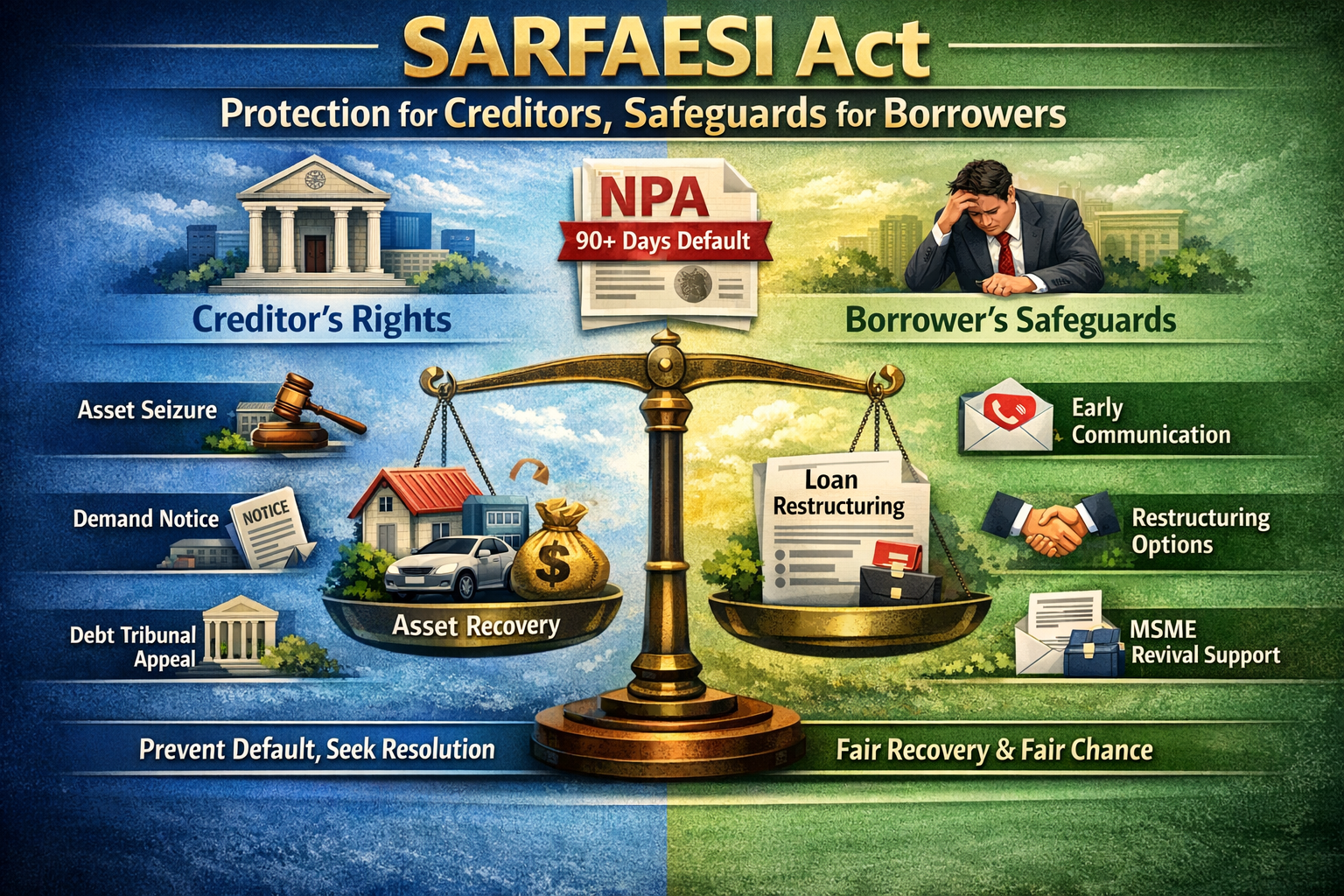
SARFAESI Act – Protection for Creditors, Safeguards for Borrowers: Understanding the Balance
The Indian banking system plays a vital role in supporting economic growth by providing credit to businesses and individuals. However, the challenge of recovering loans from defaulting borrowers historically created significant strain on banks and financial institutions. Lengthy litigation processes and procedural delays often made recovery difficult and inefficient. To address this issue, the Government of India enacted the Securitisation and Reconstruction of Financial Assets and Enforcement of Security Interest Act, 2002, commonly known as the SARFAESI Act.
The Act empowers banks and financial institutions to enforce their security interests and recover dues without having to initiate lengthy court proceedings. While the law significantly strengthens the position of creditors, it also incorporates safeguards to protect borrowers from arbitrary actions. Understanding this balance is particularly important for borrowers, especially Micro, Small and Medium Enterprises (MSMEs), which are more vulnerable to temporary financial stress.
1. Objective and Purpose of the SARFAESI Act
The primary objective of the SARFAESI Act is to enable banks and financial institutions to recover their non-performing assets (NPAs) efficiently. Prior to the enactment of this legislation, recovery of secured loans largely depended on judicial intervention, which often resulted in prolonged litigation and delayed enforcement of security interests.
The Act provides a legal framework that allows secured creditors to take possession of secured assets, sell them, and recover outstanding dues directly from the proceeds. In addition, it also facilitates the securitisation and reconstruction of financial assets through specialised entities such as asset reconstruction companies.
The legislation thus seeks to achieve three broad goals:
-
Strengthening the recovery mechanism for banks and financial institutions.
-
Reducing the burden on courts and tribunals by allowing non-judicial enforcement of security interests.
-
Maintaining financial discipline among borrowers while ensuring fair treatment.
2. Concept of Non-Performing Asset (NPA)
A key trigger for initiating recovery proceedings under the SARFAESI framework is the classification of a loan account as a Non-Performing Asset (NPA).
In the Indian banking system, a loan account generally becomes an NPA when the borrower fails to service interest or instalments for more than 90 days. Once an account is classified as an NPA, banks become legally entitled to initiate recovery measures under the SARFAESI Act.
For borrowers, particularly MSMEs that rely heavily on working capital and loan facilities, understanding this threshold is critical. Even a temporary disruption in cash flow can push an account into default if corrective steps are not taken promptly.
Therefore, financial discipline and proactive engagement with lenders play an essential role in preventing accounts from slipping into NPA status.
3. Preventive Measures to Avoid NPA Classification
Borrowers often underestimate the importance of timely intervention when facing financial stress. However, several simple measures can help prevent an account from becoming an NPA and avoid the consequences that follow under the SARFAESI framework.
3.1 Ensuring Continuity in EMI Payments
One of the most practical preventive steps is ensuring that three consecutive EMIs are not defaulted. Even if the borrower anticipates difficulty in meeting the payment obligations, servicing at least one instalment before the 90-day threshold can help regularise the account and prevent it from being classified as an NPA.
This approach allows borrowers to maintain their credit discipline while buying time to stabilise their financial position.
3.2 Early Communication with the Lending Institution
Timely communication with the bank is often the most effective strategy when financial difficulties arise. Borrowers should not wait until the account becomes irregular. Instead, they should inform the bank as soon as signs of financial stress appear.
Banks are generally more receptive to restructuring or repayment adjustments when borrowers demonstrate transparency and willingness to cooperate.
3.3 Exploring Loan Restructuring Options
Financial institutions offer various restructuring mechanisms that can help borrowers manage temporary cash flow issues. These options may include:
-
Extension of the repayment tenure
-
Reduction in instalment amounts
-
Temporary moratorium on repayments
-
Adjustment of interest rates or repayment schedules
Such restructuring arrangements can help viable businesses regain financial stability while continuing to meet their obligations to lenders.
3.4 MSME Revival and Assistance Requests
For Micro, Small and Medium Enterprises (MSMEs), proactive engagement with banks becomes even more important. MSMEs should formally write to their lending institution explaining the reasons for financial stress and requesting assistance for business revival.
These communications should clearly outline:
-
The causes of financial stress
-
The expected recovery timeline
-
Proposed restructuring or repayment plan
Banks are expected to evaluate such requests objectively and explore revival possibilities wherever feasible.
4. Safeguards Available to Borrowers under the SARFAESI Framework
Although the SARFAESI Act is designed to empower creditors, it also incorporates safeguards to ensure that borrowers are treated fairly.
Before taking possession of secured assets, banks must issue a demand notice requiring the borrower to repay the outstanding dues within a specified period. This notice provides borrowers with an opportunity to respond, raise objections, or settle the dues before enforcement measures are initiated.
Borrowers also have the right to challenge actions taken by the bank before the Debt Recovery Tribunal if they believe that the enforcement process has not been carried out in accordance with the law.
These safeguards ensure that the exercise of powers by banks remains subject to legal scrutiny and procedural fairness.
5. Judicial Perspective on Borrower Protection
The judiciary has repeatedly emphasised the importance of maintaining a balanced approach in the implementation of the SARFAESI framework. The Supreme Court of India has observed in several decisions that banks should not proceed mechanically toward recovery without considering whether a stressed enterprise, particularly an MSME, can be revived.
Courts have highlighted that viable businesses facing temporary financial difficulties should be given a fair opportunity to restructure their liabilities and continue operations. Such an approach not only protects borrowers but also benefits lenders by improving the chances of loan recovery through business revival rather than liquidation.
6. Practical Challenges in Implementation
Despite the safeguards built into the law, practical challenges remain in its implementation. In some cases, financial institutions may proceed rapidly toward enforcement without engaging meaningfully with borrowers.
Such situations can arise due to internal recovery targets, regulatory pressure to reduce NPAs, or lack of structured dialogue between lenders and borrowers. As a result, viable businesses may face recovery proceedings even when revival options could have been explored.
A more balanced and collaborative approach is therefore necessary to ensure that the objectives of the SARFAESI Act are achieved without causing unnecessary disruption to businesses.
7. The Importance of a Balanced Approach
The SARFAESI framework was designed to strike a balance between efficient loan recovery and borrower protection. While creditors must have the ability to enforce their rights and recover dues, borrowers should also receive a fair opportunity to resolve financial difficulties.
Effective implementation of this balance requires:
-
proactive communication from borrowers,
-
responsible and transparent action by banks, and
-
adherence to the legal safeguards provided under the Act.
When both sides engage constructively, many cases of financial stress can be resolved before escalating into insolvency or asset seizure.
Conclusion
The SARFAESI Act represents a significant reform in India’s financial recovery framework, providing banks and financial institutions with powerful tools to enforce security interests and reduce the burden of non-performing assets. At the same time, the law recognises the need to protect borrowers through procedural safeguards and legal remedies.
For borrowers, especially MSMEs, awareness and early action are critical. Timely repayment, open communication with lenders, and proactive restructuring efforts can often prevent an account from slipping into NPA status and triggering recovery proceedings.
Ultimately, the effectiveness of the SARFAESI framework lies in maintaining a balanced and responsible approach, where creditors exercise their recovery powers judiciously while borrowers engage transparently to address financial challenges. Such a collaborative approach can help preserve viable businesses, protect financial stability, and strengthen the overall credit ecosystem.
Unlock the Potential of Legal Expertise with LegalMantra.net – Your Trusted Legal Consultancy Partner
Disclaimer
Every effort has been made to ensure accuracy in this material. However, inadvertent errors or omissions may occur. Any discrepancies brought to the author’s notice will be rectified in subsequent editions. The author shall not be liable for any direct, indirect, incidental, or consequential damages arising from the use of this material. This article is based on various sources including statutory enactments, judicial decisions, academic research papers, professional journals, and publicly available legal materials.
Anshul Goel