
Forget Password

View News
Rupees 10 Crore CSR Trigger What Proposed Threshold Change Means
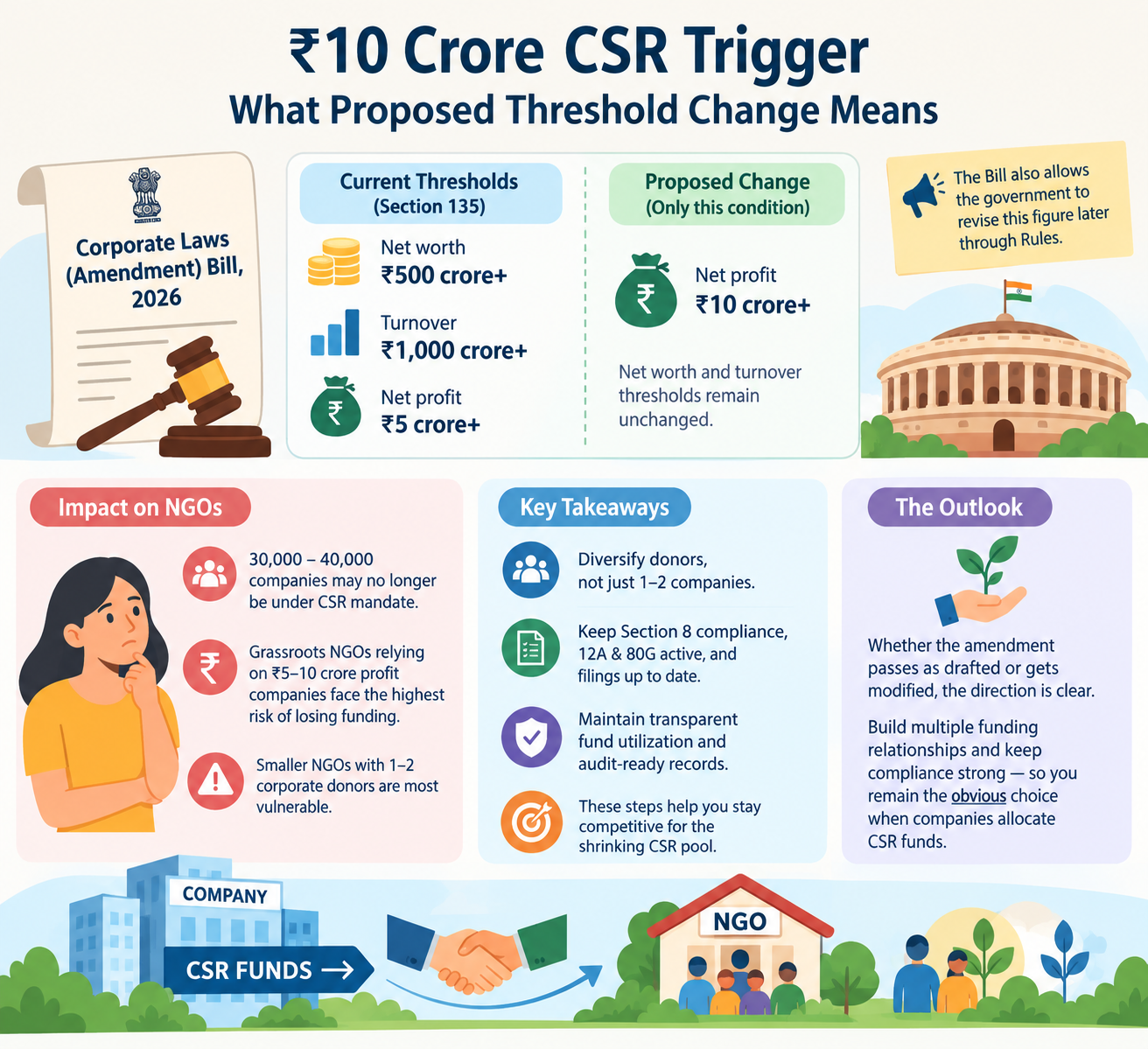
Rs 10 Crore CSR Trigger: What Proposed Threshold Change Means
NGOs seeking access to India's mandatory CSR ecosystem have long relied on Section 8 registration to get there. That's exactly why a pending amendment matters so much to them. In March, the Corporate Laws (Amendment) Bill, 2026, was introduced in Parliament, which proposes to increase the net profit requirement for CSR obligations under Section 135, from Rs. 5 crore to Rs. 10 crore. The Rs. 5 crore limit, however, remains in effect for now, until the bill is passed into law.
For organizations considering Section 8 registration, this change affects which companies are required to spend on CSR.
What the Bill Actually Changes?
Section 135 currently requires CSR compliance from any company meeting one of three conditions in the preceding financial year.
- Net worth of Rs. 500 crore or more
- Turnover of Rs. 1,000 crore or more.
- Net profit of Rs. 5 crore or more.
The Bill touches only the third condition, raising it to Rs. 10 crore. Net worth and turnover thresholds stay exactly where they are.
A company with net worth and turnover well below the other two thresholds, but a net profit of Rs. 6-9 crore, currently falls under Section 135. Once the amendment passes, that same company exits the CSR mandate entirely. A company triggered by net worth instead continues bearing CSR obligations regardless, since that threshold isn't moving.
The proposed language itself carries a second, quieter change. It reads "ten crore, or such sum as may be prescribed," which hands the government the ability to revise this figure again later through Rules notified in the Official Gazette, without needing a fresh vote in Parliament.
Why Grassroots NGOs are Watching This Closely?
Due to the Rs. 5 crore net profit limit, 30,000 to 40,000 companies come under Section 135. Indian companies have also, so far, spent a new sum of Rs. 1.5 lakh crore on CSR activities, the majority of which have been channelled through Section 8 companies.
Raising the threshold to Rs. 10 crore removes a meaningful slice of that 30,000-40,000 company pool from mandatory CSR spending altogether. For a large NGO already partnered with multiple corporate donors, that loss might be absorbable. For a smaller, grassroots organization that depends on one or two mid-sized companies for its entire CSR-funded budget, it can mean losing a funding relationship overnight, through no fault of its own governance or delivery.
A few things follow directly from this shift:
- NGOs currently funded primarily by companies with net profit in the Rs. 5-10 crore range face the most immediate exposure
- Diversifying donor relationships across multiple CSR sources, rather than depending on one or two mid-sized companies, becomes more important under the proposed change
- Section 8 company compliance, maintaining 12A and 80G status, clean annual filings, and audit-ready records, matters even more when competing for a shrinking pool of mandated CSR spenders
- Organisations working with companies triggered by the net worth or turnover thresholds, rather than net profit, face no direct impact from this specific change
What Section 8 Organizations Should Do Now?
For an NGO registered as a Section 8 company, the immediate priority isn't panicking over a bill that hasn't passed yet. It's making sure the organization's own compliance position is strong enough to remain competitive for whatever CSR funding pool exists once the dust settles. That means keeping Section 8 company compliance current, active 12AB and 80G registration, timely annual returns, and transparent fund utilization records. This is because companies with a shrinking CSR mandate are likely to become more selective, not less, about which NGOs they partner with.
Outlook
Whether this amendment passes as drafted, or gets modified during Parliamentary review, the direction is clear enough. The government is treating Rs. 5 crore as too low a bar for mandatory CSR spending, while leaving the much larger net worth and turnover thresholds untouched.
For grassroots NGOs sitting downstream of that decision, the practical response is the same regardless of the final number. Build funding relationships that don't depend on a single threshold. Keep compliance clean enough to be the obvious choice when a company does have CSR money to allocate.
Disclaimer: The information published on this website is provided for general informational and educational purposes only and does not constitute legal advice, a legal opinion, or a substitute for professional consultation. While reasonable efforts are made to ensure accuracy, the content may contain errors, omissions, outdated information or incorrect legal references. Readers are advised to independently verify the information and consult a qualified legal professional before relying upon it. No advocate-client or professional relationship is created merely by accessing or using this website.