
Forget Password

View News
Revisional Jurisdiction Sub Letting and the Veil of Partnership A Detailed Analysis of the Supreme Court 2026 Judgment
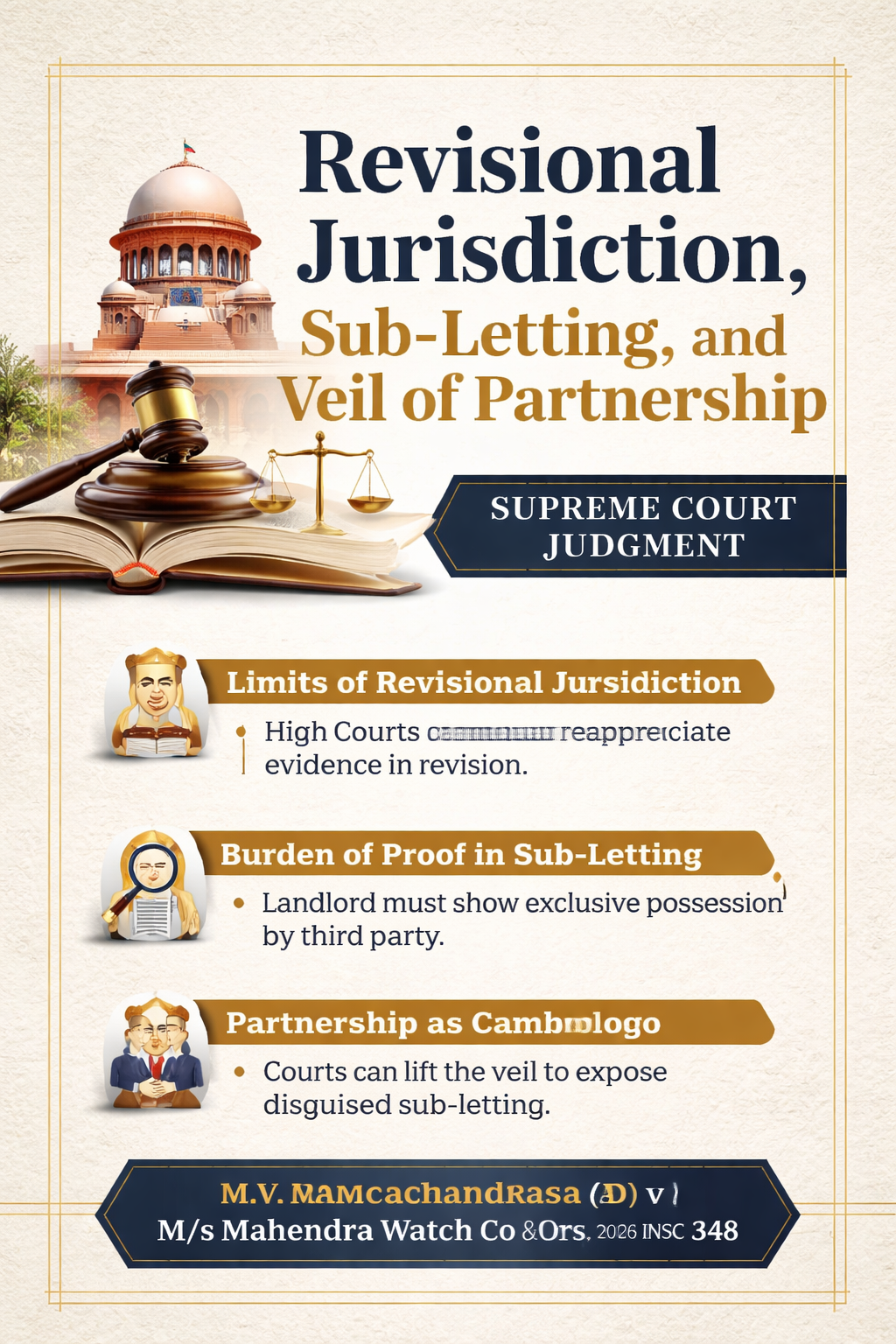
Revisional Jurisdiction, Sub-Letting, and the Veil of Partnership: A Detailed Analysis of the Supreme Court’s 2026 Judgment
Introduction
The evolution of rent control jurisprudence in India reflects a continuous judicial effort to maintain equilibrium between the protection afforded to tenants and the proprietary rights of landlords. One of the most litigated grounds for eviction remains unlawful sub-letting, particularly in commercial tenancies where complex arrangements such as partnership reconstitutions are frequently employed. The Supreme Court in Sri M.V. Ramachandrasa (Deceased) through Legal Representatives v. M/s Mahendra Watch Company & Ors. (2026) has delivered a significant judgment addressing the interplay between revisional jurisdiction, burden of proof in sub-letting, and the legal validity of partnership structures used in tenanted premises.
The judgment is not merely a resolution of a landlord-tenant dispute but a comprehensive restatement of legal principles governing revisional powers and the doctrine of sub-letting. It also addresses the recurring issue of tenants attempting to circumvent statutory restrictions through ostensibly legitimate business arrangements.
Factual Background
The dispute arose from a long-term lease arrangement concerning commercial premises situated in Bengaluru. The original landlord had obtained leasehold rights over a larger property and subsequently executed a registered lease deed in 1985 in favour of a partnership firm, namely M/s Mahendra Watch Company. The lease deed expressly restricted sub-letting or transfer of possession without the prior written consent of the landlord.
Over time, the landlord discovered that the original tenant-partner was no longer in actual possession of the premises and that the business was being conducted by other individuals who were not parties to the original lease agreement. On this basis, eviction proceedings were initiated under the Karnataka Rent Act, 1999, alleging unlawful sub-letting and parting with possession.
The trial court, after a detailed examination of oral and documentary evidence, concluded that the persons in possession were strangers to the tenancy and that the original tenant had unlawfully parted with possession. Consequently, the eviction petition was allowed. However, the High Court, in exercise of its revisional jurisdiction under Section 46 of the Act, set aside the trial court’s findings and dismissed the eviction petition. This led to the present appeal before the Supreme Court.
Scope and Limits of Revisional Jurisdiction
One of the central issues before the Supreme Court was whether the High Court had exceeded its jurisdiction by reappreciating evidence while exercising revisional powers. The Court undertook an elaborate analysis of the nature of revisional jurisdiction under rent control statutes and reiterated that such jurisdiction is inherently limited and supervisory in character.
The Court observed that revisional jurisdiction does not confer upon the High Court the authority to act as an appellate body. While appellate jurisdiction permits a rehearing on both facts and law, revisional jurisdiction is confined to examining the legality, correctness, and propriety of the impugned order. The distinction between the two is fundamental and must be maintained to preserve the legislative scheme.
In the present case, the trial court had rendered detailed findings based on the evidence on record, including inconsistencies in the respondents’ claims, absence of documentary proof of partnership, and lack of landlord consent. These findings were purely factual in nature. The High Court, however, proceeded to reassess the entire evidence and arrived at a different conclusion, thereby substituting its own findings in place of those of the trial court.
The Supreme Court categorically held that such an approach is impermissible. It emphasized that interference in revision is justified only where the findings are perverse, based on no evidence, or suffer from manifest illegality. Since none of these conditions were satisfied in the present case, the High Court had clearly transgressed the limits of its jurisdiction.
This part of the judgment reinforces the principle that revisional courts must exercise restraint and respect the findings of fact recorded by subordinate courts unless there is a compelling legal justification for interference.
Burden of Proof in Cases of Sub-Letting
The second major issue addressed by the Court relates to the burden of proof in eviction proceedings based on sub-letting. The Court reaffirmed the settled legal position that the initial burden lies on the landlord to establish that the tenant has parted with possession in favour of a third party.
However, the Court also recognized the practical difficulty in proving sub-letting, as such arrangements are often clandestine and not documented openly. In light of this, the Court reiterated that once the landlord establishes that a third party is in exclusive possession of the premises and that the original tenant is no longer in control, a presumption of sub-letting arises.
At this stage, the burden shifts to the tenant to provide a plausible explanation for such possession. The tenant must demonstrate that the arrangement is lawful and does not amount to sub-letting. Failure to discharge this burden would result in the presumption operating against the tenant.
In the present case, the landlord successfully demonstrated that the original tenant was not in possession and that the premises were being exclusively occupied by other individuals. This was sufficient to discharge the initial burden. The respondents, however, failed to produce credible evidence to establish their legal status, such as a valid partnership deed or proof of consent from the landlord.
The Court therefore concluded that the respondents had failed to rebut the presumption of sub-letting, and the landlord had successfully established the ground for eviction.
Partnership Arrangements and the Doctrine of Sub-Letting
A significant aspect of the judgment concerns the legal distinction between a genuine partnership and a disguised sub-letting arrangement. The respondents contended that the change in possession was merely a result of reconstitution of the partnership firm and did not amount to sub-letting.
The Court examined this contention in light of established legal principles. It reiterated that a partnership firm is not a separate legal entity distinct from its partners. Therefore, mere induction or retirement of partners does not, by itself, amount to sub-letting, provided the original tenant continues to retain legal possession and control over the premises.
However, the Court emphasized that this principle cannot be used as a shield to legitimise unlawful transfers. Where the original tenant has completely divested himself of possession and control, and third parties are found to be in exclusive occupation, the arrangement cannot be treated as a bona fide partnership. In such cases, the so-called partnership may be nothing more than a device to conceal sub-letting.
The Court further observed that it is open to the judiciary to “lift the veil” of such arrangements and examine the real nature of the transaction. If the partnership is found to be a mere façade, the court is justified in treating it as a case of unlawful sub-letting.
In the present case, the Court found that the original tenant had ceased to have any involvement in the business or the premises. The respondents failed to produce any reliable evidence of a valid partnership or reconstitution. The alleged documents were either unregistered or not proved in accordance with law. The evidence on record clearly indicated that the respondents were in exclusive possession and control of the premises.
Accordingly, the Court held that the arrangement amounted to unlawful sub-letting and not a genuine partnership.
Judicial Reasoning and Findings
The Supreme Court’s reasoning is marked by a careful application of settled legal principles to the facts of the case. The Court methodically addressed each issue, beginning with the scope of revisional jurisdiction, followed by the evidentiary burden in sub-letting, and finally the nature of partnership arrangements.
The Court gave significant weight to the findings of the trial court, noting that they were based on a thorough appreciation of evidence and were neither perverse nor illegal. It criticized the High Court for overstepping its jurisdiction and effectively converting a revision into an appeal.
On the issue of sub-letting, the Court relied on established precedents to hold that exclusive possession by a third party raises a presumption against the tenant. It found that the respondents had failed to rebut this presumption and had not established any lawful basis for their occupation.
With respect to the partnership argument, the Court applied the doctrine of lifting the veil and concluded that the arrangement was a mere camouflage to conceal an unlawful transfer of possession.
Conclusion
The Supreme Court ultimately allowed the appeal, set aside the High Court’s judgment, and restored the eviction order passed by the trial court. The respondents were granted a limited period to vacate the premises.
This judgment serves as a significant reaffirmation of three key principles in rent control law. First, it underscores the limited scope of revisional jurisdiction and the necessity for judicial restraint. Second, it clarifies the shifting burden of proof in cases of sub-letting and the role of presumptions in such cases. Third, it establishes that partnership arrangements cannot be used as a device to circumvent statutory prohibitions on sub-letting.
The ruling is particularly relevant in the context of commercial tenancies, where complex business structures are often employed to mask the true nature of possession. By emphasizing substance over form, the Court has ensured that the protective framework of rent control laws is not misused.
For legal practitioners and scholars, this judgment offers valuable insights into the interpretation of rent control statutes and the evidentiary standards applicable in eviction proceedings. It reinforces the idea that while the law seeks to protect tenants, it does not permit abuse of that protection at the cost of legitimate landlord righ
Unlock the Potential of Legal Expertise with LegalMantra.net – Your Trusted Legal Consultancy Partner
Disclaimer
Every effort has been made to ensure accuracy in this material. However, inadvertent errors or omissions may occur. Any discrepancies brought to the author’s notice will be rectified in subsequent editions. The author shall not be liable for any direct, indirect, incidental, or consequential damages arising from the use of this material. This article is based on various sources including statutory enactments, judicial decisions, academic research papers, professional journals, and publicly available legal materials.
Mayank Garg
LegalMantra.net Team