
Forget Password

View News
Regulation A Comprehensive Guide to Website Disclosures for Listed Entities
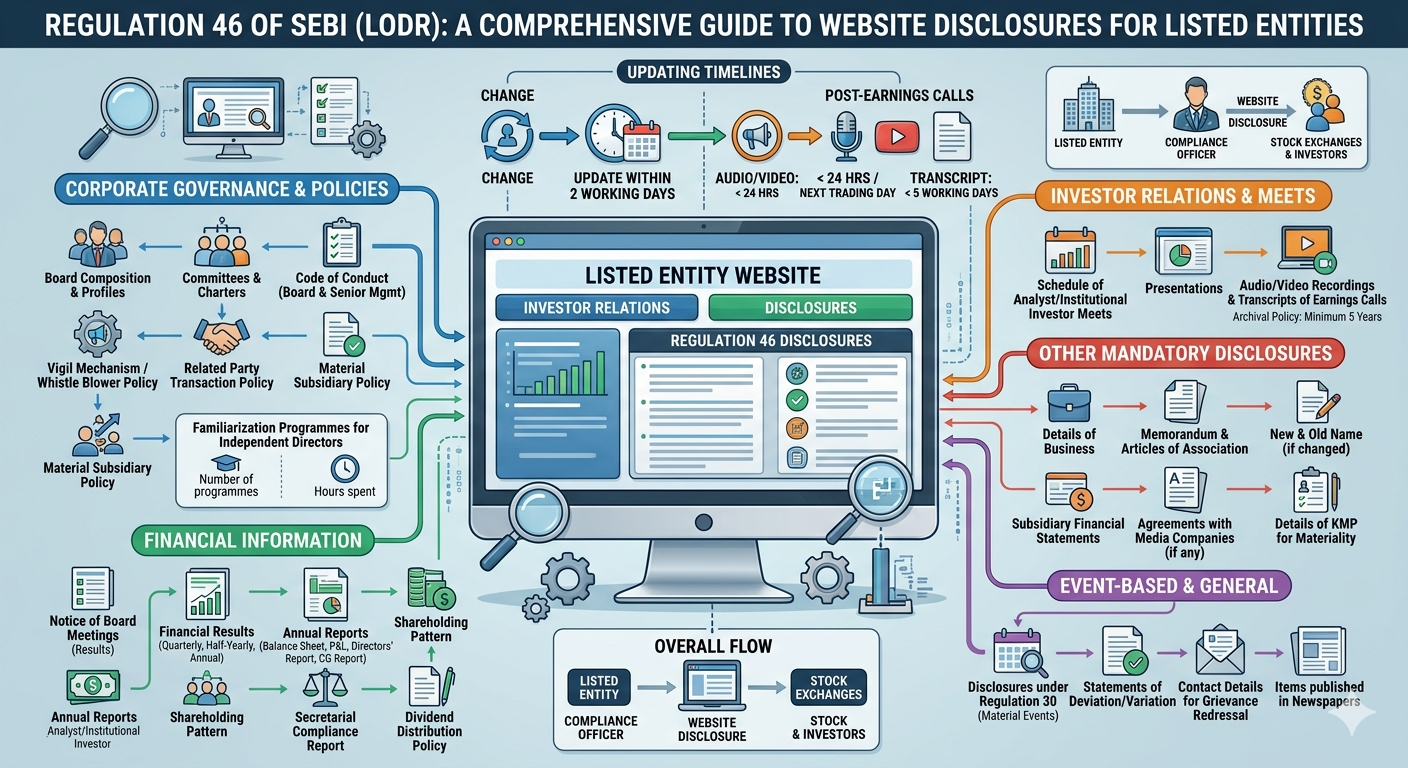
Regulation 46 of SEBI (LODR): A Comprehensive Guide to Website Disclosures for Listed Entities
1. Introduction
In today’s corporate governance framework, transparency and accessibility of information are critical for protecting investor interests. The Securities and Exchange Board of India, through Regulation 46 of the SEBI (Listing Obligations and Disclosure Requirements) Regulations, 2015, has mandated listed entities to maintain a functional website containing comprehensive disclosures. This requirement ensures that stakeholders have uninterrupted access to material information and that companies adhere to uniform disclosure standards.
Regulation 46 transforms corporate websites into a central repository of disclosures, thereby strengthening governance, reducing information asymmetry, and promoting investor confidence.
2. General Requirements under Regulation 46
Regulation 46 lays down foundational obligations relating to the maintenance and updating of a company’s website. These requirements are continuous in nature and demand strict adherence to timelines, particularly in relation to updates.
| Clause | Requirement | Timeline / Frequency | Remarks |
|---|---|---|---|
| 46(1) | Maintain a functional website | Continuous | Must contain basic company information |
| 46(2) | Host disclosures under a separate section | Continuous | Clearly identifiable section |
| 46(3)(a) | Ensure accuracy of website content | Continuous | Regular review required |
| 46(3)(b) | Update changes | Within 2 working days | Strict timeline |
The requirement of updating changes within two working days reflects SEBI’s intent to ensure real-time disclosure and prevent any informational disadvantage to investors.
3. Core Corporate Information
The regulation requires companies to disclose key corporate information that enables stakeholders to understand the structure, governance, and operations of the entity.
| Clause | Disclosure | Remarks |
|---|---|---|
| (a) | Business details | Overview of operations |
| (aa) | MOA & AOA | Updated copies |
| (ab) | Board of Directors profile | Including directorships |
| (b) | Terms of appointment of Independent Directors | Mandatory governance disclosure |
| (c) | Composition of Board Committees | Audit, NRC, Stakeholders, etc. |
| (d) | Code of Conduct | Board & Senior Management |
| (e) | Vigil Mechanism / Whistle Blower Policy | Must be accessible |
These disclosures ensure transparency in governance and align with the requirements of the Companies Act, 2013, particularly with respect to board structure and ethical standards.
4. Policy Disclosures
In addition to general corporate information, Regulation 46 mandates disclosure of key governance policies that guide the functioning of the company.
| Clause | Policy |
|---|---|
| (f) | Criteria for payment to Non-Executive Directors |
| (g) | Related Party Transaction Policy |
| (h) | Material Subsidiary Policy |
| (u) | Materiality of Events Policy (Reg 30) |
| (y) | Dividend Distribution Policy |
| (za) | Employee Benefit Scheme Documents |
These policies form the backbone of corporate governance and must be periodically reviewed to ensure consistency with regulatory amendments and board approvals.
5. Familiarization of Independent Directors
Regulation 46, read with governance provisions relating to independent directors, requires disclosure of details regarding familiarization programmes conducted for independent directors. Such disclosures enhance transparency and ensure that independent directors are adequately equipped to discharge their duties.
| Clause | Details Required |
|---|---|
| (i) | Number of programmes attended (yearly & cumulative) |
| (ii) | Hours spent |
| (iii) | Other relevant details |
6. Investor and Contact Information
To facilitate effective communication with investors, companies are required to disclose specific contact details and designated communication channels.
| Clause | Disclosure |
|---|---|
| (j) | Email for grievance redressal |
| (k) | Contact details of grievance officers |
| (v) | KMP authorized for disclosures |
| (w) | Disclosures under Regulation 30(8) |
These disclosures ensure accountability and provide investors with direct access to the company for grievance resolution.
7. Financial Information
Financial transparency is a cornerstone of Regulation 46, requiring timely disclosure of financial information and related documents.
| Clause | Disclosure | Timeline |
|---|---|---|
| (l)(i) | Notice of Board Meeting (financial results) | Before meeting |
| (l)(ii) | Financial Results | Immediately after approval |
| (l)(iii) | Annual Report | Post finalization |
| (m) | Shareholding Pattern | Periodic |
| (x) | Statement of deviation/variation | As applicable |
Timely disclosure of financial results is particularly critical, as delays may lead to regulatory penalties and concerns relating to insider trading.
8. Investor Interaction and Analyst Meets
Regulation 46 also governs disclosures relating to analyst and investor interactions, ensuring that information shared in such forums is made publicly available.
| Clause | Requirement | Timeline |
|---|---|---|
| (o)(i) | Schedule of analyst/investor meets | At least 2 working days in advance |
| (o)(ii) | Presentations | Before event |
| (oa)(i) | Audio recordings | Within 24 hours / before next trading day |
| (oa)(ii) | Video recordings | Within 48 hours |
| (oa)(iii) | Transcripts | Within 5 working days |
In addition to disclosure requirements, companies must adhere to preservation norms. Audio and video recordings must be retained for a minimum period of two years, while transcripts must be preserved for at least five years. These provisions ensure equal access to information and prevent selective disclosure.
9. Additional Disclosures
Regulation 46 further mandates certain additional disclosures that enhance transparency and provide a holistic view of the company’s operations and compliance status.
| Clause | Disclosure |
|---|---|
| (n) | Media agreements |
| (p) | Old & new name (1 year post change) |
| (q) | Newspaper publication items (Reg 47) |
| (r) | Credit ratings (updated) |
| (s) | Subsidiary financial statements |
| (t) | Secretarial Compliance Report |
| (z) | Annual Return (Section 92) |
10. Special Notes and Relaxations
The regulation provides certain practical relaxations to facilitate compliance without duplication of efforts. Companies are permitted to provide direct links to disclosures made on stock exchange websites instead of hosting the same information separately.
In the case of foreign subsidiaries, consolidated financial statements may be disclosed where required under foreign laws. Further, unaudited financial statements may be uploaded if audit is not mandatory in the relevant jurisdiction. However, such disclosures must be accompanied by an English translation to ensure accessibility.
11. Compliance Checklist
From a practical compliance perspective, companies must ensure that all regulatory requirements are adhered to in a systematic and timely manner.
| Compliance Area | Status Indicator |
|---|---|
| Website functionality and updates | |
| Separate Investor/Disclosure section | |
| Policies uploaded and updated | |
| Financial disclosures timely | |
| Analyst meet compliance | |
| Audio/video/transcripts within timeline | |
| Updates within 2 working days | |
| Preservation policy aligned with Regulation 9 |
12. Consequences of Non-Compliance
Non-compliance with Regulation 46 may attract penalties from stock exchanges and regulatory authorities. Persistent non-compliance can lead to stringent actions such as freezing of promoter shareholding or suspension of trading. Additionally, non-compliance may adversely impact the company’s reputation and investor confidence.
13. Conclusion
Regulation 46 serves as a cornerstone of digital corporate governance in India. By mandating structured and timely disclosures on company websites, it ensures transparency, accountability, and accessibility of information. A well-maintained website is not only a compliance requirement but also a strategic tool for enhancing investor trust and strengthening corporate credibility.
Disclaimer
The contents of this document are provided based on current provisions and information available. While every effort has been made to ensure accuracy and reliability, no responsibility is assumed for any errors or omissions. Users are encouraged to refer to applicable laws and regulations. This information is not to be construed as legal advice, and no liability is accepted for any consequences arising from its use.
From the desk of CS Sharath