
Forget Password

View News
Reforming Penalty Enforcement: A Critical Study of the Competition Commission of India (Manner of Recovery of Monetary Penalty) Regulations, 2025
Introduction
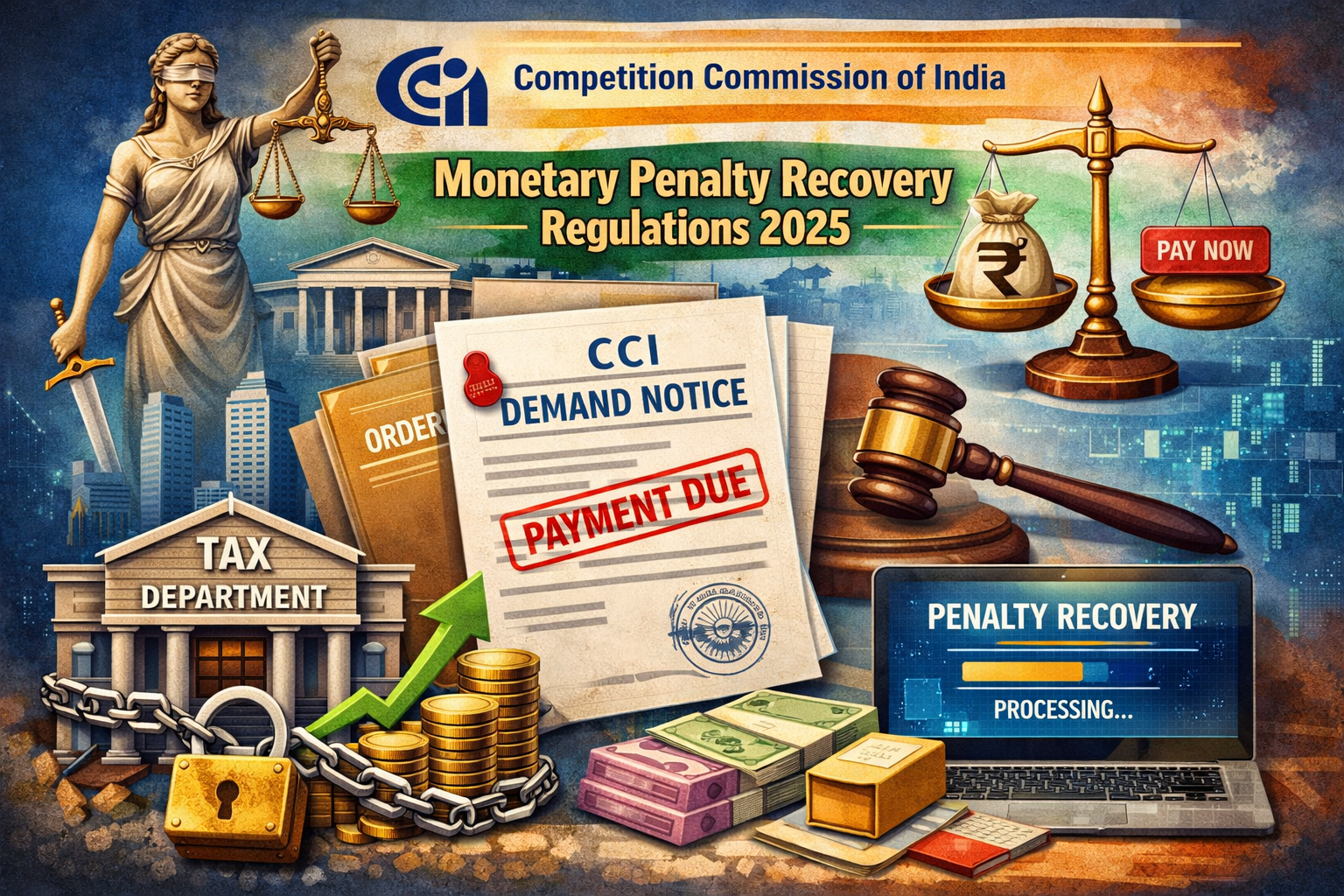
On 25 February 2025, the Competition Commission of India notified the Competition Commission of India (Manner of Recovery of Monetary Penalty) Regulations, 2025, thereby repealing the earlier Competition Commission of India (Manner of Recovery of Monetary Penalty) Regulations, 2011. This notification marks a significant procedural reform within India’s competition law enforcement framework under the Competition Act, 2002.
While the power to impose penalties has long been central to the Commission’s adjudicatory authority, the effectiveness of competition law enforcement ultimately depends on a robust and enforceable recovery mechanism. The 2025 Regulations seek to strengthen that mechanism by introducing greater procedural clarity, institutional discipline, and enforcement efficiency.
Statutory Framework under the Competition Act, 2002
Power to Impose Monetary Penalties
The Competition Act, 2002 empowers the Commission to impose monetary penalties for contraventions relating to anti-competitive agreements under Section 3, abuse of dominant position under Section 4, and combinations that are not notified or approved in accordance with Sections 5 and 6. Monetary penalties serve both punitive and deterrent objectives, ensuring that enterprises internalize the cost of non-compliance.
Power to Recover Penalties
Section 39 of the Act authorises the Commission to recover penalties in the manner specified by regulations. It further permits recovery as arrears of income tax by making a reference to the appropriate income-tax authority. The 2011 Regulations were framed to operationalise this provision. However, with evolving enforcement practices and statutory amendments, a revised regulatory framework became necessary.
Need for Repeal of the 2011 Regulations
Evolving Enforcement Landscape
Since 2011, India’s competition law regime has matured considerably. The scale and complexity of investigations have increased, the quantum of penalties has grown significantly, and appellate jurisprudence has provided interpretational guidance on penalty computation and enforcement. Additionally, the Competition (Amendment) Act, 2023 introduced structural changes to the enforcement framework.
Procedural Gaps in the Earlier Framework
The earlier regulations, though functional, left certain procedural aspects less defined. Issues concerning timelines, coordination with tax authorities, and the effect of appellate proceedings occasionally resulted in delays or interpretational ambiguity. The 2025 Regulations address these challenges by codifying clearer procedures and strengthening recovery tools.
Issuance of Demand Notice
Formal Communication of Liability
Under the 2025 Regulations, once a monetary penalty is imposed, a formal demand notice is issued specifying the amount payable and the time within which payment must be made. This marks the transition from adjudication to enforcement.
The structured notice mechanism ensures transparency and procedural fairness by clearly communicating the financial liability to the concerned enterprise or individual.
Legal Certainty and Procedural Discipline
By standardising the format and contents of the demand notice, the Regulations reduce the scope for disputes at the recovery stage. This enhances legal certainty and ensures that enforcement proceeds on a clearly documented basis.
Consequences of Non-Payment
Initiation of Recovery Proceedings
If the penalty is not paid within the stipulated period, recovery proceedings may be initiated. The Regulations provide a structured pathway for enforcement action, ensuring that non-compliance triggers timely and proportionate measures.
Recovery as Arrears of Income Tax
In accordance with Section 39(2) of the Act, the Commission may refer the matter to the income-tax authority for recovery as arrears of income tax. This mechanism leverages the established recovery infrastructure under tax law, including attachment and sale of property, thereby strengthening enforceability.
Modes of Recovery
Attachment of Property
The Regulations recognise attachment and sale of movable and immovable property as valid recovery mechanisms. This ensures that defaulters cannot evade liability through inaction.
Attachment of Bank Accounts and Third-Party Recoveries
The framework also permits attachment of bank accounts and recovery from third parties holding money on behalf of the defaulter. These measures enhance the Commission’s ability to realise penalties effectively and deter strategic non-compliance.
Interplay with Appellate Proceedings
Effect of Filing an Appeal
The Regulations clarify that mere filing of an appeal does not automatically stay recovery proceedings. Recovery may continue unless a specific stay is granted by the appellate forum.
This provision prevents misuse of appellate remedies as a delaying tactic while preserving judicial oversight where appropriate.
Adjustment and Refund
Where penalties are subsequently modified, reduced, or set aside by appellate authorities, the Regulations provide for adjustment or refund mechanisms. This ensures procedural fairness and alignment with final judicial determinations.
Digitalisation and Procedural Modernisation
Electronic Communication and Payment
The 2025 Regulations align with broader digitisation initiatives by enabling electronic service of notices and digital modes of payment. This reduces administrative delays and enhances efficiency.
Record Maintenance and Transparency
Digital processes facilitate better record-keeping and tracking of recovery proceedings, thereby improving transparency and institutional accountability.
Repeal and Saving Clause
Supersession of the 2011 Regulations
The 2025 Regulations expressly repeal the 2011 framework. This ensures that the recovery mechanism reflects current statutory realities and enforcement practices.
Continuity of Pending Proceedings
Actions initiated under the earlier regulations are typically protected through saving provisions, ensuring that pending recovery proceedings remain valid and unaffected.
Compliance Implications for Enterprises
Strengthened Enforcement Environment
The revised recovery framework underscores the seriousness of monetary penalties imposed by the Commission. Enterprises must prioritise timely compliance to avoid coercive recovery measures.
Corporate Governance Considerations
Boards, compliance officers, and legal departments should integrate monitoring mechanisms for regulatory liabilities. Strategic decisions regarding appeals must be taken in light of stricter recovery timelines.
Broader Enforcement Significance
Enhancing Deterrence
The effectiveness of competition law enforcement depends not merely on imposing penalties but on ensuring their actual realisation. The 2025 Regulations significantly enhance this enforcement capability.
Alignment with Global Best Practices
By strengthening its recovery architecture, the Commission reinforces its institutional authority and aligns India’s competition regime with international enforcement standards.
Conclusion
The Competition Commission of India (Manner of Recovery of Monetary Penalty) Regulations, 2025 represent a substantial procedural reform within India’s competition law framework. By repealing the 2011 Regulations and introducing a clearer, more structured recovery mechanism, the Commission has strengthened the enforceability of its orders under the Competition Act, 2002.
The revised framework not only enhances procedural clarity but also reinforces the deterrent purpose of monetary penalties, thereby contributing to the overall robustness and credibility of India’s competition law regime.
Unlock the Potential of Legal Expertise with LegalMantra.net – Your Trusted Legal Consultancy Partner
Disclaimer
Every effort has been made to ensure accuracy in this material. However, inadvertent errors or omissions may occur. Any discrepancies brought to the author’s notice will be rectified in subsequent editions. The author shall not be liable for any direct, indirect, incidental, or consequential damages arising from the use of this material. This article is based on various sources including statutory enactments, judicial decisions, academic research papers, professional journals, and publicly available legal materials.
Anshul Goel