
Forget Password

View News
Promoters of Defaulting Companies May Get a Second Chance
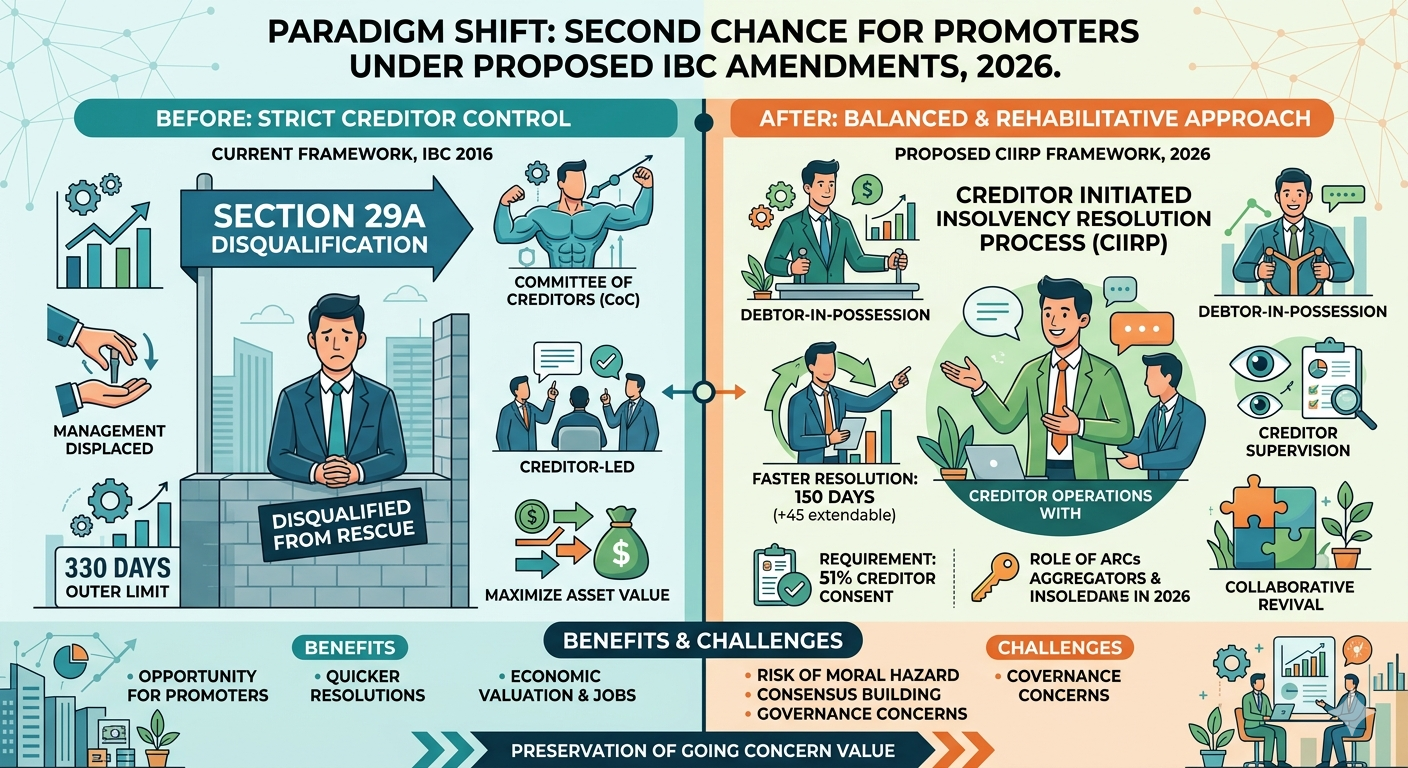
Promoters of Defaulting Companies May Get a Second Chance: A Paradigm Shift under the Proposed IBC Amendments, 2026
1. Introduction
The Insolvency and Bankruptcy Code, 2016 (IBC) was enacted with the primary objective of ensuring a time-bound and creditor-driven resolution of stressed assets in India. The legislative intent was to shift control from errant promoters to financial creditors in order to maximise asset value and instil credit discipline. Over the years, the IBC has significantly transformed India’s insolvency regime by introducing a structured and time-sensitive resolution mechanism.
However, the proposed Insolvency and Bankruptcy Code (Amendment) Bill, 2026 signals a notable shift in this approach. It introduces a framework whereby promoters of defaulting companies may be allowed to retain control and attempt revival of their businesses under creditor supervision. This emerging model reflects a transition from a strict creditor-in-control regime to a more balanced and rehabilitative approach.
2. Existing Legal Framework under IBC
2.1 Corporate Insolvency Resolution Process (CIRP)
Under the existing structure, the Corporate Insolvency Resolution Process is initiated upon default by a corporate debtor. Once the process is admitted, the management of the company is displaced and vested in an Interim Resolution Professional, who subsequently acts as the Resolution Professional. The Committee of Creditors (CoC), comprising financial creditors, exercises commercial decision-making authority regarding the resolution plan.
This framework is fundamentally creditor-centric, ensuring that those who have extended credit to the company are empowered to decide its future. The role of the promoters is effectively diminished during this process, thereby preventing them from influencing the resolution outcome.
2.2 Disqualification under Section 29A
A critical provision reinforcing this approach is Section 29A of Insolvency and Bankruptcy Code, which disqualifies certain persons, including wilful defaulters and promoters of defaulting companies, from submitting resolution plans. The rationale behind this provision is to prevent promoters who have contributed to the financial distress of the company from regaining control at a discounted valuation, thereby protecting the interests of creditors and maintaining the integrity of the insolvency process.
3. Emergence of the Creditor Initiated Insolvency Resolution Process (CIIRP)
The proposed amendments introduce the concept of a Creditor Initiated Insolvency Resolution Process (CIIRP), which marks a significant departure from the existing framework.
3.1 Nature and Structure of CIIRP
Under CIIRP, while the process is triggered by creditors upon default, the management of the company is not displaced. Instead, the board of directors continues to oversee day-to-day operations, albeit under the supervision and oversight of creditors. This model introduces a “debtor-in-possession” system, wherein the promoters retain operational control but remain accountable to the creditors.
The process resembles a negotiated settlement rather than a complete takeover, as creditors and promoters collaborate to restructure debt and revive the company. Such an approach recognises that promoters, being intimately familiar with the business, may be better positioned to restore operational efficiency.
3.2 Time-bound Resolution Framework
The CIIRP framework proposes a significantly reduced timeline, wherein the resolution process is to be completed within 150 days, extendable by an additional 45 days. This is in contrast to the existing outer limit of 330 days under CIRP. The reduced timeline is intended to ensure faster resolution and minimise value erosion of assets.
3.3 Threshold for Initiation and Approval
A crucial requirement under CIIRP is that at least 51 percent of creditors must agree to initiate and support the resolution process. This threshold ensures that a majority of financial stakeholders are aligned with the proposed restructuring plan, thereby lending legitimacy and feasibility to the process.
3.4 Reversion to CIRP upon Failure
In cases where the CIIRP fails to yield a successful resolution, the framework provides for a fallback mechanism wherein the matter reverts to the traditional CIRP. This ensures that the interests of creditors remain safeguarded and that an alternative resolution pathway remains available.
4. Role of Asset Reconstruction Companies (ARCs)
The effectiveness of CIIRP is closely linked to the ability of creditors to coordinate and achieve the required majority threshold. In this context, Asset Reconstruction Companies (ARCs) are expected to play a pivotal role.
ARCs, by virtue of aggregating distressed assets from multiple lenders, are in a unique position to consolidate debt and exercise significant influence over the resolution process. Their expertise in restructuring and recovery further enhances their ability to drive efficient outcomes. As highlighted by the Association of ARCs in India, the CIIRP framework could substantially enhance the utility of ARCs as resolution platforms, enabling faster and more effective restructuring of distressed assets.
5. Economic and Policy Context
The introduction of CIIRP must also be understood in light of prevailing economic conditions. Global supply chain disruptions, geopolitical tensions, and economic uncertainties have increased the financial stress on various sectors. These factors have heightened the risk of defaults, necessitating a more flexible and responsive insolvency framework.
The proposed amendments seek to address these challenges by providing an opportunity for early-stage intervention and restructuring, thereby preventing the escalation of financial distress into full-fledged insolvency.
6. Advantages of the Proposed Framework
The CIIRP framework offers several advantages for stakeholders.
From the perspective of promoters, it provides an opportunity to retain ownership and revive their businesses without being displaced. This creates an incentive for promoters to act in good faith and work towards restoring the financial health of the company.
For creditors, the reduced timelines and collaborative approach may lead to quicker resolutions and improved recovery rates. By avoiding prolonged litigation and operational disruptions, creditors stand to benefit from enhanced value realisation.
At a broader level, the economy benefits from the preservation of going concern value, protection of employment, and maintenance of industrial stability.
7. Legal and Practical Challenges
Despite its potential benefits, the CIIRP framework raises several legal and practical concerns.
One of the primary issues is the risk of moral hazard, wherein promoters may misuse the provision to retain control despite being responsible for the company’s financial distress. This concern is particularly significant in light of the strict disqualification norms under Section 29A.
Additionally, achieving consensus among creditors remains a challenge, especially in cases involving multiple lenders with divergent interests. The requirement of a 51 percent majority, while necessary, may lead to delays and complexities in decision-making.
There are also governance concerns associated with allowing promoters to continue managing the company during the resolution process. The risk of asset diversion, preferential transactions, and lack of transparency cannot be overlooked.
Furthermore, the increased reliance on judicial approval may place an additional burden on the National Company Law Tribunal, potentially leading to delays if not managed efficiently.
8. Comparative Analysis with Existing Framework
The CIIRP represents a shift from an adversarial and creditor-dominated model to a more cooperative and negotiated framework. While the existing CIRP emphasises creditor control and promoter exclusion, the proposed model seeks to balance the interests of both parties by enabling collaboration and shared responsibility in the resolution process.
This shift reflects a broader evolution in insolvency law, moving from a punitive approach towards a rehabilitative and value-preserving framework.
9. Conclusion
The proposed amendments to the Insolvency and Bankruptcy Code mark a significant turning point in India’s insolvency regime. By allowing promoters of defaulting companies a second chance under creditor supervision, the law aims to promote timely resolution, preserve economic value, and enhance the efficiency of the insolvency process.
However, the success of this framework will depend on the establishment of robust safeguards, effective creditor coordination, and vigilant regulatory oversight. If implemented judiciously, the CIIRP could emerge as a transformative mechanism, aligning the interests of promoters and creditors while strengthening the overall insolvency ecosystem in India.
Unlock the Potential of Legal Expertise with LegalMantra.net – Your Trusted Legal Consultancy Partner
Disclaimer
Every effort has been made to ensure accuracy in this material. However, inadvertent errors or omissions may occur. Any discrepancies brought to the author’s notice will be rectified in subsequent editions. The author shall not be liable for any direct, indirect, incidental, or consequential damages arising from the use of this material. This article is based on various sources including statutory enactments, judicial decisions, academic research papers, professional journals, and publicly available legal materials.
CS, LL.B, LL.M Anshul Goel
LegalMantra.net Team