
Forget Password

View News
24 May 2026
Prohibition of Benami Property Transactions Act 1988
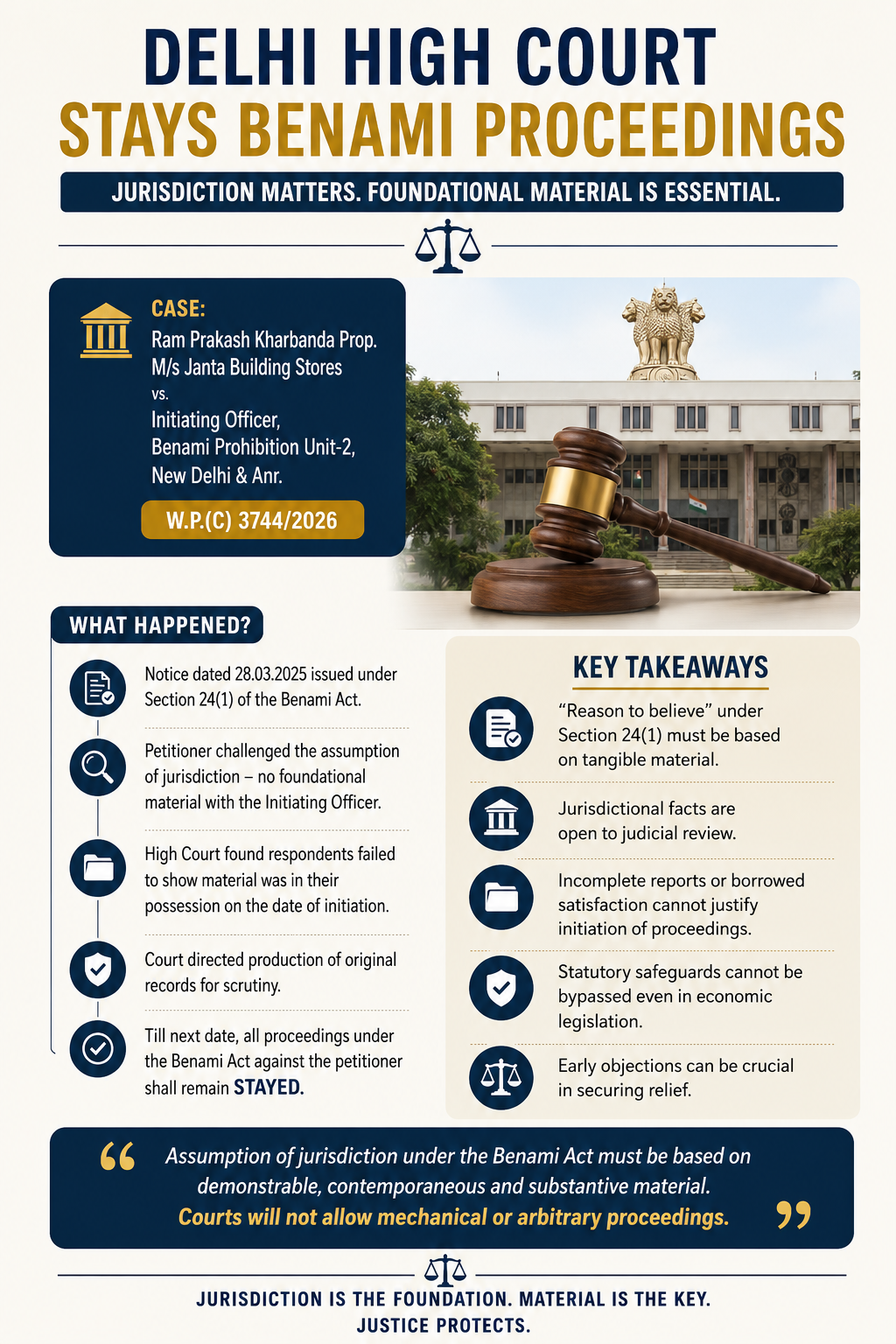
Analysis of Ram Prakash Kharbanda Prop. M/s Janta Building Stores v. Initiating Officer, Benami Prohibition Unit-2, New Delhi & Anr.
| Particulars / Heading | Detailed and Comprehensive Analysis |
|---|---|
| Case Title | Ram Prakash Kharbanda Prop. M/s Janta Building Stores v. Initiating Officer, Benami Prohibition Unit-2, New Delhi & Anr. |
| Court | Delhi High Court |
| Case Number | W.P.(C) 3744/2026 along with CM APPL. 18324/2026 and CM APPL. 18325/2026 |
| Coram / Bench Composition | The matter was heard by a Division Bench comprising Hon’ble Mr. Justice Dinesh Mehta and Hon’ble Mr. Justice Vinod Kumar. |
| Relevant Statute Involved | Prohibition of Benami Property Transactions Act, 1988 |
| Central Legal Controversy | The principal controversy before the Court revolved around the legality of assumption of jurisdiction under Section 24(1) of the Benami Act. The petitioner challenged the validity of the proceedings on the ground that the Initiating Officer lacked foundational material necessary for formation of “reason to believe,” which is a mandatory statutory requirement before initiation of proceedings under the Act. |
| Nature of Proceedings | The proceedings arose from a show cause notice dated 28.03.2025 issued by the Initiating Officer under Section 24(1) of the Benami Act alleging benami transactions against the petitioner. |
| Core Jurisdictional Issue | Whether the Initiating Officer possessed legally sustainable and tangible material at the time of issuance of notice under Section 24(1), sufficient to satisfy the statutory requirement of “reason to believe.” |
| Importance of Section 24(1) | Section 24(1) forms the foundation of Benami proceedings. It authorizes the Initiating Officer to issue a notice only if he has “reason to believe,” based on material in his possession, that a person is a benamidar in respect of a property. Thus, possession of material and formation of opinion are jurisdictional preconditions. |
| Meaning of “Reason to Believe” in the Present Context | The expression “reason to believe” has consistently been interpreted by courts to mean that the authority must possess objective and tangible material leading to a rational conclusion. Such satisfaction cannot be arbitrary, hypothetical, borrowed, or mechanical. The belief must be formed independently after due application of mind. |
| Petitioner’s Fundamental Challenge | The petitioner argued that the proceedings were void ab initio because the Initiating Officer did not possess the underlying records, complete appraisal report, or foundational documents necessary to form a valid opinion under Section 24(1). |
| Petitioner’s Consistent Stand Before Authorities | From the initial stage before the Initiating Officer to the proceedings before the Adjudicating Authority and ultimately before the High Court, the petitioner consistently maintained that the jurisdictional fact required under Section 24(1) was absent. |
| Specific Allegations Raised by Petitioner | The petitioner contended that: (i) the Initiating Officer only had partial and illegible extracts of appraisal reports; (ii) complete appraisal reports were not available; (iii) internal invoices and supporting records allegedly relied upon were absent; and (iv) the proceedings were initiated merely on incomplete references and secondary information. |
| Challenge to Existence of Foundational Material | The petitioner specifically questioned whether the material referred to in the show cause notice was actually available with the Initiating Officer on the date of initiation of proceedings. This challenge directly attacked the jurisdictional competence of the authority. |
| Proceedings Before the High Court – Order dated 24.03.2026 | During hearing on 24.03.2026, learned counsel for the petitioner argued that responses provided by the Initiating Officer to questionnaires clearly indicated absence of actual supporting material in possession of the authority. |
| Key Submission Recorded by the Court | The Court recorded the petitioner’s submission that Section 24(1) specifically requires existence of material for formation of opinion and if such material is absent, the proceedings are bad in law because the “jurisdictional fact” itself does not exist. |
| Legal Significance of “Jurisdictional Fact” | A jurisdictional fact is a fact that must exist before a statutory authority can validly exercise power. If such fact is absent, the entire proceeding becomes vulnerable to judicial review and can be quashed for lack of jurisdiction. |
| Response by Revenue Authorities | The respondents sought time before the Court to file a short counter affidavit specifically addressing the jurisdictional challenge raised by the petitioner. |
| Importance of Order dated 24.03.2026 | The order was significant because the High Court acknowledged that the challenge raised was not merely procedural but went to the root of the authority’s jurisdiction under the Benami Act. |
| Counter Affidavit Filed by Respondents | Pursuant to the Court’s direction, the respondents filed a counter affidavit attempting to justify the initiation of proceedings under the Benami Act. |
| Proceedings Before the High Court – Order dated 05.05.2026 | On 05.05.2026, the petitioner argued that even after filing of counter affidavit, the respondents failed to demonstrate that the Initiating Officer actually possessed the foundational material necessary for assumption of jurisdiction. |
| Reliance on Annexures by Petitioner | The petitioner drew attention to Annexures P26, P29, and P33, particularly page 2973 of the paperbook, to establish that even according to the respondents, only “clear/legible copies” of portions of appraisal reports were available rather than complete original reports. |
| Argument Regarding Invoices and Supporting Records | It was specifically argued that internal invoices and accounting documents allegedly referred to in communications were not available with the Initiating Officer and nothing in the counter affidavit established possession of such records. |
| Prima Facie Observation by the High Court | The Division Bench observed that the respondents had failed to prima facie establish that the material referred to in various show cause notices and communications was actually in possession of the Initiating Officer on the relevant date when proceedings were initiated. |
| Judicial Concern Expressed by the Court | The Court expressed concern regarding whether the statutory threshold under Section 24(1) had genuinely been satisfied before initiation of proceedings carrying serious civil consequences. |
| Direction for Production of Original Records | Since the respondents failed to conclusively establish possession of material, the Court directed the respondents to produce the original records lying with the Initiating Officer for judicial examination on the next date of hearing. |
| Legal Importance of Direction to Produce Records | This direction is extremely significant because it reflects judicial insistence on verification of actual contemporaneous records rather than acceptance of generalized assertions made in affidavits. |
| Implication of Court’s Observation | The Court’s observation implied that initiation of proceedings under the Benami Act cannot be sustained merely on the basis of incomplete extracts, borrowed satisfaction, or secondary references without availability of primary material. |
| Proceedings Before the High Court – Order dated 22.05.2026 | On 22.05.2026, after considering the material and earlier proceedings, the High Court granted interim protection to the petitioner. |
| Interim Relief Granted | The Court ordered that till the next date of hearing, proceedings in furtherance of the notice dated 28.03.2025 and all consequential proceedings under the Benami Act against the petitioner shall remain stayed. |
| Importance of Interim Stay | Grant of interim stay in Benami proceedings is legally significant because courts ordinarily refrain from interfering at the show cause or adjudication stage unless strong jurisdictional infirmities are demonstrated. |
| Reason Why Interim Relief Was Significant | The interim protection indicated that the Court found the jurisdictional challenge substantial enough to warrant protection against continuation of proceedings pending further judicial examination. |
| Broader Legal Principle Emerging from the Matter | The case reinforces that statutory authorities exercising drastic powers affecting property rights must strictly comply with jurisdictional requirements prescribed under the statute. |
| Reaffirmation of Judicial Review under Article 226 | The matter reiterates that constitutional courts retain the power to judicially review whether jurisdictional facts actually existed before statutory proceedings were initiated. |
| Role of Foundational Material in Benami Proceedings | The proceedings emphasize that existence of foundational material is not a mere procedural formality but a substantive safeguard against arbitrary exercise of power under the Benami Act. |
| Impact on Future Benami Litigation | The matter may encourage stricter judicial scrutiny in future cases involving: incomplete appraisal reports, borrowed satisfaction, absence of primary documents, mechanical issuance of notices, and non-application of mind by authorities. |
| Relevance for Economic Offence Jurisprudence | The case contributes to evolving jurisprudence that even under stringent economic legislations, statutory safeguards and procedural fairness cannot be diluted. |
| Practical Litigation Lesson | One of the most important practical lessons emerging from the case is that objections raised at the initial stage before the Initiating Officer and Adjudicating Authority can later become decisive factors in constitutional proceedings before High Courts. |
| Strategic Importance of Early Objections | The petitioner’s consistent objections regarding absence of material ultimately formed the basis for judicial scrutiny, direction for production of original records, and grant of interim stay. |
| Likely Future Course of Litigation | The matter may eventually lead to detailed judicial interpretation regarding: (i) scope of “reason to believe”; (ii) degree of material necessary under Section 24(1); (iii) extent of judicial review over jurisdictional satisfaction; and (iv) validity of proceedings initiated on incomplete or secondary information. |
| Overall Legal Significance of the Case | The interim orders of the Delhi High Court underscore that assumption of jurisdiction under the Benami Act must be based on demonstrable, contemporaneous, and substantive material actually available with the Initiating Officer at the time of initiation of proceedings. |
| Conclusion | The case serves as a crucial reminder that proceedings under the Benami Act cannot be initiated casually or mechanically. Jurisdictional safeguards under Section 24(1) are substantive in nature and constitutional courts will intervene where authorities fail to establish existence of foundational material before invoking drastic statutory powers affecting property rights. |
Unlock the Potential of Legal Expertise with LegalMantra.net – Your Trusted Legal Consultancy Partner
Disclaimer
Every effort has been made to ensure accuracy in this material. However, inadvertent errors or omissions may occur. Any discrepancies brought to the author’s notice will be rectified in subsequent editions. The author shall not be liable for any direct, indirect, incidental, or consequential damages arising from the use of this material. This article is based on various sources including statutory enactments, judicial decisions, academic research papers, professional journals, and publicly available legal materials.
Anshul Goel