
Forget Password

View News
Personal Injury and Legal Claims Comprehensive Guide for Victims
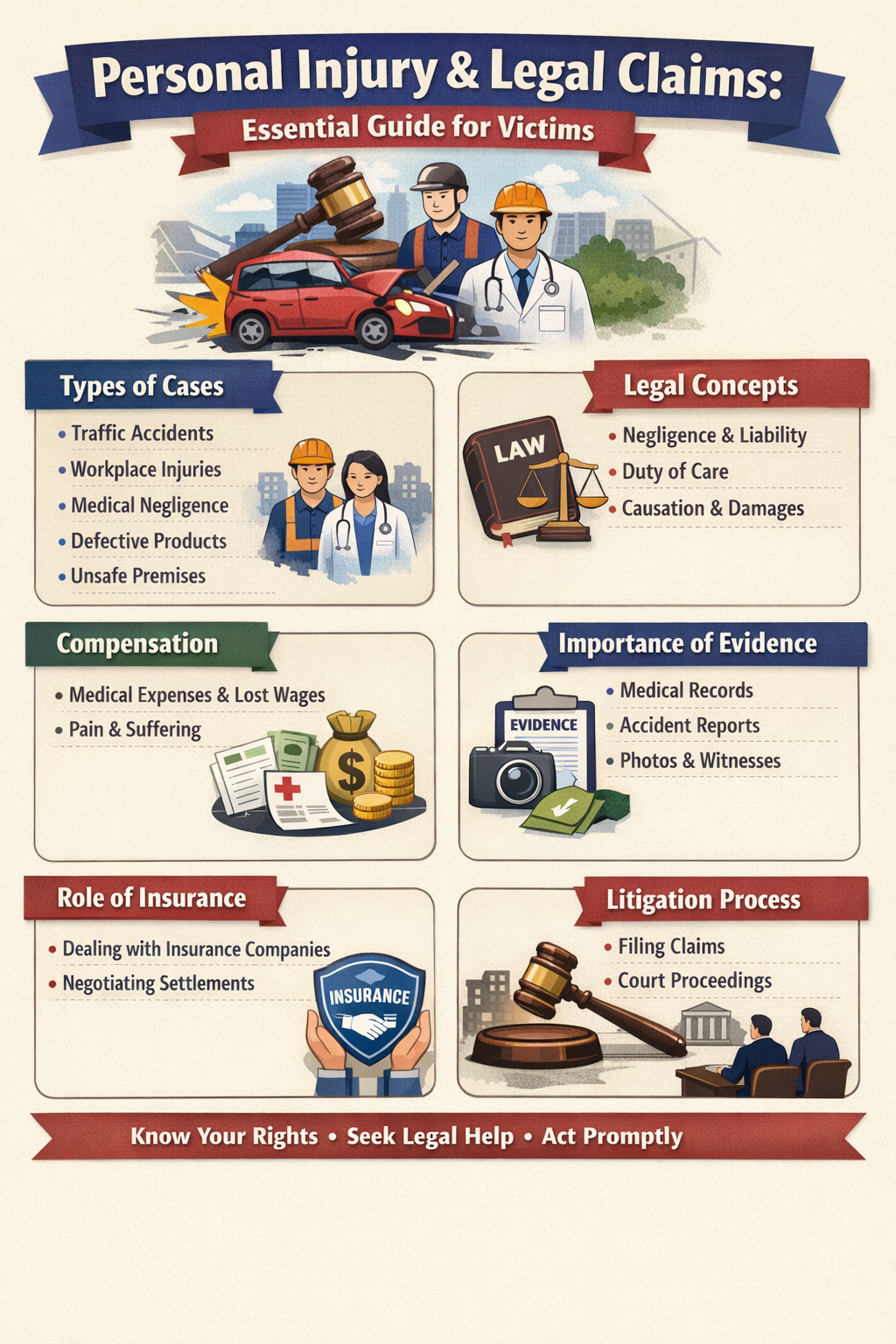
Personal Injury and Legal Claims: A Comprehensive Guide for Victims
Introduction
Personal injuries occur unexpectedly and often alter the course of an individual’s life within moments. Beyond the immediate physical harm, victims frequently endure prolonged emotional distress, psychological trauma, and substantial financial burdens. Medical expenses, loss of income, rehabilitation costs, and diminished earning capacity can create overwhelming hardship. In such circumstances, personal injury law serves as a vital legal mechanism to ensure accountability and provide financial redress.
Personal injury litigation is not merely about monetary compensation; it is fundamentally about restoring dignity, enforcing responsibility, and safeguarding the rights of individuals who have suffered due to another’s negligence or wrongful conduct. A clear understanding of the legal framework governing such claims is therefore essential for victims seeking justice.
I. Legal Concept and Scope of Personal Injury
1. Meaning and Nature of Personal Injury
In legal terms, a personal injury refers to harm caused to an individual’s body, mind, or emotional well-being due to the negligent, reckless, or intentional actions of another party. Unlike property damage claims, which concern material loss, personal injury claims focus on the human impact of the harm — including physical suffering, psychological consequences, and the disruption of daily life.
The injury may be temporary or permanent. It may involve visible physical damage such as fractures and burns, or less visible but equally serious conditions such as trauma, anxiety disorders, or neurological impairments.
2. Foundation in the Doctrine of Negligence
The majority of personal injury claims are grounded in the doctrine of negligence. Negligence arises when a person fails to exercise the standard of care that a reasonable person would have exercised in similar circumstances, thereby causing harm to another.
To successfully establish negligence, the claimant must generally prove the following elements:
-
Existence of Duty of Care: The defendant owed a legal duty to act with reasonable care toward the claimant.
-
Breach of Duty: The defendant failed to meet the required standard of care.
-
Causation: The breach directly caused the injury.
-
Damages: The claimant suffered actual loss or harm as a result.
Failure to establish any of these components may weaken the claim. Therefore, understanding the interplay between duty, breach, causation, and damage is crucial in personal injury litigation.
II. Categories of Personal Injury Claims
Personal injury law encompasses a wide range of situations where individuals suffer harm due to unsafe conduct or conditions.
1. Road Traffic Accidents
Road accidents constitute one of the most common sources of personal injury claims. These cases may involve motorists, pedestrians, cyclists, passengers, or public transport users. Liability may arise due to rash driving, violation of traffic rules, intoxicated driving, or mechanical defects.
Such cases often require examination of police reports, eyewitness statements, CCTV footage, and expert accident reconstruction evidence to establish fault.
2. Workplace Injuries
Employers are legally obligated to provide a safe working environment. Injuries may occur due to hazardous machinery, inadequate safety measures, exposure to toxic substances, or failure to comply with statutory safety regulations.
Workplace injury claims may involve compensation under labour laws, employees’ compensation statutes, or civil negligence actions depending on jurisdictional provisions.
3. Medical Negligence
Medical malpractice arises when healthcare professionals fail to provide treatment in accordance with accepted medical standards. Errors may occur in diagnosis, surgery, prescription of medication, post-operative care, or informed consent procedures.
These claims are often complex and require expert medical testimony to determine whether the standard of care was breached and whether the injury was directly attributable to that breach.
4. Product Liability and Defective Goods
Manufacturers and sellers have a duty to ensure that products placed in the market are reasonably safe. Injuries caused by defective pharmaceuticals, faulty machinery, contaminated food products, or unsafe consumer goods may give rise to product liability claims.
5. Premises Liability and Public Space Injuries
Owners and occupiers of property must ensure that their premises are safe for visitors. Slips and falls, structural collapses, poor maintenance, or inadequate warning signs may result in liability.
Although these categories differ in legal nuances, the central objective remains consistent: establishing accountability and securing fair compensation for the injured party.
III. Compensation and Types of Damages
1. Purpose of Compensation
The primary aim of personal injury law is compensatory in nature. The court seeks to place the victim, as far as money can, in the position they would have been in had the injury not occurred. While financial compensation cannot undo physical harm, it provides practical support and acknowledges the loss suffered.
2. Economic (Special) Damages
Economic damages refer to quantifiable financial losses, including:
-
Medical treatment expenses (past and future)
-
Hospitalization and rehabilitation costs
-
Loss of wages during recovery
-
Loss of future earning capacity
-
Costs of assistive devices or home modifications
These damages are calculated based on documentary evidence such as medical bills, salary records, and expert financial assessments.
3. Non-Economic (General) Damages
Non-economic damages compensate for intangible harm, including:
-
Pain and suffering
-
Emotional distress
-
Loss of enjoyment of life
-
Permanent disability or disfigurement
-
Loss of companionship (in certain cases)
Although these damages are more difficult to quantify, courts consider medical reports, expert testimony, and the severity and duration of suffering.
4. Punitive or Exemplary Damages
In cases involving gross negligence, reckless misconduct, or intentional wrongdoing, courts may award punitive damages. These are not merely compensatory but are intended to punish the wrongdoer and deter similar conduct in the future.
IV. Importance of Evidence in Personal Injury Cases
Evidence forms the backbone of any successful personal injury claim. Without adequate documentation and proof, even legitimate claims may fail.
Victims should preserve:
-
Medical records and diagnostic reports
-
Accident or police reports
-
Photographs or video recordings of injuries and accident scenes
-
Witness statements
-
Correspondence with insurers or liable parties
-
Employment records showing loss of income
Prompt reporting of the incident and immediate medical attention are critical, not only for health reasons but also to establish a clear causal link between the accident and the injury.
V. Role of Insurance in Personal Injury Claims
Insurance companies frequently play a central role in personal injury cases, especially in motor vehicle accidents, workplace incidents, and premises liability claims.
While insurance coverage facilitates compensation, insurers typically aim to minimize payouts. Victims may be offered early settlements that do not fully account for long-term medical needs or future income loss.
Legal representation is therefore significant in negotiating fair settlements, evaluating compensation offers, and ensuring that victims do not unknowingly waive important legal rights.
VI. The Litigation Process
1. Pre-Litigation Stage
Personal injury proceedings generally begin with the issuance of a legal notice or filing of a claim against the responsible party. This stage often involves negotiation and settlement discussions.
A substantial number of cases are resolved at this stage, saving time and litigation costs.
2. Court Proceedings
If settlement efforts fail, the matter proceeds to trial. During litigation:
-
Both parties submit pleadings.
-
Evidence is presented.
-
Witnesses are examined and cross-examined.
-
Legal arguments are advanced.
The court then determines liability and quantifies compensation. Although the process may be lengthy, judicial determination ensures impartial adjudication.
VII. Limitation Periods and Timely Action
Every legal system prescribes limitation periods within which a claim must be filed. Failure to initiate proceedings within the prescribed time may bar the claim entirely, irrespective of its merits.
Since limitation periods vary depending on the nature of the injury and governing statutes, prompt legal consultation is essential. Timely action safeguards legal rights and preserves crucial evidence.
VIII. Challenges Faced by Victims
Victims of personal injury often confront multiple challenges, including:
-
Emotional and psychological stress
-
Financial instability due to loss of income
-
Medical uncertainty regarding recovery
-
Complex legal procedures
-
Negotiating with experienced insurers or corporate defendants
In many instances, financial urgency pressures victims into accepting inadequate settlements. Legal awareness and professional representation can significantly improve outcomes and protect long-term interests.
Conclusion
Personal injury litigation serves as a fundamental pillar of civil justice by holding individuals and entities accountable for negligent or wrongful conduct. It provides a structured legal framework through which victims can seek redress for physical, emotional, and financial harm.
Although compensation cannot erase suffering, it offers financial stability, recognizes the victim’s loss, and reinforces the principle that harm caused by negligence must not go unaddressed. A thorough understanding of legal rights, evidentiary requirements, insurance dynamics, procedural stages, and limitation periods empowers victims to pursue justice with clarity and confidence.
Personal injury law ultimately reflects a broader societal commitment to fairness, responsibility, and the protection of human dignity.
"Unlock the Potential of Legal Expertise with LegalMantra.net - Your Trusted Legal Consultancy Partner”
Disclaimer: Every effort has been made to avoid errors or omissions in this material in spite of this, errors may creep in. Any mistake, error or discrepancy noted may be brought to our notice which shall be taken care of in the next edition In no event the author shall be liable for any direct indirect, special or incidental damage resulting from or arising out of or in connection with the use of this information Many sources have been considered including Newspapers, Journals, Bare Acts, Case Materials , Charted Secretary, Research Papers etc
LegalMantra.net team
Prerna Yadav