
Forget Password

View News
Off-Market Transfer of Shares by Promoters to Non-Promoters in SME Listed Companies
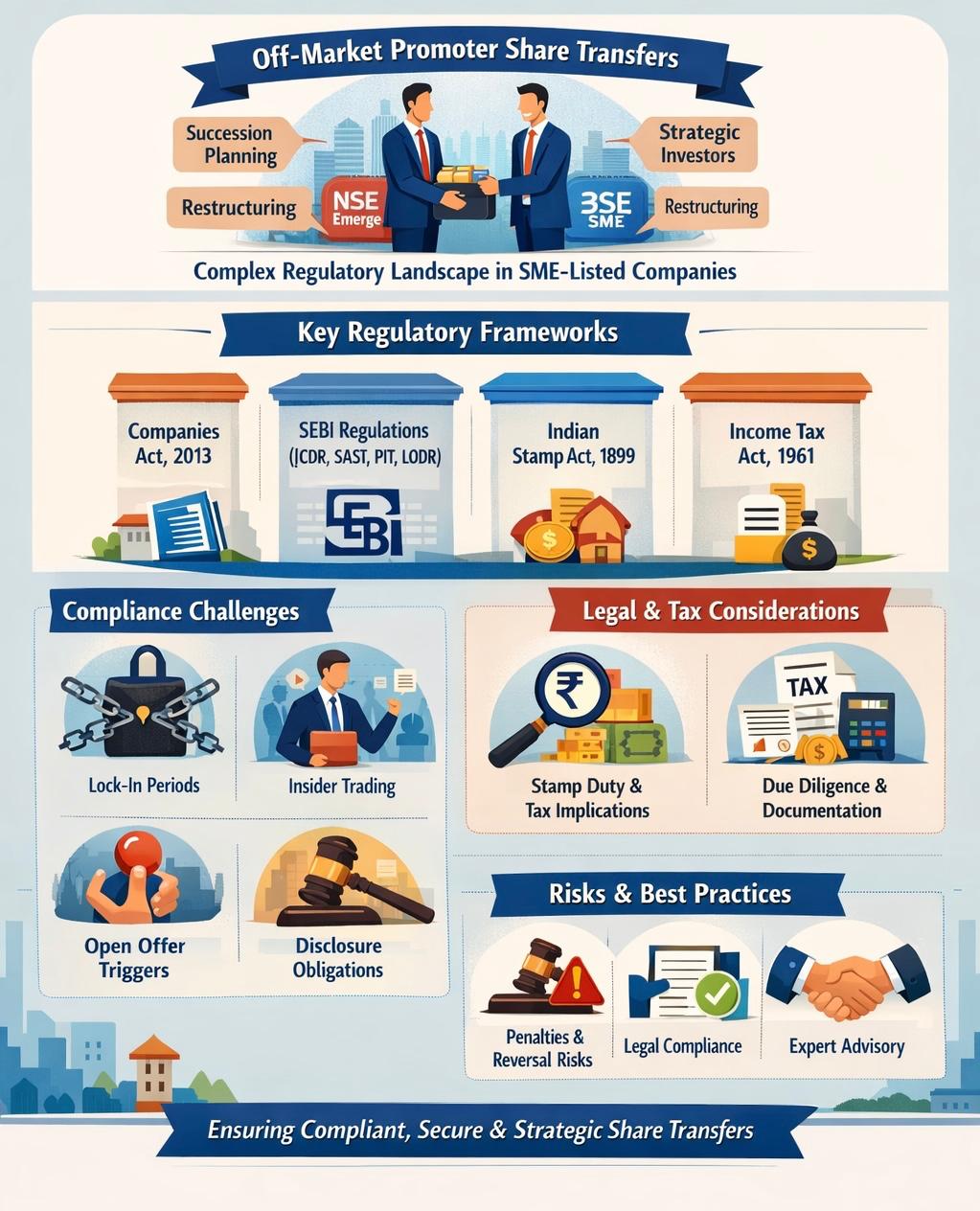
Off-Market Transfer of Shares by Promoters to Non-Promoters in SME Listed Companies:
A Comprehensive Legal, Regulatory and Compliance Analysis
Abstract
The restructuring of promoter shareholding is a common phenomenon in modern capital markets. In India, particularly within the SME listing platforms, promoters frequently consider transferring shares to strategic investors, financial partners, or new stakeholders for business expansion, succession planning, or capital restructuring. Off-market share transfer has emerged as a preferred route for such transactions because it enables direct transfer of securities between parties without routing the transaction through the stock exchange trading system.
Despite its operational simplicity, the transfer of shares outside the exchange mechanism is subject to a complex regulatory architecture comprising the Companies Act, 2013, SEBI regulations, the Income-tax Act, and the Indian Stamp Act. Failure to adhere to these legal requirements may result in regulatory action, including penalties, reversal of transactions, or triggering of open-offer obligations.
This article provides a comprehensive legal analysis of off-market share transfers by promoters to non-promoters in SME-listed companies. It examines the regulatory framework, procedural mechanism, valuation considerations, disclosure requirements, and tax implications, while also highlighting practical compliance considerations.
1. Introduction: Shareholding Restructuring in India’s SME Capital Markets
India’s capital market ecosystem has witnessed significant expansion over the last decade, particularly in the Small and Medium Enterprise (SME) segment facilitated by platforms such as NSE Emerge and BSE SME. These platforms have enabled emerging companies to access capital markets while providing investors with new investment opportunities.
As companies mature after listing, promoters often revisit their ownership structure for strategic reasons. These may include bringing in long-term investors, monetising a portion of promoter holdings, facilitating succession planning, or aligning shareholding structures with evolving business objectives.
One mechanism through which such restructuring can occur is the off-market transfer of shares. An off-market transfer refers to the transfer of securities directly between two parties without executing the trade on a recognised stock exchange. While this method offers flexibility and confidentiality, it must operate within the boundaries of multiple regulatory frameworks designed to ensure market transparency and investor protection.
In SME-listed entities, where promoter shareholding typically remains substantial, such transfers require careful examination of lock-in restrictions, takeover regulations, insider trading restrictions, disclosure requirements, and tax consequences.
2. Regulatory Architecture Governing Off-Market Share Transfers
The legality and procedural validity of promoter share transfers are governed by a combination of corporate law, securities regulation, and tax legislation. These frameworks collectively ensure that share transfers do not undermine investor protection or market integrity.
2.1 Companies Act, 2013
The Companies Act, 2013 establishes the fundamental legal principles governing transferability of shares in Indian companies. Section 56 of the Act prescribes the procedure for transferring securities, including documentation, stamping, and updating the Register of Members.
In a dematerialised securities environment, however, the procedural aspects of transfer are primarily carried out electronically through depositories.
2.2 SEBI Regulatory Framework
The Securities and Exchange Board of India (SEBI) regulates the securities market and imposes multiple compliance obligations that influence promoter share transfers.
Several SEBI regulations become relevant when a promoter intends to transfer shares to a non-promoter investor.
| Regulation | Key Objective | Relevance to Off-Market Transfer |
|---|---|---|
| SEBI (ICDR) Regulations, 2018 | Regulates IPO and lock-in conditions | Determines whether promoter shares are transferable |
| SEBI (SAST) Regulations, 2011 | Governs takeover and acquisition thresholds | May trigger open offer obligations |
| SEBI (PIT) Regulations, 2015 | Prevents trading on UPSI | Restricts transfer during possession of UPSI |
| SEBI (LODR) Regulations, 2015 | Mandates disclosures for listed entities | Requires disclosure of promoter shareholding changes |
2.3 Other Applicable Laws
Additional laws that influence share transfer transactions include:
| Statute | Compliance Aspect |
|---|---|
| Indian Stamp Act, 1899 | Payment of stamp duty on share transfers |
| Income-tax Act, 1961 | Tax implications based on valuation and consideration |
| Depositories Act, 1996 | Governs electronic transfer through depositories |
These regulatory layers create a comprehensive compliance ecosystem that must be carefully navigated.
3. Procedural Mechanism for Dematerialised Share Transfers
India’s securities market has transitioned almost entirely to dematerialised securities, eliminating physical share certificates for listed companies. Consequently, share transfers now occur through electronic instructions within the depository system.
3.1 Initiation of Transfer
When a promoter intends to transfer shares in dematerialised form, the process begins with a transfer instruction issued through the promoter’s Depository Participant (DP). The instruction may be executed either through a Delivery Instruction Slip (DIS) or through online authorisation within the demat account.
The instruction specifies the quantity of shares to be transferred and the details of the recipient’s demat account.
3.2 Role of Depositories and Depository Participants
India operates two recognised depositories:
-
National Securities Depository Limited (NSDL)
-
Central Depository Services Limited (CDSL)
Depository Participants act as intermediaries between investors and these depositories. They maintain demat accounts and execute electronic instructions relating to transfer of securities.
Once the promoter provides the instruction, the DP processes the transaction electronically and the shares are credited to the transferee’s demat account.
3.3 Elimination of Physical Transfer Instruments
Unlike earlier physical share transfers requiring Form SH-4 and physical share certificates, dematerialised transfers are executed entirely through electronic instructions. This system enhances security, reduces documentation, and eliminates risks associated with physical certificates.
3.4 Updating of Ownership Records
Upon successful completion of the transfer, the depository system automatically updates the beneficial ownership records. The company’s Register of Members is updated through data received from the depository, ensuring accuracy and transparency.
4. Lock-in Restrictions under SEBI ICDR Regulations
A crucial legal limitation affecting promoter share transfers arises from the lock-in provisions under the SEBI (Issue of Capital and Disclosure Requirements) Regulations, 2018.
4.1 Minimum Promoter Contribution
Under the ICDR Regulations, promoters must contribute at least 20 percent of the post-issue capital at the time of an Initial Public Offering.
This minimum promoter contribution is subject to a lock-in period of three years from the date of allotment.
4.2 Lock-in of Excess Promoter Shareholding
Promoter shareholding exceeding the minimum contribution is typically locked-in for one year from the date of allotment.
4.3 Implications for Share Transfers
Any attempt to transfer shares that remain under the mandatory lock-in period is prohibited. Depository systems are programmed to reject such transfer instructions automatically.
Therefore, promoters must carefully verify whether the shares proposed to be transferred are outside the lock-in period before initiating any off-market transaction.
5. Takeover Regulations and Open Offer Triggers
The SEBI (Substantial Acquisition of Shares and Takeovers) Regulations, 2011 impose additional obligations where share transfers result in significant changes in ownership.
5.1 Acquisition Threshold
An acquisition of 25 percent or more of the voting rights of a listed company triggers a mandatory open offer obligation. The acquirer must offer to purchase at least 26 percent of shares from public shareholders.
5.2 Creeping Acquisition
An acquirer holding between 25 percent and 75 percent may acquire up to 5 percent additional shares in a financial year without triggering an open offer.
5.3 Disclosure Requirements
Changes in shareholding of 2 percent or more require disclosure to stock exchanges within two working days.
| Transaction Event | Disclosure Requirement |
|---|---|
| Acquisition ?2% shares | Disclosure to stock exchange |
| Disposal ?2% shares by promoter | Disclosure obligation |
| Crossing 25% threshold | Mandatory open offer |
Therefore, promoter transfers must be evaluated carefully to ensure that the transaction does not inadvertently trigger takeover regulations.
6. Insider Trading Regulations and Trading Restrictions
The SEBI (Prohibition of Insider Trading) Regulations, 2015 prohibit trading in securities while in possession of Unpublished Price Sensitive Information (UPSI).
6.1 Applicability to Promoter Transfers
Promoters are typically classified as insiders under the regulations. Therefore, any transfer of shares by promoters must comply with insider trading restrictions.
If a promoter possesses UPSI at the time of transfer, executing an off-market transaction would constitute a violation of the regulations.
6.2 Pre-Clearance and Trading Window
Most listed companies adopt a Code of Conduct that requires designated persons, including promoters and directors, to obtain pre-clearance before executing trades.
Trading is also restricted during designated trading window closure periods.
6.3 Disclosure of Trades
Promoters and designated persons must disclose trades exceeding ?10 lakh in value within two trading days.
| Provision | Requirement |
|---|---|
| Regulation 3 | Restriction on communication of UPSI |
| Regulation 4 | Prohibition of trading while in possession of UPSI |
| Regulation 7(2) | Disclosure of trades exceeding ?10 lakh |
7. Valuation and Pricing Considerations
Unlike preferential allotments or other primary market transactions, secondary market share transfers between residents are generally not subject to mandatory valuation requirements.
However, pricing implications arise under the Income-tax Act.
7.1 Tax Implications for Seller
Under Section 50CA of the Income-tax Act, if shares are transferred at a price lower than their Fair Market Value (FMV), the FMV may be deemed as the full value of consideration for capital gains calculation.
7.2 Tax Implications for Buyer
Section 56(2)(x) provides that if a person acquires shares at a value lower than FMV and the difference exceeds ?50,000, the difference may be taxable as income in the hands of the buyer.
7.3 Flexibility of Pricing
From a securities law perspective, SEBI does not prescribe a minimum or maximum transfer price for off-market transactions.
However, tax provisions effectively discourage substantial deviation from fair market value.
8. Illustrative Case Study
Consider the following hypothetical scenario.
| Particular | Details |
|---|---|
| Company | ABC Tech Ltd |
| Listing Platform | NSE Emerge |
| IPO Date | September 2023 |
| Promoter Holding | 35% |
Out of the promoter’s holding:
| Category | Shares | Lock-in Status |
|---|---|---|
| Minimum Promoter Contribution | 20% | Locked till Sept 2026 |
| Excess promoter holding | 15% | Free after Sept 2024 |
Suppose the promoter proposes to transfer 10 percent shareholding to a strategic investor in September 2025.
Legal evaluation would reveal that the shares proposed for transfer fall outside the lock-in period and therefore may be transferred. However, both the promoter and the investor must make disclosures under the takeover regulations if the change in shareholding exceeds the prescribed threshold.
9. Compliance Roadmap for Off-Market Transfers
A structured compliance approach is essential to avoid regulatory breaches.
| Compliance Step | Relevant Law | Timeline |
|---|---|---|
| Verify lock-in status | SEBI ICDR Regulations | Before transaction |
| Confirm absence of UPSI | SEBI PIT Regulations | Before execution |
| Execute transfer instruction via DP | Depositories Act | On transfer date |
| Pay applicable stamp duty | Indian Stamp Act | At transfer stage |
| Disclose shareholding change | SEBI SAST Regulations | Within 2 working days |
| Report high-value trades | SEBI PIT Regulations | Within 2 trading days |
| Update shareholding pattern | SEBI LODR Regulations | Quarterly |
10. Best Practices for Promoters and Listed Companies
Successful execution of off-market promoter transfers requires careful compliance management.
Promoters should obtain legal advice prior to executing any share transfer transaction to ensure that regulatory restrictions are fully understood. Proper documentation should be maintained for each stage of the transaction, including agreements, disclosures, and regulatory filings.
Listed companies must ensure that their internal compliance systems, including insider trading codes and disclosure mechanisms, are functioning effectively. Continuous monitoring of regulatory updates is also essential, as SEBI frequently modifies disclosure norms and takeover thresholds.
Conclusion
Off-market share transfers from promoters to non-promoters are legally permissible within the Indian regulatory framework. Nevertheless, such transactions are subject to a complex network of corporate, securities, and tax regulations designed to protect investor interests and maintain market transparency.
Promoters and companies must therefore carefully examine lock-in restrictions, takeover thresholds, insider trading limitations, disclosure obligations, and taxation consequences before executing any transaction.
When implemented with appropriate professional guidance and regulatory diligence, off-market transfers can serve as an effective tool for strategic shareholding restructuring in SME-listed companies.
Disclaimer:
This article is intended solely for academic and informational purposes. It should not be construed as professional legal or financial advice. Readers are advised to seek independent professional consultation before acting upon the information contained herein.