
Forget Password

View News
Navigating the Global Frontier: Immigration and Asylum in 2026
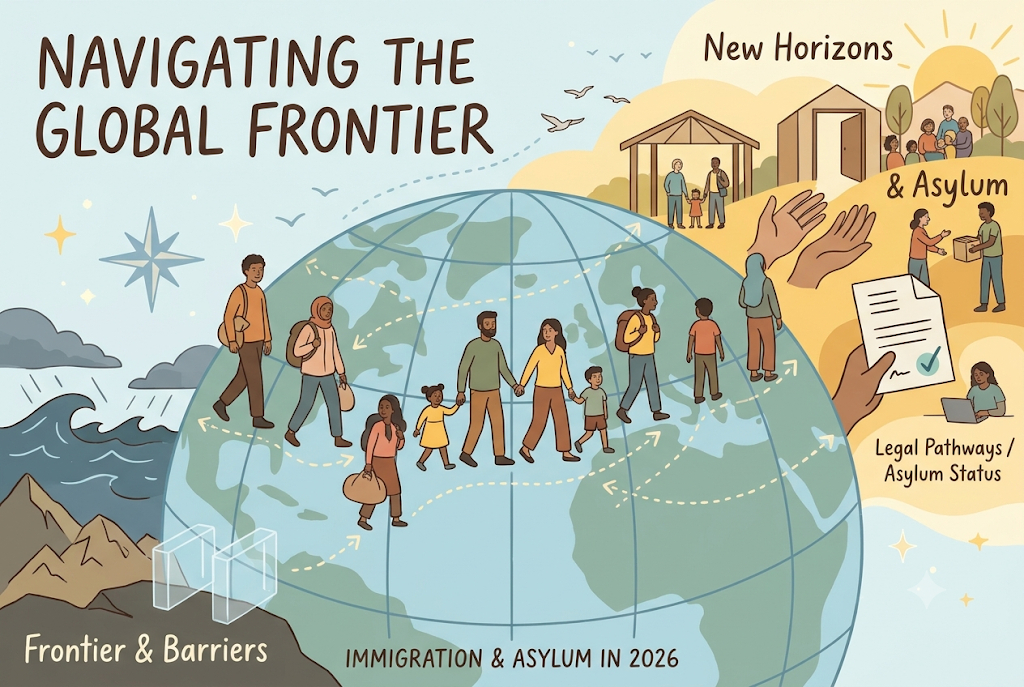
Navigating the Global Frontier: Immigration and Asylum in 2026
~Sura Anjana Srimayi
INTRODUCTION
The year 2026 marks a pivotal moment for global migration and asylum systems. As the world grapples with record-high levels of forced displacement, driven by prolonged conflicts in regions such as Ukraine, Sudan, and the Middle East, the traditional frameworks of international protection are undergoing radical transformation. For over 117 million people forcibly displaced worldwide, the search for safety has become increasingly fraught with political, legal, and technological obstacles. As nations struggle to balance national security with humanitarian obligations, the global landscape of migration is shifting toward tighter border controls, the "externalization" of asylum processes, and a deepening securitization of the refugee experience.
The Geopolitics of Displacement
In 2026, displacement is no longer merely a byproduct of crisis; it is frequently treated as a component of foreign policy. Geopolitical fragmentation and major-power rivalries have normalized the use of displaced populations as bargaining chips, where humanitarian commitments are increasingly tied to political or economic interests.
This "instrumentalization" of migration, where states use the threat or management of migrant flows to exert pressure on neighbors, has prompted a militarized response. From the reinforcement of borders in Eastern Europe to offshore processing centers globally, governments are prioritizing containment over the traditional humanitarian response. Consequently, the cornerstone of international refugee law, the principle of non-refoulement (not returning individuals to a country where they face persecution), is facing unprecedented strain as states seek to prevent migrants from ever reaching their territory.
Regulatory Shifts: The EU Migration Pact
Perhaps the most significant legal development in 2026 is the implementation of the European Union's New Pact on Migration and Asylum, which becomes fully applicable in June. Designed to replace a patchwork of older regulations, the Pact introduces a harmonized, "securitized" approach to asylum across EU Member States.
Key components of this framework include:
- Mandatory Border Screening: All individuals entering illegally are subject to rapid identity, health, and security checks, with data fed into the centralized Eurodac biometric database.
- Accelerated Border Procedures: Applicants deemed unlikely to receive protection are processed in fast-track border facilities, essentially remaining in a legal limbo where they are not considered to have entered the country.
- Solidarity and Responsibility: The Pact attempts to replace the old "Dublin" rules with a new distribution system intended to share the burden of asylum processing more equitably among Member States, though its success remains a subject of intense debate.
The Tech-Surveillance Frontier
As borders become more formidable, technology has become an essential tool for migration governance. In 2026, the use of AI, biometric monitoring, and algorithmic analysis is expanding rapidly. While advocates argue that these tools improve efficiency and case management, critics highlight the "surveillance creep" into the lives of migrants. The overhaul of digital border management systems, such as the EU’s interoperable Entry-Exit System, represents the most advanced effort globally to digitally manage, track, and control migration flows.
Human Impact and the Ethics of Control
Despite these regulatory and technological advancements, the human cost of displacement continues to deepen. The reliance on detention as a primary tool of control, even when it fails to act as an effective deterrent, remains a major point of contention. There is growing global pressure to end the detention of children and to invest in community-based alternatives, which are often found to be more humane and cost-effective.
Furthermore, the focus on securitization often leaves those in need of protection with diminished access to legal counsel and fundamental rights. As humanitarian aid budgets face cuts in several regions, the gap between the legal right to seek asylum and the practical ability to do so continues to widen, leaving millions in transit, in camps, or in precarious urban settlements with little prospect of long-term stability.
CONCLUSION
The landscape of immigration and asylum in 2026 is characterized by a fundamental tension: the clash between an increasingly borderless global crisis and the hardening of national frontiers. While states are developing sophisticated legal and technological frameworks to manage migration, these efforts are often reactive and driven by short-term political expediency rather than long-term humanitarian strategy. As the international community moves forward, the central challenge remains whether systems can evolve to address the root causes of displacement, such as conflict, climate change, and inequality, while upholding the essential human dignity of those forced to seek refuge. The path ahead requires moving beyond the "crisis" narrative and recommitting to an affirmative, protection-based response that views migration not as a security threat to be mitigated, but as a complex human reality that demands compassion and legal consistency.
~Sura Anjana Srimayi