
Forget Password

View News
MCA Approves SFIO Prosecution Against Dalmia Group
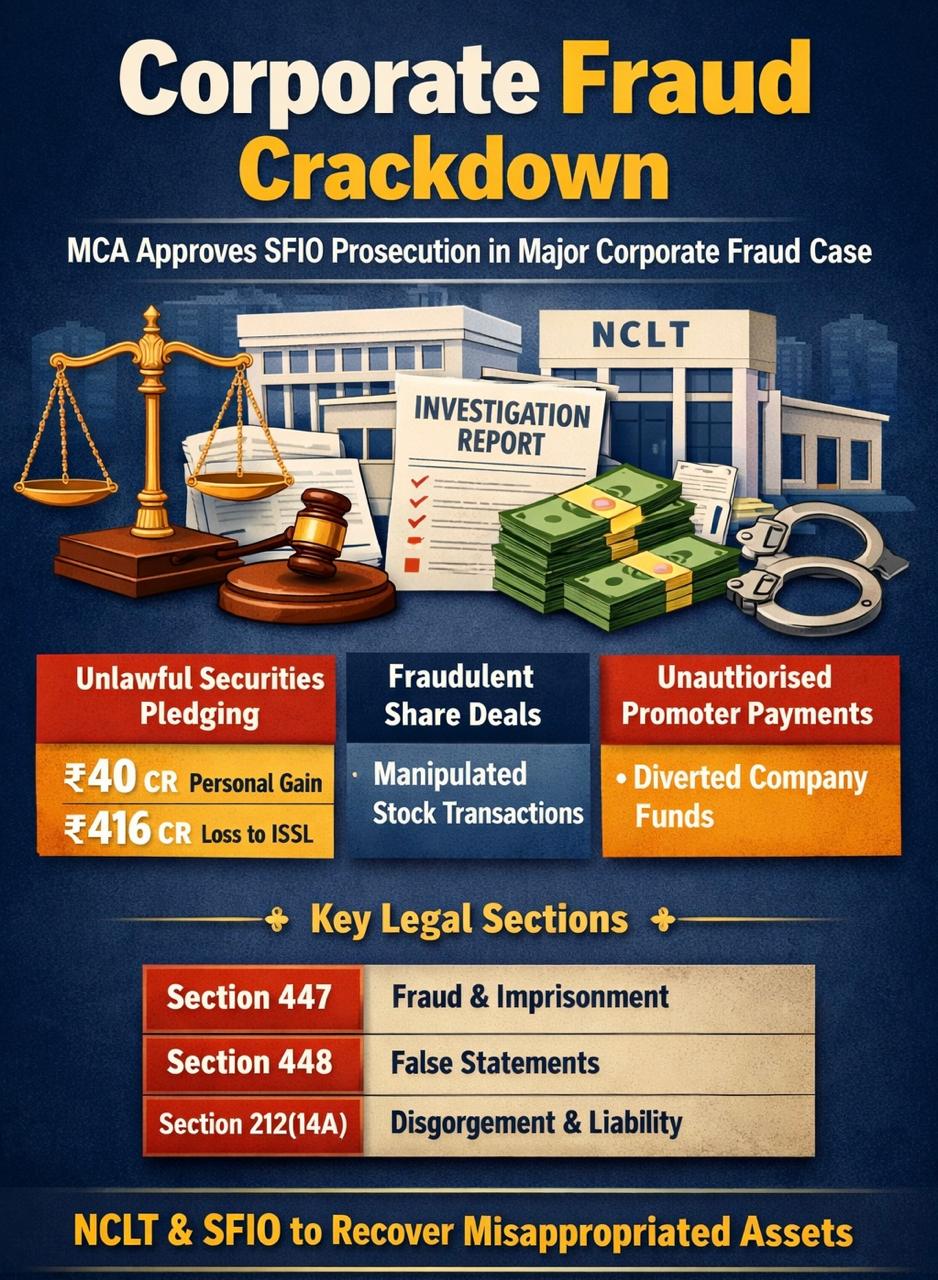
MCA Approves SFIO Prosecution Against Dalmia Group: A Comprehensive Analysis of Corporate Fraud Enforcement under the Companies Act, 2013
1. Introduction
In a significant development in India’s corporate regulatory landscape, the Ministry of Corporate Affairs (MCA) has approved the recommendation of the Serious Fraud Investigation Office (SFIO) to initiate criminal prosecution against several individuals and entities associated with the Dalmia Group. The order, dated 28 January 2026, represents a critical milestone in the enforcement of corporate governance norms and signals the government’s increasing reliance on stringent statutory provisions to address complex financial frauds.
The approval enables SFIO to proceed with prosecution against key individuals including Puneet Yadu Dalmia, Gautam Dalmia and Yadu Hari Dalmia, along with multiple corporate entities forming part of the Dalmia Bharat Group. The allegations span unlawful pledging of securities, manipulation of financial statements, fraudulent share transactions, and unauthorised diversion of funds to promoters.
2. Statutory and Institutional Framework
2.1 Role of SFIO and MCA Approval
The SFIO, constituted under the Companies Act, 2013, is empowered to investigate serious corporate frauds. However, prosecution by SFIO requires prior approval of the Central Government. The MCA’s order serves as the formal sanction enabling SFIO to initiate criminal proceedings before competent courts.
2.2 Multi-Agency Coordination
The MCA has directed that the investigation report be shared with multiple regulatory and enforcement authorities to ensure coordinated action. These include the Securities and Exchange Board of India, Central Bureau of Investigation, National Financial Reporting Authority, National Stock Exchange, Bombay Stock Exchange, National Securities Depository Limited and Central Depository Services Limited. This reflects the interconnected nature of corporate fraud and its impact across regulatory domains.
2.3 Role of NCLT in Civil Recovery
The MCA has further directed SFIO to approach the National Company Law Tribunal under Section 212(14A) of the Companies Act, 2013. This provision empowers the Tribunal to order disgorgement of assets and impose personal liability on directors and officers without limitation, thereby extending the scope of enforcement beyond criminal prosecution to financial restitution.
3. Nature of Allegations and Charges
The MCA order categorises the alleged misconduct into three distinct but interrelated heads, each involving serious violations of corporate law principles.
3.1 Unlawful Pledging of Securities and False Financial Statements
The primary allegation pertains to the unlawful pledging of securities belonging to the Dalmia Bharat Group. The SFIO investigation indicates that such actions resulted in an unlawful gain of approximately ?40 crore to Puneet Yadu Dalmia and a consequential loss of approximately Rs 416 crore to IL&FS Securities Services Limited (ISSL).
In addition to the financial implications, the accused are alleged to have approved financial statements that failed to present a true and fair view of the company’s affairs. This aspect of the allegation directly undermines the credibility of financial reporting and violates core principles of transparency and accountability under corporate law.
The entities implicated under this charge include Dalmia Bharat Limited and Dalmia Cement (Bharat) Limited, along with several associated entities such as Allied Financial Services Pvt Ltd and a network of related companies, suggesting the use of a layered corporate structure.
3.2 Fraudulent Share Transactions
The second category of allegations relates to fraudulent share transactions carried out with the intent of generating unlawful personal gains. These transactions are alleged to have been executed across listed entities, including Dalmia Bharat Sugar and Industries Limited.
Such conduct raises concerns under securities regulation, particularly in relation to market manipulation, insider trading, and abuse of fiduciary position by promoters and directors.
3.3 Unauthorised Payments to Promoters
The third charge involves the routing of unauthorised payments to promoters through orchestrated financial arrangements. The allegations indicate that corporate funds were diverted without proper approvals and routed through multiple channels to benefit promoter entities.
An important dimension of this charge is the invocation of liability against a professional under Section 448 of the Companies Act, highlighting the accountability of certifying professionals in ensuring the accuracy of corporate disclosures.
4. Legal Provisions Invoked
The prosecution is primarily based on stringent provisions of the Companies Act, 2013, which are summarised below:
| Section | Provision | Key Implications |
|---|---|---|
| Section 447 | Punishment for Fraud | Provides for imprisonment and severe financial penalties, including unlimited fines |
| Section 448 | Punishment for False Statements | Applies to false declarations in financial statements and reports |
| Section 212(14A) | Disgorgement and Liability | Enables recovery of unlawful gains and imposition of personal liability |
The combined application of these provisions reflects a comprehensive enforcement strategy addressing both criminal culpability and financial recovery.
5. Recognition of Victim and Financial Impact
A notable feature of the MCA order is the explicit recognition of IL&FS Securities Services Limited as a victim of the alleged fraud. The loss of Rs 416 crore attributed to the unlawful pledging of securities is central to the enforcement action.
Given the historical financial distress faced by the IL&FS group, recovery of these funds assumes particular significance for creditors and stakeholders. The direction to pursue disgorgement indicates a clear intent to prioritise restitution.
6. Modus Operandi and Corporate Structuring
The investigation suggests that the alleged fraud was executed through a complex network of interconnected entities, including financial service providers, technology companies, and real estate-linked firms. Such structuring indicates a deliberate attempt to route transactions through multiple layers, thereby complicating detection and regulatory scrutiny.
This approach is consistent with patterns observed in sophisticated corporate frauds, where related-party transactions and shell entities are used to obscure the flow of funds.
7. Broader Implications for Corporate Governance
The present case has far-reaching implications for corporate governance and regulatory enforcement in India.
Firstly, it reinforces the principle that directors and key managerial personnel may be held personally liable for fraudulent conduct, thereby strengthening accountability. Secondly, it underscores the importance of maintaining the integrity of financial statements, as any deviation from the “true and fair view” standard may attract severe consequences. Thirdly, it highlights the expanding scope of liability for professionals, including company secretaries and auditors, who play a critical role in corporate compliance.
Additionally, the involvement of multiple regulatory agencies demonstrates an integrated approach to enforcement, ensuring that violations are addressed comprehensively across legal and financial domains.
8. Conclusion
The MCA’s approval of SFIO’s prosecution recommendation in the Dalmia Group case represents a landmark development in India’s corporate enforcement regime. By combining criminal prosecution with civil recovery mechanisms and multi-agency coordination, the government has signalled a strong commitment to combating corporate fraud.
The proceedings before courts and the National Company Law Tribunal will be closely watched, as they are likely to set important precedents regarding the interpretation of fraud provisions, the scope of director liability, and the enforcement of financial reporting standards. Ultimately, the case serves as a reminder of the critical importance of transparency, accountability, and ethical conduct in corporate governance.
Unlock the Potential of Legal Expertise with LegalMantra.net – Your Trusted Legal Consultancy Partner
Disclaimer
Every effort has been made to ensure accuracy in this material. However, inadvertent errors or omissions may occur. Any discrepancies brought to the author’s notice will be rectified in subsequent editions. The author shall not be liable for any direct, indirect, incidental, or consequential damages arising from the use of this material. This article is based on various sources including statutory enactments, judicial decisions, academic research papers, professional journals, and publicly available legal materials.
Mayank Garg