
Forget Password

View News
Maritime Governance and the Right to Freedom of Navigation
Maritime Governance and the Right to Freedom of Navigation
Throughout history, the oceans have been the main conduits for international trade, communication, and cultural interchange. The seas have facilitated international cooperation and economic growth, from ancient maritime routes to contemporary commercial lanes. But the seas' vastness and lack of borders have also led to complicated legal issues with relation to jurisdiction, resource extraction, and vessel mobility. The United Nations Convention on the Law of the Sea (UNCLOS), sometimes known as the "constitution of the oceans," is the main source of the current framework controlling marine activity. The notion of freedom of navigation, which guarantees that ships of all governments may navigate international waters without excessive interference, is one of the most important tenets developed under this regime.
Historical Development of the Freedom of the Seas
The idea of freedom of navigation can be traced back to early international legal thought. In the seventeenth century, the Dutch jurist Hugo Grotius articulated the concept of mare liberum or “free seas,” arguing that the oceans could not be appropriated by any single nation and should remain open for all states to use. This principle emerged as a response to maritime powers that attempted to monopolize sea routes and colonial trade.
As maritime trade increased throughout time, the idea of freedom of the seas became more widely accepted. But coastal states also claimed more authority over adjacent waters for resource management and security. A complete legal framework governing maritime zones was finally developed as a result of striking a compromise between these conflicting interests, and UNCLOS was adopted in 1982.
The Legal Framework of UNCLOS
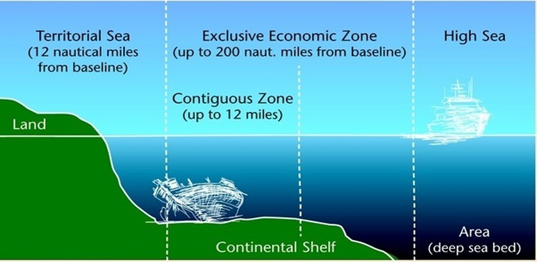
The ocean is divided into various maritime zones, each with unique rights and responsibilities, according to the United Nations Convention on the Law of the Sea. These areas consist of the high seas, continental shelf, exclusive economic zone (EEZ), territorial sea, and contiguous zone.
The state exercises sovereignty in the territorial sea, which is up to 12 nautical miles from a coastal state's baseline, in a manner akin to that of its land territory. Nonetheless, even within this zone, foreign ships are entitled to "innocent passage," which allows them to sail through as long as their operations do not jeopardize the coastal state's peace, security, or good order.
The Exclusive Economic Zone is located up to 200 nautical miles from the baseline, beyond the territorial sea. The coastal state has sovereign rights to explore and exploit natural resources within the EEZ. However, other states continue to enjoy significant liberties, such as overflight, navigation, and the installation of pipelines and submarine cables. These liberties uphold the essential idea that international seas must continue to be usable by all.
Lastly, the freedom of the seas principle governs the high seas, which are outside sovereign borders. All states have equal rights to conduct scientific study, fish, navigate, and install communication lines in these regions, regardless of whether they are landlocked or coastal. No state has the right to assert its sovereignty over any area of the high seas.
Freedom of Navigation as a Pillar of Global Trade
For the global economy to function, freedom of navigation is essential. Maritime routes are crucial to the supply networks of contemporary commerce since they carry around 90% of all worldwide goods. International trade would be susceptible to arbitrary limitations imposed by coastal nations in the absence of a globally acknowledged right of passage.
Additionally, this principle guarantees that commercial and naval ships can operate equally throughout the world's oceans. International maritime law promotes economic cooperation and lessens the possibility of disputes over marine transportation by establishing stability and predictability.
Contemporary Challenges to Freedom of Navigation
The concept of freedom of navigation still faces difficulties in modern geopolitics, notwithstanding the legal certainty offered by UNCLOS. Tensions between states are frequently caused by disagreements over resource-rich areas, important waterways, and maritime borders. For instance, disputes over navigational rights and conflicting territorial claims have centered on the South China Sea. Some coastal governments claim to have broad interpretations of their authority, which other states contend could limit legal navigation.
In a similar vein, strategically significant narrow marine chokepoints like the Straits of Hormuz and Malacca are crucial. These rivers are essential routes for international trade, especially when it comes to the movement of energy resources. There could be serious geopolitical and economic repercussions from any disruption or restriction of navigation in these areas.
Security issues, such as illegal trafficking, marine terrorism, and piracy, present another difficulty. In order to combat these dangers, coastal states occasionally defend more stringent maritime mobility regulations. International law mandates that security measures be applied in a way that respects established navigational freedoms, even though they are necessary.
Judicial and Arbitral Developments
The interpretation of UNCLOS laws and the clarification of navigational rights have been greatly aided by international tribunals and arbitration procedures. The Permanent Court of Arbitration's ruling in the Philippines v. China South China Sea Arbitration (2016) is a noteworthy example. The tribunal determined that several maritime claims and actions in the South China Sea violated UNCLOS. The decision upheld the more general idea that international maritime law controls how oceans are used, even though it mainly dealt with questions of maritime entitlements and environmental obligations.
These rulings show how crucial legal procedures are to settling conflicts amicably and maintaining the rule of law in international waters.
Balancing Coastal Sovereignty and Global Commons
The central challenge of the law of the sea lies in balancing the legitimate interests of coastal states with the collective interests of the international community. Coastal states understandably seek to protect their security and economic resources, while the global community depends on unrestricted maritime transit.
UNCLOS attempts to strike this balance by recognizing both sovereign rights and international freedoms. The doctrine of innocent passage, transit passage through straits used for international navigation, and freedoms within the EEZ all reflect efforts to reconcile national authority with global mobility.
Furthermore, environmental protection has emerged as a critical component of maritime governance. States are increasingly required to ensure that navigational activities do not cause marine pollution or damage fragile ecosystems. Thus, freedom of navigation must be exercised responsibly and in accordance with international environmental obligations.
Conclusion
One of the most extensive and well recognized systems of international law is the law of the sea. The United Nations Convention on the Law of the Sea has given ocean governance a solid legal basis by outlining governments' rights and obligations and establishing distinct maritime zones. Within this context, freedom of navigation continues to be a fundamental tenet that upholds international cooperation, supports international trade, and protects the oceans as a common human resource.
As geopolitical tensions, environmental concerns, and technological advancements continue to reshape maritime activity, the principles embodied in UNCLOS will remain essential for maintaining order on the world’s oceans. Upholding freedom of navigation while respecting the rights of coastal states will be crucial to ensuring that the seas continue to serve as a domain of peaceful and lawful interaction among nations.
Unlock the Potential of Legal Expertise with LegalMantra.net – Your Trusted Legal Consultancy Partner
Disclaimer
Every effort has been made to ensure accuracy in this material. However, inadvertent errors or omissions may occur. Any discrepancies brought to the author’s notice will be rectified in subsequent editions. The author shall not be liable for any direct, indirect, incidental, or consequential damages arising from the use of this material. This article is based on various sources including statutory enactments, judicial decisions, academic research papers, professional journals, and publicly available legal materials.
Prerna Yadav
LegalMantra.net Team