
Forget Password

View News
Legal Validity of DigiLocker and mParivahan Documents under Motor Vehicles Law
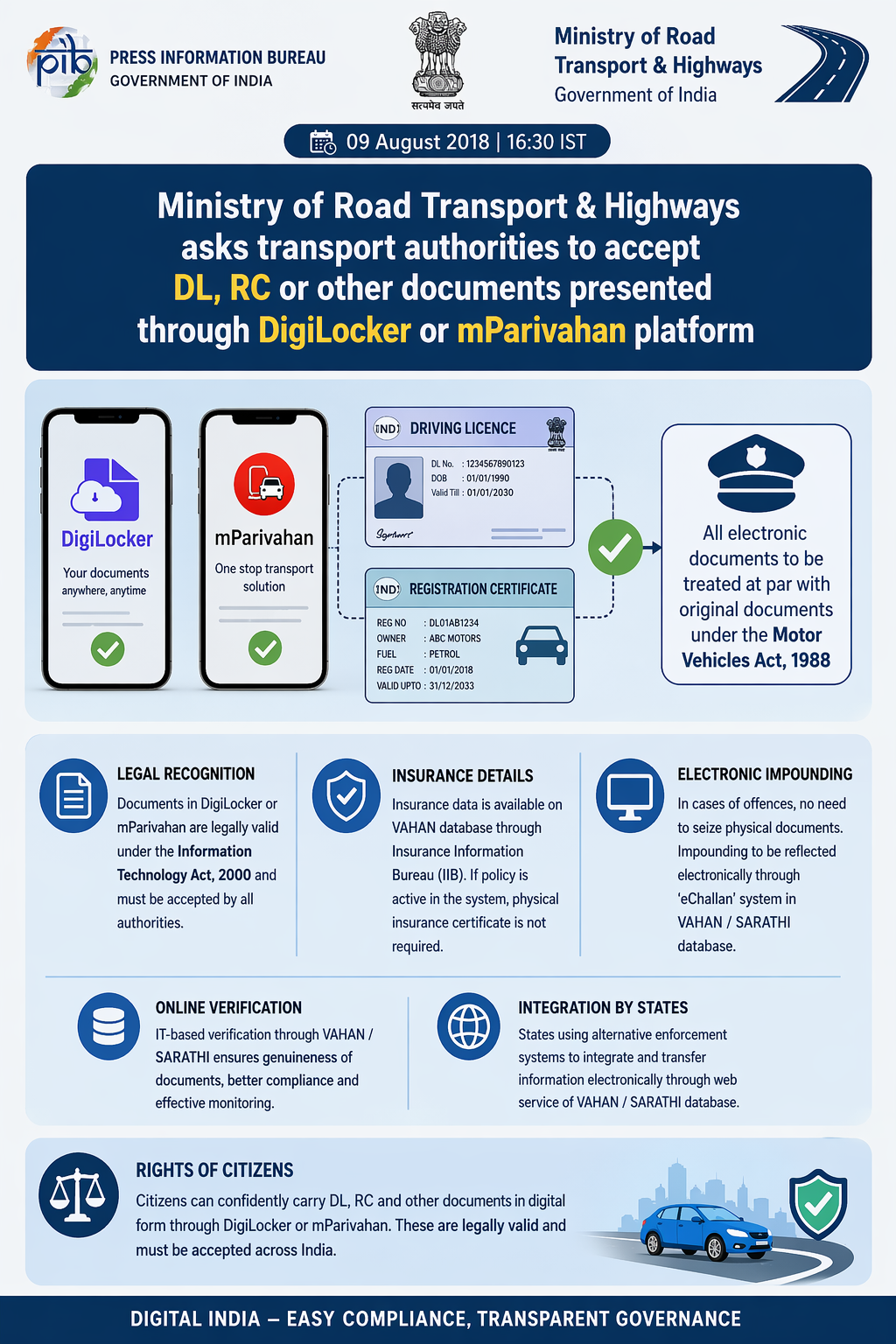
Legal Validity of DigiLocker and mParivahan Documents under Motor Vehicles Law
1.0 Introduction
The rapid digitisation of governance in India has significantly transformed the manner in which citizens interact with regulatory authorities. One such major reform pertains to the acceptance of electronic documents in place of physical copies for motor vehicle compliance. In this regard, the Press Information Bureau issued a clarification on 09 August 2018 under the aegis of the Ministry of Road Transport & Highways, addressing concerns regarding the validity of documents stored in digital platforms such as DigiLocker and mParivahan.
This advisory holds substantial legal importance, particularly in the context of enforcement under the Motor Vehicles Act, 1988 and the Information Technology Act, 2000.
2.0 Background and Regulatory Concern
2.1 A number of grievances and RTI applications were received by the Ministry highlighting that traffic enforcement authorities were not accepting digital versions of key documents such as Driving Licence (DL) and Registration Certificate (RC).
2.2 Despite the availability of authenticated digital records through government-backed platforms, citizens were often penalised or required to produce physical documents, leading to legal ambiguity and inconvenience.
3.0 Legal Recognition of Electronic Documents
3.1 The advisory explicitly clarifies that documents such as Driving Licence, Registration Certificate, and other transport-related certificates presented through DigiLocker or mParivahan are legally valid.
3.2 Such electronic documents are deemed equivalent to original physical documents by virtue of provisions under the Information Technology Act, 2000, which grants legal recognition to electronic records.
3.3 Consequently, enforcement authorities are obligated to treat digitally presented documents at par with physical copies under the Motor Vehicles Act, 1988 and the Central Motor Vehicles Rules, 1989.
4.0 Integration with VAHAN and SARATHI Databases
4.1 The Government has integrated transport-related data into centralised databases, namely:
- VAHAN – Vehicle Registration Database
- SARATHI – Driving Licence Database
4.2 These databases enable real-time access and verification of vehicle and driver-related information through platforms like mParivahan and eChallan systems.
4.3 The digitisation ensures transparency, reduces document fraud, and enhances administrative efficiency.
5.0 Insurance Data and Compliance Relaxation
5.1 The advisory further highlights that insurance data is being updated regularly by the Insurance Information Bureau in the VAHAN database.
5.2 Where insurance details are available and valid in the system, the requirement to produce a physical insurance certificate stands waived.
5.3 This provision reduces compliance burden and aligns with the broader objective of paperless governance.
6.0 Electronic Impounding through eChallan System
6.1 In cases where documents are required to be impounded due to offences, the advisory introduces a significant procedural reform.
6.2 Instead of physically seizing documents, enforcement authorities may record such impounding electronically through the eChallan system.
6.3 The status of impounded documents is reflected in the VAHAN/SARATHI database, thereby eliminating the need for physical custody of documents.
7.0 Implications for Enforcement Authorities
7.1 Enforcement agencies are required to adopt digital verification mechanisms and refrain from insisting on physical documents where electronic versions are available.
7.2 States using independent enforcement systems are directed to integrate with VAHAN/SARATHI databases through web services to ensure uniformity and interoperability.
8.0 Practical Impact on Citizens
8.1 Citizens are now legally empowered to carry transport-related documents in digital form without the risk of penal action.
8.2 The initiative promotes ease of compliance, reduces administrative friction, and supports the Government’s Digital India mission.
9.0 Conclusion
The 2018 advisory marks a crucial step towards digitisation of transport compliance in India. By granting legal validity to electronic documents stored in DigiLocker and mParivahan, the Government has not only simplified regulatory processes but also strengthened transparency and accountability in enforcement.
The move aligns with evolving technological frameworks and reinforces the legal sanctity of electronic governance under Indian law. However, effective implementation depends on awareness and strict adherence by enforcement authorities across all states.
(For Detailed Reference)
Official PIB Release dated 09 August 2018.
Unlock the Potential of Legal Expertise with LegalMantra.net – Your Trusted Legal Consultancy Partner
Disclaimer
Every effort has been made to ensure accuracy in this material. However, inadvertent errors or omissions may occur. Any discrepancies brought to the author’s notice will be rectified in subsequent editions. The author shall not be liable for any direct, indirect, incidental, or consequential damages arising from the use of this material. This article is based on various sources including statutory enactments, judicial decisions, academic research papers, professional journals, and publicly available legal materials.
Anshul Goel
LegalMantra.net Team