
Forget Password

View News
Legal Battles Against Illegal, Unreported, and Unregulated Fishing
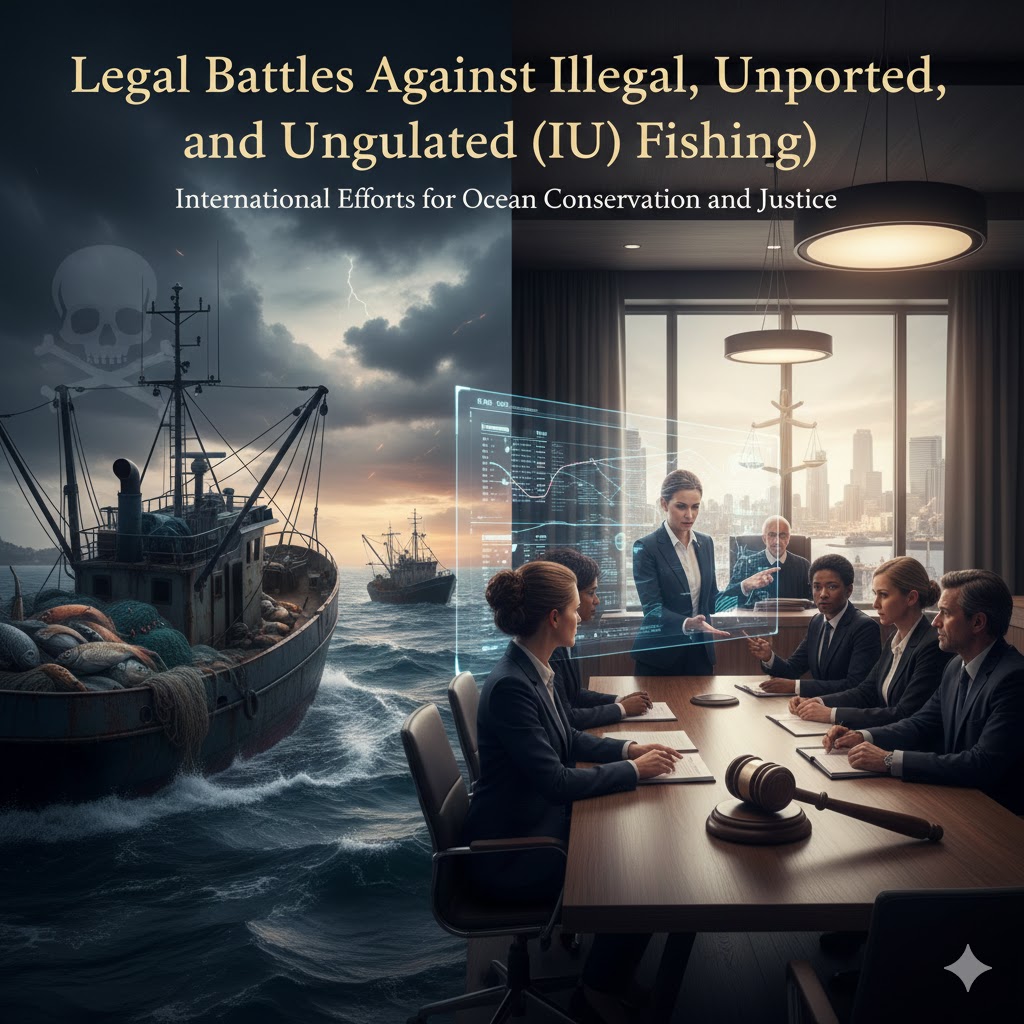
Legal Battles Against Illegal, Unreported, and Unregulated (IUU) Fishing
~ Sura Anjana Srimayi
INTRODUCTION
Illegal, Unreported, and Unregulated (IUU) fishing represents one of the gravest threats to global marine sustainability, food security, and the livelihoods of coastal communities. It undermines conservation efforts, distorts fair competition in seafood markets, and deprives states of vital revenue. Estimates suggest that IUU fishing causes annual global economic losses ranging between USD 10 billion and USD 23.5 billion, while accelerating the depletion of already vulnerable fish stocks.
The battle against IUU fishing is no longer confined to patrol vessels on the high seas. It has increasingly shifted to courtrooms, international tribunals, port authorities, customs offices, and diplomatic forums. Through a complex interaction of domestic laws, international treaties, and institutional enforcement mechanisms, states are engaging in sustained legal struggles to curb this transnational maritime crime. This article examines the legal framework governing IUU fishing, key enforcement battlegrounds, landmark disputes, and the evolving role of international adjudicatory bodies.
I. UNDERSTANDING IUU FISHING: CONCEPT AND CLASSIFICATION
The term Illegal, Unreported, and Unregulated fishing encompasses three distinct yet often overlapping categories:
1. Illegal Fishing
Illegal fishing refers to activities conducted in violation of national laws or international obligations. These include:
-
Fishing without a valid licence or authorisation;
-
Fishing in closed areas or during prohibited seasons;
-
Use of banned fishing gear or methods;
-
Fishing in another state’s Exclusive Economic Zone (EEZ) without consent.
Such activities directly infringe coastal state sovereignty and international conservation measures.
2. Unreported Fishing
Unreported fishing involves catches that are not reported or are misreported to relevant national authorities or Regional Fisheries Management Organisations (RFMOs). Underreporting undermines stock assessments, disrupts quota systems, and compromises sustainable fisheries management.
3. Unregulated Fishing
Unregulated fishing occurs in areas or for fish stocks where no applicable conservation or management measures exist, or where vessels operate in a manner inconsistent with international obligations. This includes fishing by vessels flying the flag of non-member states of RFMOs in regulated areas.
II. INTERNATIONAL LEGAL FRAMEWORK GOVERNING IUU FISHING
1. United Nations Convention on the Law of the Sea (UNCLOS)
UNCLOS forms the foundational legal regime governing maritime activities. It establishes:
-
Sovereign rights of coastal states over living resources within their EEZs (Articles 56 and 61);
-
Duties of flag states to effectively exercise jurisdiction and control over vessels flying their flag (Article 94);
-
Obligations of states to cooperate in the conservation of marine living resources (Articles 117–119).
UNCLOS thus provides both jurisdictional authority and due diligence obligations critical to combating IUU fishing.
2. UN Fish Stocks Agreement (UNFSA)
The UNFSA supplements UNCLOS by strengthening conservation and management measures for straddling and highly migratory fish stocks. It enhances compliance through:
-
Compatibility of conservation measures;
-
Strengthened flag state responsibility;
-
Compliance and enforcement mechanisms through RFMOs.
3. FAO Compliance Agreement
This agreement focuses on flag state responsibility, requiring states to ensure that vessels flying their flag do not undermine international conservation measures.
4. Agreement on Port State Measures (PSMA)
The Agreement on Port State Measures, which entered into force in 2016, is the most significant contemporary legal instrument targeting IUU fishing. It seeks to deny IUU-caught fish access to global markets by:
-
Mandating prior notification and authorisation before port entry;
-
Standardising inspection procedures;
-
Facilitating information sharing between states.
By shifting enforcement from the high seas to ports, the PSMA provides a cost-effective and legally robust mechanism to disrupt IUU fishing operations.
III. LEGAL BATTLEGROUNDS IN THE FIGHT AGAINST IUU FISHING
1. Coastal State Jurisdiction and Enforcement Actions
Coastal states exercise sovereign rights over marine living resources within their EEZs up to 200 nautical miles. Legal disputes often arise when foreign-flagged vessels are apprehended for illegal fishing activities. Key legal questions involve:
-
The legality of vessel seizure;
-
Application of the right of hot pursuit;
-
Proportionality of penalties imposed.
Case Study: The Silver Sea 2
In 2015, Indonesian authorities seized the Thai-flagged vessel Silver Sea 2, a large refrigerated cargo vessel accused of facilitating illegal transshipment and disabling its Vessel Monitoring System (VMS). The Indonesian courts upheld stringent enforcement measures, including the proposed destruction of the vessel, underscoring Indonesia’s aggressive stance against IUU fishing. The case exemplifies the assertion of coastal state jurisdiction and the use of deterrent sanctions within the bounds of national and international law.
2. Flag State Responsibility and the Challenge of Flags of Convenience
Under UNCLOS, flag states bear primary responsibility for ensuring compliance of their vessels with international fisheries regulations. However, the widespread use of Flags of Convenience (FOCs)—registration in states with weak enforcement mechanisms—poses a significant legal challenge.
Legal strategies to address this issue include:
-
RFMO-maintained IUU vessel blacklists;
-
Diplomatic pressure on flag states to deregister non-compliant vessels;
-
Advisory opinions clarifying the scope of flag state due diligence obligations.
Judicial and quasi-judicial forums increasingly emphasise that flag state responsibility is not merely formal but requires effective control and enforcement.
3. Market State Measures and Supply Chain Accountability
Market-based legal tools have become a critical front in combating IUU fishing. Major seafood-importing jurisdictions, including the European Union and the United States, have implemented stringent catch documentation and traceability requirements.
Legal disputes in this domain commonly involve:
-
Trade restrictions or import bans on non-cooperating states;
-
Prosecution of importers for falsification of catch certificates and shipping documents;
-
Establishing legal causation between illegal harvesting and downstream commercial transactions.
These measures aim to dismantle the economic incentives sustaining IUU fishing by targeting its profitability.
IV. ROLE OF INTERNATIONAL TRIBUNALS AND JUDICIAL PRECEDENTS
1. International Tribunal for the Law of the Sea (ITLOS)
ITLOS has played a pivotal role in clarifying state rights and obligations in fisheries enforcement. In cases such as M/V Virginia G, the Tribunal affirmed the regulatory authority of coastal states within their EEZs.
2. Advisory Opinions and Flag State Obligations
ITLOS advisory opinions have reinforced the principle that flag states must exercise effective control over vessels flying their flag, particularly concerning conservation and management of marine living resources. These opinions strengthen the legal basis for holding flag states internationally accountable.
CONCLUSION
The legal battle against Illegal, Unreported, and Unregulated fishing is complex, multi-layered, and inherently transnational. While international instruments such as the PSMA signify a decisive shift towards coordinated enforcement and market denial strategies, persistent challenges remain. Flag-hopping, opaque vessel ownership structures, and the involvement of organised criminal networks continue to test the limits of legal enforcement.
Although prosecutions against individual vessels yield important symbolic and practical victories, lasting success requires sustained political will, judicial cooperation among states, and consistent implementation of international obligations. Only through the rigorous and coordinated application of law—from port inspections to international tribunal rulings—can the global community effectively confront and ultimately reverse the destructive impact of IUU fishing on the world’s oceans.
"Unlock the Potential of Legal Expertise with LegalMantra.net - Your Trusted Legal Consultancy Partner”
Disclaimer: Every effort has been made to avoid errors or omissions in this material in spite of this, errors may creep in. Any mistake, error or discrepancy noted may be brought to our notice which shall be taken care of in the next edition In no event the author shall be liable for any direct indirect, special or incidental damage resulting from or arising out of or in connection with the use of this information Many sources have been considered including Newspapers, Journals, Bare Acts, Case Materials , Charted Secretary, Research Papers etc