
Forget Password

View News
Juvenile Delinquency: Legal Responses to Youth Crime
Juvenile Delinquency: Legal Responses to Youth Crime
Introduction
Juvenile delinquency refers to criminal or antisocial conduct committed by children below the age of eighteen years. It includes a broad spectrum of unlawful acts ranging from theft, assault, vandalism, drug-related offences, and cybercrime to serious offences such as sexual assault and homicide. Over the last decade, juvenile delinquency has emerged as one of the most debated issues in criminal jurisprudence due to the increasing involvement of minors in organized crime, cyber offences, and violent crimes. This rise has compelled legislators, courts, and policymakers to reassess the balance between protecting society and safeguarding the rights of children.
The philosophy underlying juvenile justice differs fundamentally from that of the adult criminal justice system. While adults are primarily subjected to punitive measures aimed at deterrence and retribution, juvenile justice recognizes that children possess greater potential for emotional, psychological, and behavioural reform. Modern legal systems acknowledge that juveniles often commit offences due to environmental influences rather than inherent criminal tendencies. Consequently, the focus shifts from punishment to rehabilitation, counselling, education, and reintegration into society.
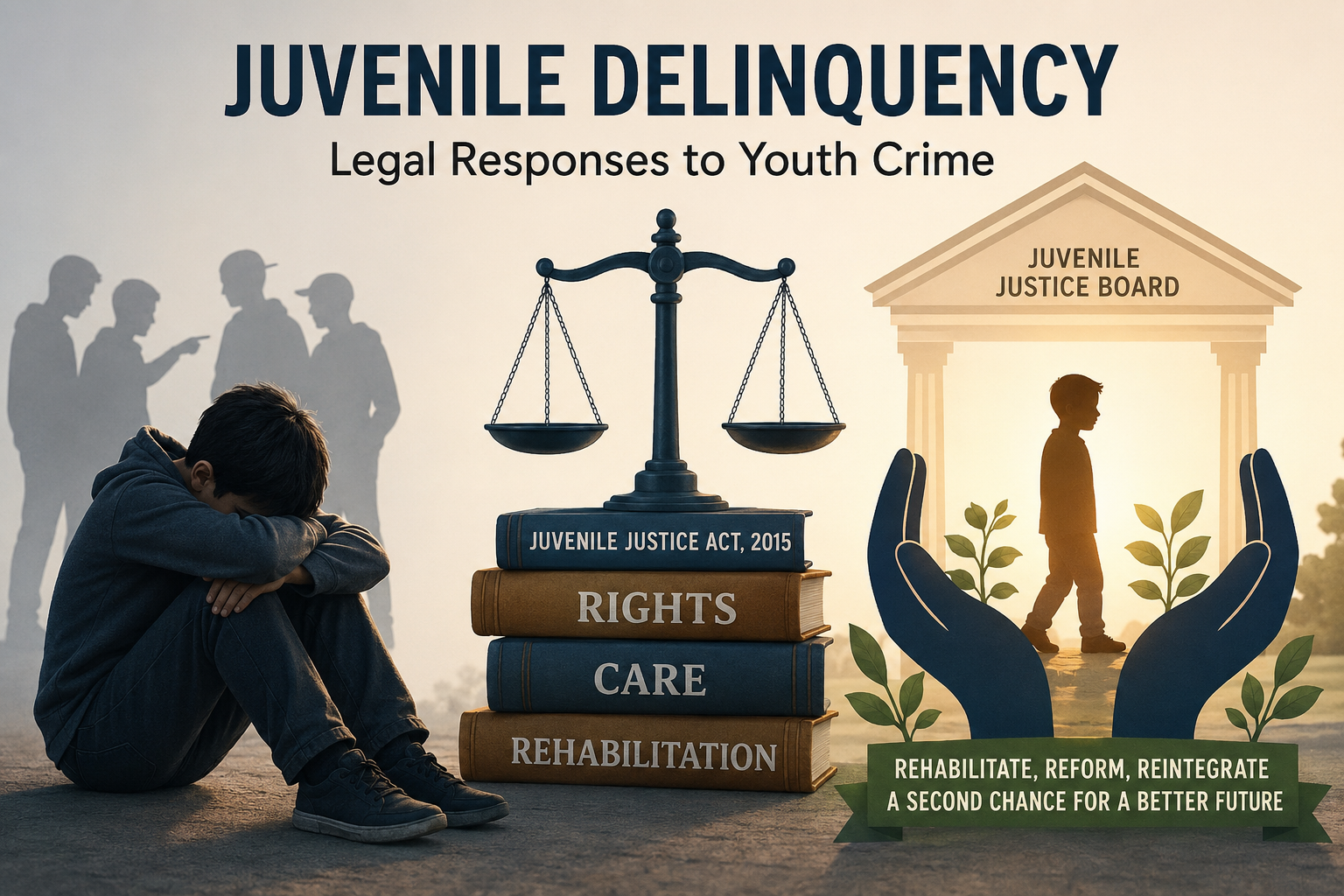
India has adopted this reformative approach through the Juvenile Justice (Care and Protection of Children) Act, 2015, which seeks to ensure that every child in conflict with law receives an opportunity to reform while simultaneously maintaining public confidence in the justice delivery system. However, the increasing involvement of juveniles in heinous crimes has also prompted debates regarding accountability, victim rights, and the appropriate age for criminal responsibility.
Understanding Juvenile Delinquency
Juvenile delinquency is not merely a legal issue but also a complex social, psychological, and economic phenomenon. The expression "child in conflict with law" under the Juvenile Justice Act refers to a person who has not completed eighteen years of age on the date of commission of an alleged offence. The terminology itself reflects the reformative philosophy of the legislation by avoiding labels such as "criminal" or "offender," thereby reducing social stigma.
Unlike adult offenders, juvenile delinquents are viewed as individuals whose behaviour has often been shaped by adverse circumstances, including dysfunctional family environments, poverty, lack of education, peer influence, or psychological trauma. Numerous studies conducted by the National Crime Records Bureau (NCRB) reveal that a significant proportion of juveniles apprehended for offences belong to economically weaker sections and have either dropped out of school or experienced unstable family environments. Such findings reinforce the understanding that juvenile offending is frequently a manifestation of social neglect rather than inherent criminality.
Major Causes of Juvenile Delinquency
Juvenile delinquency results from the interaction of multiple social, economic, psychological, and technological factors rather than any single cause. Family-related issues remain one of the most significant contributors. Children raised in abusive households, broken families, or environments characterized by neglect often lack emotional stability and adequate parental supervision. Domestic violence, substance abuse by parents, and prolonged family conflicts frequently expose children to behavioural problems that may eventually culminate in criminal conduct.
Economic deprivation also plays a substantial role in juvenile offending. Poverty often limits access to quality education, healthcare, and recreational opportunities, thereby increasing the likelihood of children engaging in theft, drug trafficking, or other unlawful activities for survival or financial gain. Child labour, homelessness, and exploitation further aggravate these vulnerabilities.
Peer pressure represents another major influencing factor. Adolescents frequently seek social acceptance, making them susceptible to gang recruitment, substance abuse, and organized criminal activities. In metropolitan cities, criminal gangs have increasingly targeted vulnerable children for activities such as drug distribution, mobile snatching, burglary, and cyber fraud because juveniles traditionally received comparatively lenient treatment under the law.
Technological advancement has also transformed the nature of juvenile delinquency. Easy access to smartphones, social media platforms, encrypted messaging applications, online gaming communities, and the dark web has facilitated new forms of cybercrime involving minors. Incidents of online financial fraud, identity theft, cyberbullying, hacking, phishing, revenge pornography, and circulation of obscene material involving juveniles have increased considerably, necessitating specialized legal and psychological interventions.
Mental health disorders, including depression, anxiety, behavioural disorders, attention deficit hyperactivity disorder (ADHD), and untreated emotional trauma, also contribute significantly to juvenile offending. Many children in conflict with law have experienced prolonged neglect, bullying, abandonment, or physical abuse without receiving adequate counselling or psychiatric assistance.
International Framework Governing Juvenile Justice
India's juvenile justice framework is significantly influenced by international human rights instruments that emphasize child welfare over punitive justice. The United Nations Convention on the Rights of the Child (UNCRC), 1989, ratified by India in 1992, recognizes every child's inherent right to survival, development, dignity, participation, and protection from exploitation. Article 40 of the Convention specifically requires State Parties to establish procedures that promote the child's sense of dignity and facilitate reintegration into society.
Similarly, the United Nations Standard Minimum Rules for the Administration of Juvenile Justice, 1985, commonly known as the Beijing Rules, advocate diversion from formal judicial proceedings wherever appropriate and encourage rehabilitation instead of incarceration. The Riyadh Guidelines (1990) further emphasize preventive strategies through education, family support, and community participation, while the Havana Rules (1990) prescribe standards for the protection of juveniles deprived of their liberty.
These international standards have substantially influenced the development of India's juvenile justice legislation.
Legal Framework in India
The principal legislation governing juvenile justice in India is the Juvenile Justice (Care and Protection of Children) Act, 2015, subsequently amended in 2021. The Act replaced the Juvenile Justice Act, 2000, primarily in response to changing societal concerns following the 2012 Delhi gang rape case.
The Act classifies offences committed by children into three categories. Petty offences are those punishable with imprisonment up to three years. Serious offences are punishable with imprisonment ranging between three and seven years, whereas heinous offences are those carrying punishment exceeding seven years under the Indian Penal Code or other penal statutes.
One of the most significant provisions introduced by the 2015 Act is Section 15, which empowers the Juvenile Justice Board (JJB) to conduct a preliminary assessment in cases involving children aged between sixteen and eighteen years accused of committing heinous offences. The Board evaluates the child's mental and physical capacity to commit the offence, the ability to understand its consequences, and the surrounding circumstances before deciding whether the matter should be transferred to the Children's Court for trial as an adult.
It is important to note that this preliminary assessment does not determine guilt. Instead, it merely identifies the appropriate forum for conducting the trial. This distinction has repeatedly been emphasized by Indian courts.
Institutional Framework under the Juvenile Justice Act
The Juvenile Justice Act establishes specialized institutions designed to provide a child-friendly justice delivery mechanism. The Juvenile Justice Board (JJB) serves as the primary authority for children alleged to have committed offences. Comprising a Metropolitan Magistrate or Judicial Magistrate and two social workers, including at least one woman member, the Board conducts inquiries using informal and child-sensitive procedures. The objective is to ensure that children are treated with dignity while determining appropriate rehabilitative measures.
The Child Welfare Committee (CWC) functions as the competent authority for children requiring care and protection. It deals with abandoned children, victims of trafficking, abused children, orphaned minors, and children rescued from exploitative conditions. The Committee possesses powers equivalent to those of a Magistrate for matters concerning child protection.
Observation Homes provide temporary accommodation for children during inquiry proceedings, whereas Special Homes house children who have been found to have committed offences and require rehabilitative care. These institutions focus on formal education, vocational training, psychological counselling, healthcare, recreational activities, and personality development rather than conventional imprisonment. Place of Safety institutions have also been established for children above sixteen years involved in heinous offences pending appropriate legal determination.
Important Judicial Pronouncements
Indian courts have consistently reiterated that juvenile justice is fundamentally reformative rather than punitive.
In Dr. Subramanian Swamy v. Raju, (2014) 8 SCC 390, the Supreme Court upheld the constitutional validity of the Juvenile Justice Act, 2000, rejecting demands to reduce the age of juvenility from eighteen to sixteen years. The Court observed that international conventions recognize eighteen years as the threshold for childhood and emphasized that juveniles deserve opportunities for reform because of their evolving mental and emotional maturity.
Following the widespread public outrage over the Mukesh & Another v. State (NCT of Delhi), popularly known as the Nirbhaya case, Parliament enacted the Juvenile Justice Act, 2015. One of the accused was below eighteen years of age and therefore received the maximum punishment permissible under the 2000 Act, namely three years in a special home. The public debate generated by this case ultimately led to the introduction of Section 15 permitting preliminary assessment for juveniles aged sixteen to eighteen accused of heinous offences.
In Shilpa Mittal v. State (NCT of Delhi), (2020) 2 SCC 787, the Supreme Court clarified the interpretation of offences that prescribe a minimum sentence below seven years but a maximum sentence exceeding seven years. The Court held that such offences cannot automatically be treated as heinous offences under the Juvenile Justice Act and should instead be treated as serious offences until legislative clarification is provided. This judgment resolved an important ambiguity regarding offence classification.
In Barun Chandra Thakur v. Master Bholu (2022), arising out of the BMW hit-and-run case, the Supreme Court examined the scope of preliminary assessment under Section 15 and reiterated that the Juvenile Justice Board must carefully evaluate the child's psychological maturity and understanding before deciding whether trial as an adult is appropriate.
The judiciary has consistently emphasized that even when a juvenile is tried as an adult, constitutional safeguards relating to dignity, fair trial, and rehabilitation continue to apply.
Rehabilitation as the Foundation of Juvenile Justice
The cornerstone of juvenile justice is rehabilitation rather than incarceration. The law recognizes that a child's personality is still developing and that timely intervention can prevent future criminal behaviour. Consequently, rehabilitation programmes extend beyond mere legal proceedings and encompass formal education, vocational training, psychological counselling, behavioural therapy, family counselling, community participation, and post-release rehabilitation.
Skill development programmes enable children to acquire employable skills, thereby reducing the risk of recidivism. Counselling sessions involving both juveniles and their families seek to rebuild interpersonal relationships and address underlying emotional issues. Community-based rehabilitation initiatives encourage social acceptance and reduce the stigma associated with prior involvement in criminal proceedings.
Restorative justice has also gained increasing importance. Instead of focusing exclusively on punishment, restorative practices seek to repair harm caused to victims through mediation, apology, compensation where appropriate, and community engagement, thereby promoting accountability while facilitating reintegration.
Emerging Trends in Juvenile Crime
Recent years have witnessed a changing pattern of juvenile delinquency. Traditional offences such as theft, robbery, and assault continue to occur, but cyber-enabled crimes have increased significantly. Juveniles have been implicated in phishing scams, cryptocurrency frauds, hacking, identity theft, online financial fraud, cyberbullying, circulation of intimate images, and offences under the Information Technology Act, 2000.
The influence of social media algorithms, online gaming platforms, violent digital content, and anonymous online communities has altered behavioural patterns among adolescents. Radicalization through digital platforms and recruitment into organized criminal networks have also emerged as new challenges for law enforcement agencies.
These developments necessitate specialized cyber awareness programmes, digital literacy education, and technologically equipped investigative agencies capable of addressing youth cybercrime while maintaining child-sensitive procedures.
Challenges in the Existing Juvenile Justice System
Despite possessing a comprehensive legislative framework, the implementation of juvenile justice laws in India continues to face significant obstacles. Many Observation Homes and Special Homes suffer from inadequate infrastructure, overcrowding, shortage of qualified psychologists, counsellors, probation officers, and vocational instructors. The absence of trained personnel adversely affects individualized rehabilitation plans.
Delays in disposal of cases before Juvenile Justice Boards often prolong uncertainty for children and their families, undermining the objective of speedy justice. Social stigma remains another major challenge, as children released after rehabilitation frequently encounter discrimination in education, employment, and community life, thereby increasing the likelihood of reoffending.
Another contentious issue concerns the effectiveness of trying juveniles as adults in heinous offences. Supporters argue that serious crimes require stronger deterrence and greater accountability, whereas critics contend that exposing adolescents to the adult criminal justice system may defeat the rehabilitative objectives underlying juvenile justice legislation.
Furthermore, inconsistent implementation across different States, inadequate monitoring of child care institutions, and limited awareness among police personnel regarding child-friendly procedures continue to affect the effectiveness of the system.
The Way Forward
Addressing juvenile delinquency requires a holistic approach extending beyond criminal law. Preventive interventions must begin at the family and community levels through stronger parenting programmes, early childhood counselling, school-based behavioural support, and accessible mental healthcare. Educational institutions should incorporate life skills, emotional intelligence, conflict resolution, digital ethics, and cyber safety into their curricula to equip children with responsible decision-making abilities.
Police officers, prosecutors, judicial officers, probation officers, and social workers require regular training on child psychology and child-friendly legal procedures. Diversion programmes, restorative justice mechanisms, and community service initiatives should be expanded to reduce unnecessary institutionalization.
The Government should also strengthen monitoring of child care institutions, improve rehabilitation infrastructure, and establish specialized cybercrime intervention units for juveniles. Greater coordination among schools, families, child protection authorities, civil society organizations, and law enforcement agencies is essential to identify vulnerable children before they enter the criminal justice system.
Public awareness campaigns aimed at reducing social stigma against rehabilitated juveniles can further facilitate successful reintegration and significantly reduce recidivism.
Conclusion
Juvenile delinquency represents one of the most sensitive challenges confronting modern criminal justice systems because it involves balancing public safety with the developmental needs of children. The Indian juvenile justice framework rightly recognizes that children possess immense capacity for reform and that punishment alone rarely addresses the underlying causes of youth crime. Through the Juvenile Justice (Care and Protection of Children) Act, 2015, India has sought to harmonize international child rights standards with domestic concerns regarding serious juvenile offending by introducing a nuanced framework that combines accountability with rehabilitation.
Judicial pronouncements have consistently reinforced that rehabilitation remains the guiding principle of juvenile justice, even where older adolescents accused of heinous offences may face trial before Children's Courts following a rigorous preliminary assessment. Nevertheless, the effectiveness of the legal framework ultimately depends upon robust implementation, adequate institutional infrastructure, professional counselling services, quality education, and community participation.
As India continues to confront emerging forms of juvenile crime, particularly cyber-enabled offences, the future of juvenile justice lies not in harsher punishment but in strengthening preventive mechanisms, addressing socio-economic inequalities, expanding mental health support, and ensuring that every child is given a genuine opportunity to reform and become a responsible citizen. A compassionate, rights-based, and evidence-driven juvenile justice system is not merely a legal necessity but an investment in the nation's future.
Disclaimer
Every effort has been made to ensure accuracy in this material. However, inadvertent errors or omissions may occur. Any discrepancies brought to the author’s notice will be rectified in subsequent editions. The author shall not be liable for any direct, indirect, incidental, or consequential damages arising from the use of this material. This article is based on various sources including statutory enactments, judicial decisions, academic research papers, professional journals, and publicly available legal materials.
~Prerna Yadav