
Forget Password

View News
Inherent Powers of NCLT Scope, Limitations and the Recall vs Review Debate under IBC
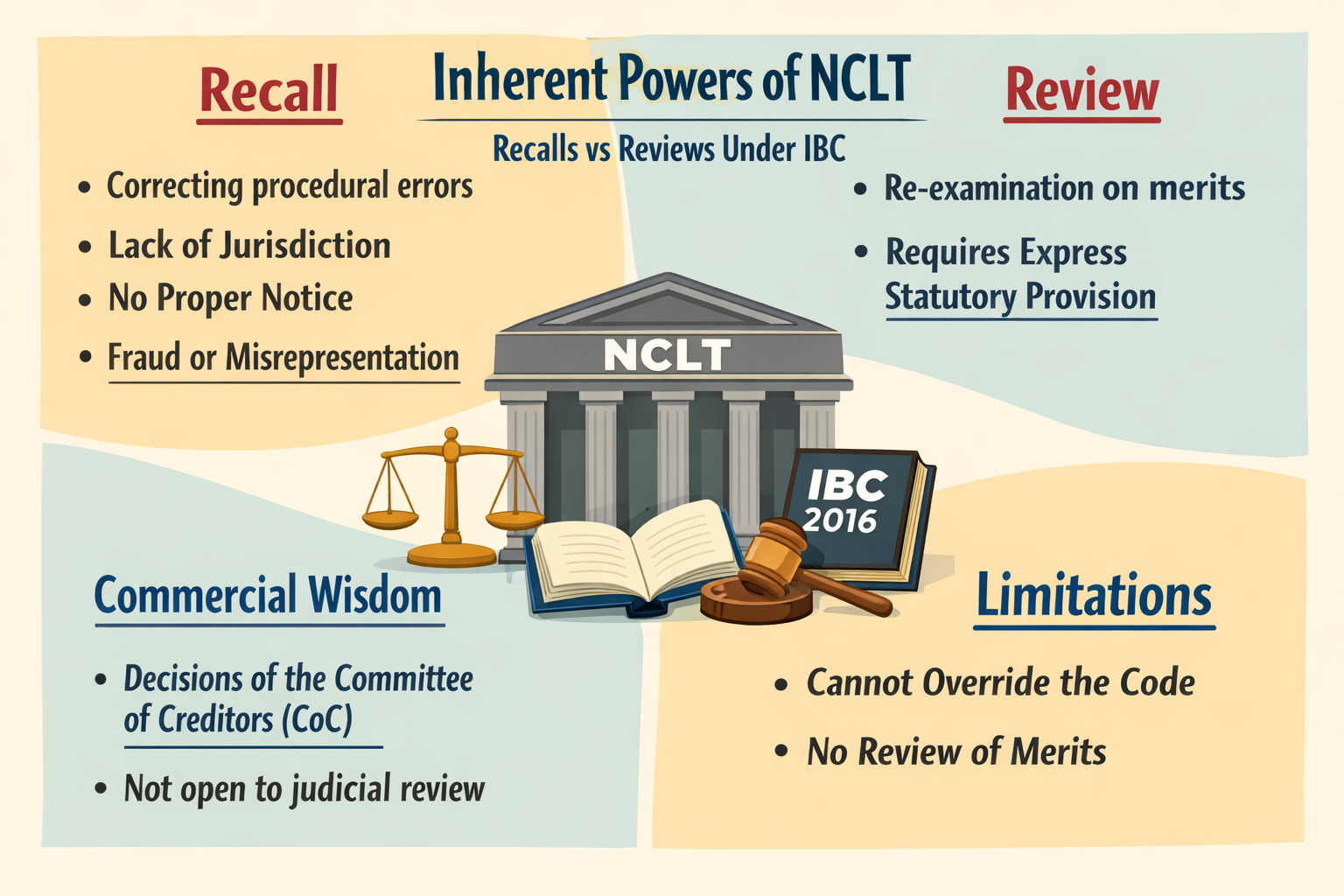
Inherent Powers of NCLT: Scope, Limitations and the Recall vs Review Debate under IBC
1. Introduction
The primary function of any judicial or quasi-judicial authority is to ensure the delivery of justice in a manner that is both timely and effective. Justice, however, is not confined merely to the final outcome of a case but extends to the fairness of the procedure adopted in reaching that outcome. In the course of adjudication, there may arise situations where procedural lapses, factual misunderstandings, or inadvertent errors occur. If such defects are not corrected, they have the potential to vitiate the entire proceeding, thereby undermining the very objective of justice delivery.
To address such contingencies, courts and tribunals are vested with inherent powers. These powers enable them to act in situations where the law may be silent, thereby ensuring that justice is not defeated merely due to procedural technicalities. In the context of insolvency law, the Insolvency and Bankruptcy Code, 2016 recognizes the importance of balancing the interests of various stakeholders, and in doing so, implicitly acknowledges the necessity of such inherent powers. The adjudicating authority under the Code, namely the National Company Law Tribunal, is therefore entrusted with the responsibility of exercising these powers within the framework of the law.
2. Legal Framework and Nature of Inherent Powers
The National Company Law Tribunal is constituted under Section 408 of the Companies Act, 2013 as a specialized forum to adjudicate disputes relating to companies. Its jurisdiction extends to matters concerning insolvency, oppression and mismanagement, and other corporate disputes. While the substantive powers of the Tribunal are derived from statutory provisions, its inherent powers are preserved through Rule 11 of the National Company Law Tribunal Rules, 2016.
Rule 11 does not confer any new jurisdiction upon the Tribunal; rather, it recognizes and preserves powers that are inherently vested in a judicial body. These powers are intended to enable the Tribunal to make such orders as may be necessary to meet the ends of justice or to prevent abuse of its process. The existence of such powers is rooted in the principle that no court or tribunal can be rendered helpless in the face of procedural injustice merely because there is no explicit statutory provision addressing a particular situation.
3. Distinction Between Recall and Review
A critical aspect of understanding the inherent powers of the Tribunal lies in distinguishing between the concepts of recall and review. Though often used interchangeably in common parlance, these terms carry distinct legal meanings and implications.
Recall of an order refers to the act of setting aside or vacating a decision on account of fundamental procedural defects. Such defects may include absence of notice to a party, lack of jurisdiction, or the presence of fraud or misrepresentation. In such cases, the very foundation of the proceeding is affected, and the order passed cannot be sustained in the eyes of law. Recall, therefore, operates as a corrective mechanism aimed at restoring procedural fairness.
On the other hand, review involves a re-examination of the merits of a case. It entails reconsidering the correctness of the decision based on legal or factual errors. Unlike recall, the power of review is not inherent and must be expressly conferred by statute. In the absence of such statutory authorization, a tribunal cannot undertake a review of its own decisions.
This distinction was authoritatively recognized in Kapra Mazdoor Ekta Union v. Birla Cotton Spinning & Weaving Mills Ltd., where the Supreme Court clarified that while procedural review is permissible to correct defects that vitiate proceedings, a substantive review on merits is impermissible unless expressly provided by law.
4. Judicial Evolution on Recall Powers of NCLT
The jurisprudence surrounding the recall powers of the Tribunal has evolved through a series of judicial pronouncements. Initially, a restrictive approach was adopted in Agarwal Coal Corporation Pvt. Ltd. v. Sun Paper Mill Ltd., where it was held that the Tribunal does not possess inherent powers to review its judgments and that Rule 11 is merely procedural in nature. The decision emphasized that parties aggrieved by an order must seek remedy through the appellate mechanism rather than invoking inherent powers.
However, this view was subsequently reconsidered in Union Bank of India v. Dinkar T. Venkatasubramanian, wherein the appellate tribunal acknowledged that the power to recall is indeed inherent in nature. It was observed that denying such power would lead to injustice, particularly in cases where orders are obtained through fraud or where parties are deprived of an opportunity to be heard. The tribunal relied upon established judicial principles to affirm that inherent powers are essential for ensuring fairness in adjudication.
5. Commercial Wisdom of Committee of Creditors and Its Interface with Inherent Powers
The Insolvency and Bankruptcy Code places significant emphasis on the role of the Committee of Creditors (CoC), whose decisions are guided by the principle of commercial wisdom. The CoC is entrusted with determining whether a corporate debtor should be revived or liquidated, and such decisions are generally insulated from judicial interference.
In K. Sashidhar v. Indian Overseas Bank, the Supreme Court held that the adjudicating authority cannot question the commercial wisdom of the CoC. The Tribunal’s role is limited to ensuring that the resolution plan complies with the requirements of the Code. Similarly, in Greater Noida Industrial Development Authority v. Prabhjit Singh Soni, it was reiterated that while the Tribunal cannot interfere with commercial decisions, it retains the authority to ensure adherence to statutory provisions.
Thus, while inherent powers enable the Tribunal to correct procedural irregularities, they cannot be invoked to override the commercial decisions of the CoC. The two operate in distinct spheres, with inherent powers serving as a safeguard against procedural injustice rather than a tool for substantive intervention.
6. Grounds for Exercise of Recall Jurisdiction
The exercise of recall jurisdiction by the Tribunal is not unfettered and is confined to specific circumstances. Courts have consistently recognized that recall may be justified in cases where the Tribunal lacked jurisdiction to pass the order, where a party was not served with notice or was denied an opportunity to be heard, or where the order was obtained through fraud or misrepresentation. In such situations, the defect strikes at the root of the proceeding, rendering the order unsustainable.
These grounds reflect the underlying principle that procedural fairness is integral to justice, and any deviation from it must be corrected to maintain the legitimacy of the adjudicatory process.
7. Inherent Powers in Withdrawal of Insolvency Proceedings
The significance of inherent powers was also recognized in the context of withdrawal of insolvency proceedings. In Uttara Foods & Feeds Pvt. Ltd. v. Mona Pharmachem, the Supreme Court permitted the withdrawal of a petition after its admission by invoking inherent powers, even in the absence of a specific statutory provision at that time.
This principle was later codified through Section 12A of the Insolvency and Bankruptcy Code, 2016, which allows withdrawal of insolvency applications subject to the approval of ninety percent of the Committee of Creditors. Further clarity was provided in Swiss Ribbons Pvt. Ltd. v. Union of India, where the Court upheld the validity of such withdrawals even before the constitution of the CoC, depending on the facts and circumstances of the case.
8. Limitations on Exercise of Inherent Powers
Despite their importance, inherent powers are subject to well-defined limitations. The Tribunal cannot exercise these powers in a manner that contradicts express statutory provisions. It cannot undertake a review of its own decisions on merits under the guise of recall. Furthermore, inherent powers are not intended to serve as a substitute for appellate remedies.
The exercise of such powers must be cautious and restrained, ensuring that they are invoked only when necessary to prevent injustice or abuse of process. This restraint is essential to maintain the balance between judicial discretion and statutory certainty.
9. Conclusion
The inherent powers of the National Company Law Tribunal play a crucial role in the effective functioning of the insolvency framework in India. They serve as a mechanism to address procedural irregularities, rectify injustices, and uphold the integrity of the adjudicatory process. At the same time, these powers are not absolute and must be exercised within the confines of the Insolvency and Bankruptcy Code, 2016.
The distinction between recall and review remains central to understanding the scope of these powers. While recall is permissible to correct procedural defects, review on merits is beyond the Tribunal’s jurisdiction in the absence of statutory authorization. By exercising inherent powers judiciously and in harmony with the statutory framework, the Tribunal ensures that the objectives of the Code—namely, value maximization and equitable treatment of stakeholders—are effectively achieved.
Unlock the Potential of Legal Expertise with LegalMantra.net – Your Trusted Legal Consultancy Partner
Disclaimer
Every effort has been made to ensure accuracy in this material. However, inadvertent errors or omissions may occur. Any discrepancies brought to the author’s notice will be rectified in subsequent editions. The author shall not be liable for any direct, indirect, incidental, or consequential damages arising from the use of this material. This article is based on various sources including statutory enactments, judicial decisions, academic research papers, professional journals, and publicly available legal materials.
Mayank Garg
LegalMantra.net Team