
Forget Password

View News
India’s Traffic Congestion and Its Cost to Workers and the Law
India’s Traffic Congestion and Its Cost to Workers and the Law
~ Sura Anjana Srimayi
INTRODUCTION
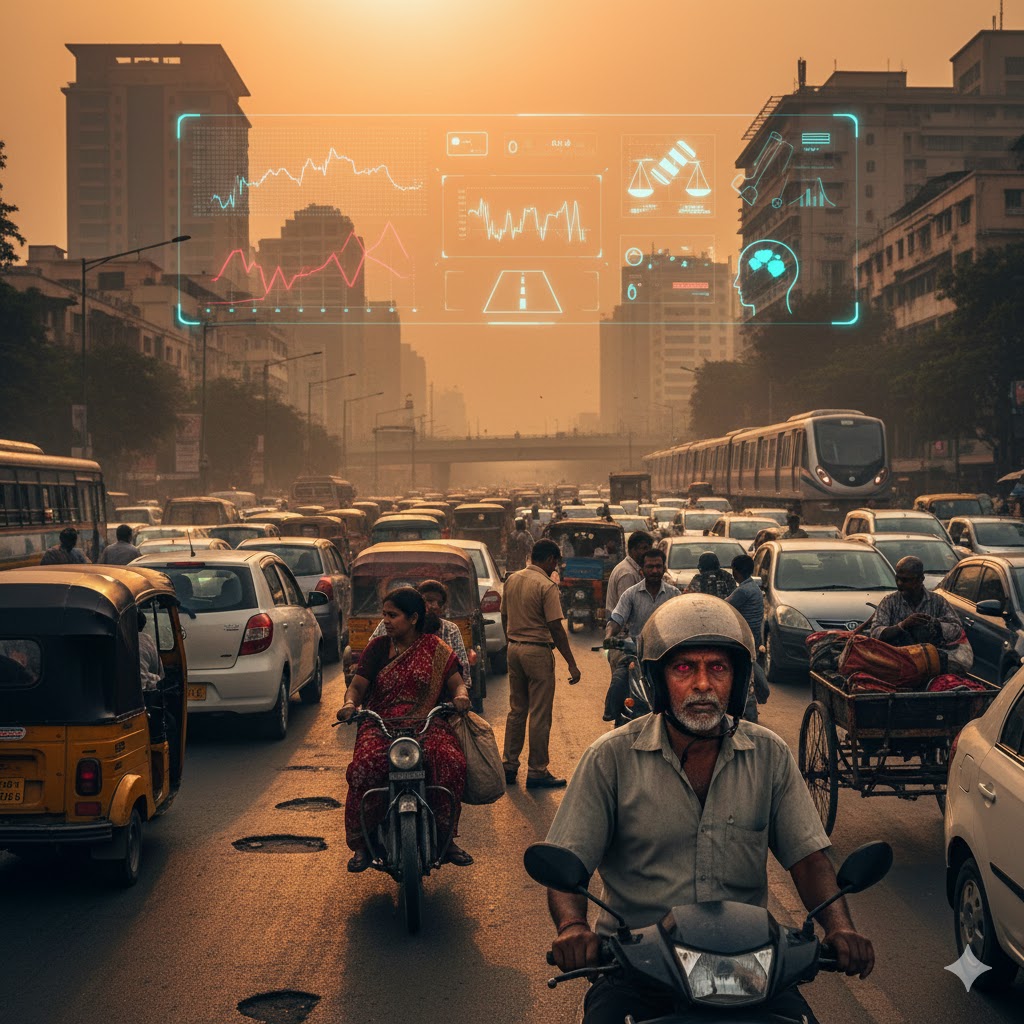
Traffic congestion in India has evolved from a routine urban inconvenience into a deep-rooted systemic crisis. In rapidly urbanising metropolitan cities such as Bengaluru, Mumbai, Delhi, Hyderabad, and Pune, congestion has become a defining feature of daily life. Indian cities frequently rank among the most congested globally, a reflection not merely of population growth but of structural deficiencies in urban planning, public transport, road infrastructure, and enforcement mechanisms.
This crisis is no longer limited to delays in commuting. It has far-reaching implications for economic productivity, physical and mental health, workplace efficiency, and constitutional rights. For millions of Indian workers, traffic congestion erodes dignity, well-being, and the ability to participate meaningfully in economic and family life. From a legal perspective, the issue raises serious questions about the State’s obligations under the Constitution and statutory law to ensure safe, efficient, and humane mobility.
THE DAILY TOLL ON THE INDIAN WORKER
The Commute as a Daily Struggle
For the average Indian worker, the journey to and from the workplace is often unpredictable, exhausting, and emotionally draining. What should ideally be a routine transition between home and work has become a daily ordeal marked by uncertainty, delays, and fatigue. Workers frequently leave home much earlier than required, not to enhance productivity, but to hedge against unpredictable traffic conditions.
This daily struggle disproportionately affects wage earners, shift workers, delivery personnel, healthcare professionals, and those employed in time-sensitive service sectors, where punctuality directly impacts income and job security.
Economic Loss and Productivity Drain
The most visible and measurable consequence of traffic congestion is economic loss. A significant portion of working hours in Indian metropolitan regions is lost annually to congestion, translating into billions of rupees in foregone productivity. These losses are borne not only by employers and the economy at large, but directly by employees themselves.
For individual workers, prolonged commuting effectively reduces real income. Time spent in traffic is unpaid, non-productive, and mentally exhausting. Whether the worker is unskilled, semi-skilled, or highly skilled, a substantial part of annual earnings is indirectly eroded through lost hours, reduced efficiency, and burnout. The opportunity cost of this lost time—whether for additional work, skill development, rest, or family life—is enormous and often irreversible.
Further, congestion introduces chronic unpredictability into travel systems. To avoid late arrivals, employees are compelled to budget excessive buffer time for commuting, thereby sacrificing personal time even on days when traffic flows smoothly. This uncertainty disrupts business operations, supply chains, logistics networks, and service delivery, all of which rely heavily on time discipline.
Health and Psychological Consequences
Beyond economic loss, traffic congestion imposes a severe human cost. Daily exposure to chaotic traffic environments contributes significantly to stress, anxiety, irritability, and long-term psychological strain. The persistent sense of losing control over one’s time, combined with aggressive driving, noise pollution, and lack of lane discipline, creates a climate of constant mental pressure.
Physically, congestion is a major contributor to air and noise pollution. Vehicles stuck in traffic emit higher levels of harmful pollutants due to idling and inefficient combustion. Two-wheeler riders, pedestrians, traffic police, and roadside workers are especially vulnerable to prolonged exposure. Numerous studies link such exposure to respiratory illnesses, cardiovascular diseases, reduced life expectancy, and premature mortality.
Thus, the daily commute itself becomes a health hazard, diminishing worker productivity and increasing public healthcare burdens.
LEGAL AND CONSTITUTIONAL IMPLICATIONS
Traffic Congestion as a Constitutional Issue
India’s traffic crisis is not merely an administrative or infrastructural failure; it raises fundamental constitutional concerns. Indian courts have increasingly recognised that access to safe, motorable, and well-maintained roads is intrinsic to the Right to Life guaranteed under Article 21 of the Constitution of India.
The judiciary has adopted a progressive interpretation of Article 21, extending it beyond mere survival to encompass dignity, safety, health, and access to economic opportunity. Mobility, in this sense, is not a luxury but a prerequisite for exercising other fundamental rights.
Right to Life and Safe Roads (Article 21)
Judicial precedents, particularly from High Courts such as the Bombay High Court, have explicitly held that citizens have a fundamental right to reasonably safe road conditions. Courts have recognised that poorly maintained roads, potholes, inadequate traffic management, and negligent civic administration pose direct threats to life and personal liberty.
In several landmark cases, courts have ordered compensation for deaths and injuries caused by defective roads and potholes, while fixing accountability on municipal authorities, contractors, and public officials. These rulings elevate road safety and traffic management from matters of policy discretion to constitutional obligations, thereby imposing a positive duty on the State to act.
The Motor Vehicles Act, 1988 and Enforcement Failures
The Motor Vehicles Act, 1988, substantially strengthened by the Motor Vehicles (Amendment) Act, 2019, forms the backbone of India’s traffic regulation framework. The Act comprehensively addresses:
-
Licensing standards and driver training
-
Vehicle registration and fitness requirements
-
Road safety norms and traffic discipline
-
Penalties for violations such as speeding, reckless driving, drunk driving, and illegal parking
However, the primary challenge lies not in legislative inadequacy but in enforcement failure. Traffic rules relating to lane discipline, pedestrian safety, parking restrictions, and footpath usage are routinely violated with minimal consequences. Inconsistent enforcement fosters a culture of impunity, directly contributing to congestion and chaos.
Despite clear legal prohibitions on encroachment of footpaths and misuse of public roads, administrative laxity compromises pedestrian safety and aggravates vehicular congestion. Courts have repeatedly emphasised the need for strict enforcement, proper road markings, scientific traffic planning, and accountability mechanisms to ensure compliance.
CONCLUSION
Traffic congestion in India represents a silent yet severe assault on economic productivity, public health, and the constitutional promise of a dignified life. For the Indian worker, congestion translates into lost income, declining health, psychological stress, and reduced quality of life. Judicial interventions have rightly recognised that safe and efficient mobility is not merely an administrative objective but a constitutional mandate under Article 21.
Addressing this crisis requires a comprehensive, multi-layered approach that extends beyond road expansion alone. Sustainable solutions must integrate both supply-side and demand-side interventions, including:
-
Robust Public Transport Investment: Large-scale development of reliable, affordable, and safe public transport systems such as metros and bus rapid transit networks.
-
Urban Planning Reforms: Promotion of mixed-use zoning to reduce the physical separation between residential and workspaces, thereby shortening commute distances.
-
Smart Traffic Management: Use of technology for adaptive traffic signals, congestion pricing, and real-time monitoring to optimise road usage.
-
Strict Legal Enforcement: Zero-tolerance enforcement of traffic laws, supported by judicial oversight and administrative accountability.
Ultimately, resolving India’s traffic crisis also requires a cultural shift—from the glorification of private vehicle ownership to the collective acceptance of public and shared mobility. Only by treating traffic congestion as a national emergency, rather than a routine inconvenience, can India unlock its full economic potential and secure for its workers the fundamental right to a healthy, dignified, and productive life.
"Unlock the Potential of Legal Expertise with LegalMantra.net - Your Trusted Legal Consultancy Partner”
Disclaimer: Every effort has been made to avoid errors or omissions in this material in spite of this, errors may creep in. Any mistake, error or discrepancy noted may be brought to our notice which shall be taken care of in the next edition In no event the author shall be liable for any direct indirect, special or incidental damage resulting from or arising out of or in connection with the use of this information Many sources have been considered including Newspapers, Journals, Bare Acts, Case Materials , Charted Secretary, Research Papers etc