
Forget Password

View News
IBBI Notifies International Valuation Standards
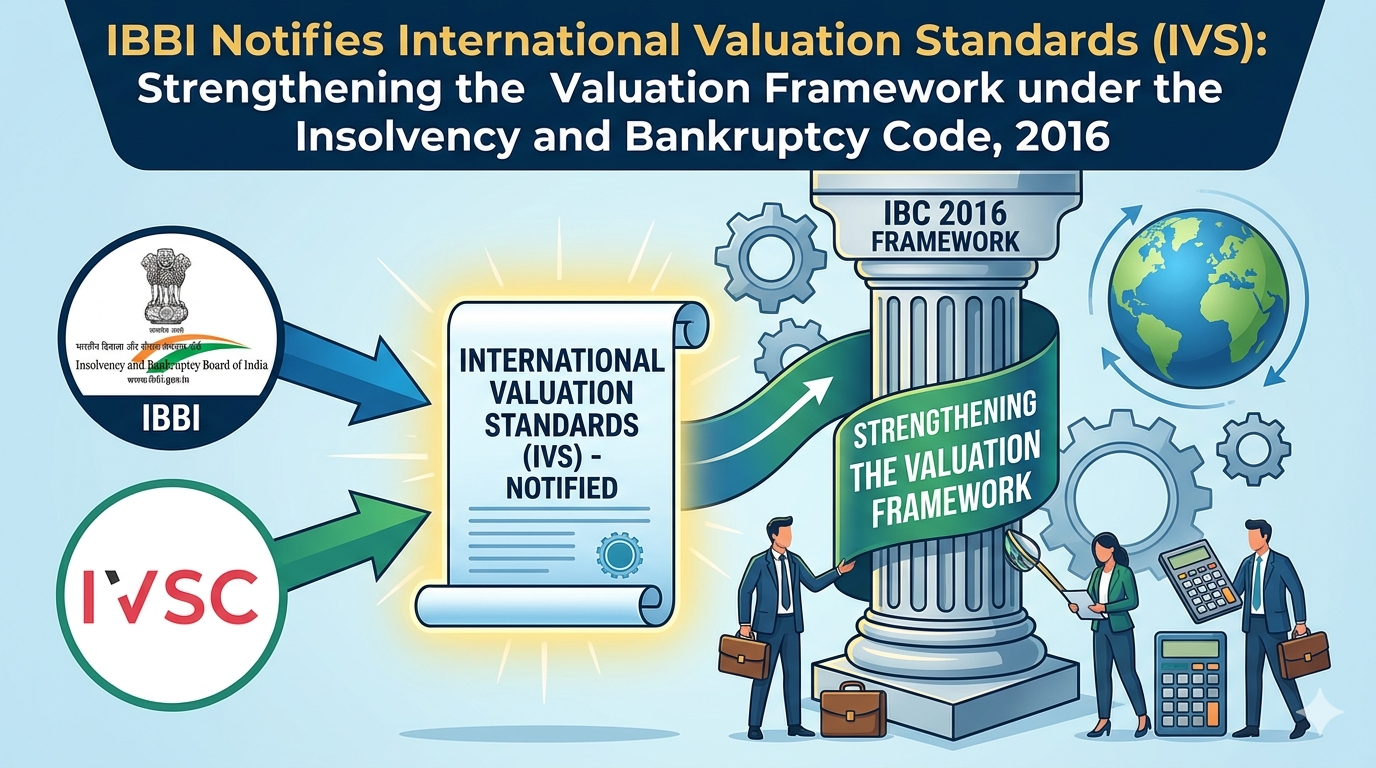
IBBI Notifies International Valuation Standards (IVS): Strengthening the Valuation Framework under the Insolvency and Bankruptcy Code, 2016
1. Introduction
The Insolvency and Bankruptcy Board of India (IBBI), through its Circular No. IBBI/RV/93/2026 dated 1st April 2026, has introduced a major reform in the insolvency valuation regime by notifying the International Valuation Standards (IVS) issued by the International Valuation Standards Council as the applicable standards for valuation under the Insolvency and Bankruptcy Code, 2016. This step is aimed at enhancing transparency, consistency, and global alignment in valuation practices.
The circular reflects the regulator’s commitment to ensuring that valuation, which is a cornerstone of insolvency proceedings, is conducted in a standardized and globally accepted manner.
2. Significance of Valuation in Insolvency Proceedings
2.1 Role of Valuation in Value Maximisation
Under the Code, one of the primary objectives is the maximisation of the value of assets of the corporate debtor within a time-bound framework. Valuation acts as a foundational element in determining both fair value and liquidation value, which are essential for evaluating resolution plans and liquidation strategies.
2.2 Importance for Stakeholders
Valuation impacts multiple stakeholders in the insolvency ecosystem. It enables the Committee of Creditors to take informed commercial decisions, assists resolution applicants in formulating viable plans, and aids adjudicating authorities such as the National Company Law Tribunal in ensuring fairness and legality in the process. Therefore, the reliability and objectivity of valuation reports are crucial for maintaining confidence in the insolvency framework.
3. Legal Framework Mandating Valuation Standards
The circular derives authority from various regulations framed under the Code, which mandate that valuation must be conducted in accordance with standards notified by the IBBI.
3.1 Relevant Regulatory Provisions
The following table summarises the key regulations requiring adherence to notified valuation standards:
| Regulation | Provision | Applicable Process |
|---|---|---|
| Regulation 35(1)(c) | CIRP Regulations, 2016 | Corporate Insolvency Resolution Process |
| Regulation 35(3) | Liquidation Regulations, 2016 | Liquidation Process |
| Regulation 3(1)(b) | Voluntary Liquidation Regulations, 2017 | Voluntary Liquidation |
| Regulation 39(1)(c) | Pre-packaged Insolvency Regulations, 2021 | Pre-pack Insolvency |
| Regulation 30(2) | Personal Guarantor Regulations, 2019 | Bankruptcy of Personal Guarantors |
3.2 Legislative Intent and Interpretation
These provisions collectively indicate a clear legislative intent to bring uniformity in valuation practices across all insolvency processes. The emphasis is on eliminating inconsistencies and ensuring that valuation outcomes are credible, comparable, and defensible.
4. Adoption of International Valuation Standards (IVS)
4.1 Nature and Scope of IVS
The International Valuation Standards (IVS) are a globally recognised framework that provides comprehensive guidance on valuation methodologies, ethical practices, and reporting standards. These standards are principle-based and are designed to be adaptable across jurisdictions and asset classes.
4.2 Key Attributes of IVS
The following table highlights the core attributes of IVS:
| Aspect | Description |
|---|---|
| Standardisation | Provides uniform definitions and approaches |
| Global Acceptance | Recognised across multiple jurisdictions |
| Coverage | Includes tangible and intangible assets |
| Transparency | Emphasises clear assumptions and disclosures |
| Professional Judgment | Allows flexibility within a structured framework |
5. Applicability and Enforcement
5.1 Effective Date
The circular has come into force with immediate effect from 1st April 2026. This means that all valuation assignments undertaken after this date must comply with IVS.
5.2 Scope of Application
The applicability of the circular extends to all stakeholders involved in valuation under the Code. This includes registered valuers, registered valuer organisations, insolvency professionals, insolvency professional agencies, and entities involved in insolvency processes such as CIRP, liquidation, voluntary liquidation, pre-pack insolvency, and personal guarantor bankruptcy.
6. Impact on Stakeholders
6.1 Impact on Registered Valuers
Registered valuers are now required to align their methodologies, documentation, and reporting practices with IVS. This necessitates an upgrade in technical knowledge and adherence to stricter professional standards, thereby increasing accountability.
6.2 Impact on Insolvency Professionals
Insolvency professionals must ensure that valuation assignments are conducted in compliance with IVS. This enhances the reliability of valuation reports and reduces ambiguities in decision-making.
6.3 Impact on Committee of Creditors
The adoption of IVS improves comparability and reliability of valuation outputs, enabling the Committee of Creditors to make better-informed commercial decisions.
6.4 Impact on Adjudicating Authorities
Adjudicating authorities benefit from standardized valuation reports, which facilitate quicker resolution of disputes and reduce litigation arising from inconsistent valuation practices.
7. Practical Challenges in Implementation
7.1 Transition and Capacity Building
The transition to IVS may pose challenges for professionals who are not familiar with international standards. Training and capacity-building initiatives will be essential to ensure smooth implementation.
7.2 Interpretation and Application
Since IVS is principle-based, it relies heavily on professional judgment. This may lead to interpretational differences, particularly in complex valuation scenarios.
7.3 Harmonisation with Domestic Laws
Another challenge lies in aligning IVS with existing Indian frameworks such as the Companies Act, 2013 and taxation laws, which may have different valuation requirements.
8. Comparative Analysis: Indian Standards vs IVS
The following table provides a comparative overview:
| Particulars | Indian Valuation Framework | IVS Framework |
|---|---|---|
| Approach | Rule-based | Principle-based |
| Scope | Limited to specific regulations | Broad and comprehensive |
| Global Alignment | Limited | High |
| Flexibility | Restricted | High |
| Cross-border Relevance | Moderate | Strong |
9. Conclusion
The notification of International Valuation Standards by the IBBI marks a significant milestone in the evolution of India’s insolvency framework. By adopting globally accepted standards, the regulator has enhanced the credibility, transparency, and efficiency of valuation processes under the Code.
This reform is expected to strengthen investor confidence, facilitate better resolution outcomes, and reduce disputes arising from valuation inconsistencies. Ultimately, it reinforces the core objective of the insolvency regime, which is the maximisation of value through a fair and transparent process.
Unlock the Potential of Legal Expertise with LegalMantra.net – Your Trusted Legal Consultancy Partner
Disclaimer
Every effort has been made to ensure accuracy in this material. However, inadvertent errors or omissions may occur. Any discrepancies brought to the author’s notice will be rectified in subsequent editions. The author shall not be liable for any direct, indirect, incidental, or consequential damages arising from the use of this material. This article is based on various sources including statutory enactments, judicial decisions, academic research papers, professional journals, and publicly available legal materials.
Mayank Garg
LegalMantra.net Team