
Forget Password

View News
How Designated Persons Can Access Funds During Trading Window Closure
SEBI's Game-Changing Guidance on Share Pledges
How Designated Persons Can Access Funds During Trading Window Closure
Issue No.: I/4275/2026 | February 6, 2026 | SEBI Informal Guidance
SEBI just clarified that Designated Persons can pledge company shares during trading window closure periods to raise funds—including for personal emergencies. This is game-changing for many employees who hold ESOP options. However, there are specific requirements and a critical 6-month window rule that you must follow.
The Challenge
Picture this: Your ESOP options vest, and you have 3 months to exercise them. But your company's trading window is closed for exactly those 3 months—you can't buy or sell shares freely. You need funds for the exercise, but borrowing against shares wasn't clearly allowed. Until now.Designated persons at Avenue Supermarts faced exactly this problem. They couldn't exercise their ESOPs because they had no way to raise capital. The trading window closure blocked traditional options, and pledging shares wasn't clearly permitted. SEBI's new guidance changes this.
SEBI's Three Key Rulings
Query 1: Is Pledge + Revocation = Contra Trade?
When you pledge shares to a bank and later revoke the pledge, there IS a change in beneficial ownership—similar to selling. However, SEBI says it's NOT a contra trade if you don't buy other shares within a 6-month window (both before and after revocation). The only exception is ESOP exercise itself, which is allowed. Everything else is off-limits for 6 months around the pledge revocation date.
Query 2: Can You Pledge During Trading Window Closure?
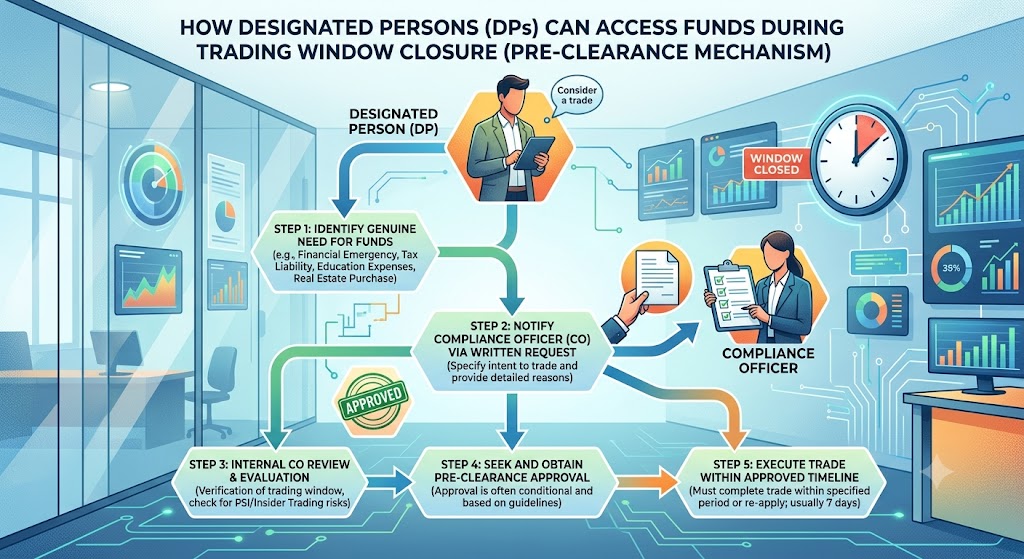
Yes, absolutely. Trading window restrictions don't apply to share pledges if done for 'bona fide' purposes. You just need pre-clearance from your Compliance Officer. The pre-clearance must be in writing before you pledge. Your Compliance Officer will evaluate whether your reason qualifies as bona fide.
Query 3: What About Medical Emergency? House Purchase?
The regulations say 'such as raising funds'—meaning the list is illustrative, not exhaustive. Other purposes qualify: medical emergency, house purchase, home loan repayment, or any other legitimate personal need. Your Compliance Officer decides on a case-by-case basis whether the purpose is bona fide. They use your company's Code of Conduct as the guide.
How The Pledge Mechanism Works
Follow this 6-step process to pledge your shares properly:
Step 1: Identify Your Purpose — Need funds for ESOP exercise? Medical emergency? House purchase? Document your reason clearly.
Step 2: Check Company CoC — Review your company's Code of Conduct. Does it recognize your purpose as bona fide?
Step 3: Request Pre-Clearance — Submit your request to Compliance Officer with documentation. Get written approval before proceeding.
Step 4: Pledge Your Shares — Once cleared, approach your bank and pledge existing shares or shares to-be-allotted.
Step 5: Manage The 6-Month Window — Don't acquire ANY other shares for 6 months before revocation and 6 months after (ESOP exercise allowed).
Step 6: Revoke Pledge — Once funds are repaid, remove the pledge and document with Compliance Officer.
Real-World Scenarios
Scenario 1: ESOP Exercise During Window Closure — ALLOWED
You pledge existing shares → Get loan → Exercise ESOP options → Repay loan → Revoke pledge (2 months later). SEBI's view: Perfectly fine. ESOP exercise is allowed.
Scenario 2: Medical Emergency — ALLOWED IF APPROVED
Your parent needs surgery → Pledge shares during window closure → Get funds → Pay hospital → Pledge revoked (1 month later). SEBI's view: Allowed IF Compliance Officer agrees this is bona fide.
Scenario 3: House Purchase + ESOP Exercise — ALLOWED IF MANAGED CAREFULLY
Pledge shares → Get loan for house down payment → Exercise ESOP options → Use proceeds to repay → Revoke pledge. SEBI's view: Both purposes are bona fide. Just manage your share acquisitions carefully.
Scenario 4: Pledge Then Buy Other Shares — VIOLATION
Pledge shares → Get loan → Revoke pledge 3 months later → Buy OTHER company shares 2 months later. SEBI's view: This is a CONTRA TRADE violation. The 6-month window is sacred.
The Non-Negotiable Requirements
• Bona Fide Purpose — Separates legitimate needs from market manipulation.
• Written Pre-Clearance — Must get approval from Compliance Officer in writing BEFORE pledging.
• 6-Month Window — No other share acquisitions for 6 months before or after revocation.
• PIT Compliance — Ensure no insider trading violations.
• Documentation — Keep records for regulators.
Critical Points Not To Miss
1. Pre-Clearance Is Mandatory — You cannot pledge and ask forgiveness later. Pre-clearance must be obtained in writing before pledging.
2. The 6-Month Window Is Absolute — If you revoke a pledge, don't acquire ANY other company shares for 6 months before or after (except ESOP exercise).
3. Other SEBI Regulations Still Apply — This guidance covers PIT Regulations only. Other SEBI rules still apply.
4. Your Company's CoC Must Not Dilute This — Companies cannot use this guidance to create loopholes. Their rules must be stricter or equal.
5. This Is Guidance, Not Board Approval — Different facts may require different outcomes. This is enforcement guidance, not final approval.
What This Means For You
For Designated Persons (DPs)
• Document your bona fide reason clearly • Submit pre-clearance request with proof • Wait for written approval before approaching bank • Plan share acquisitions carefully • Keep records of pledge creation and revocation dates
For Compliance Officers
• Evaluate each pledge request individually • Verify bona fide nature using CoC guidelines • Check PIT Regulation compliance • Monitor share acquisitions in the 6-month bands • Maintain detailed pre-clearance documentation
For Company Boards
• Update Code of Conduct to list bona fide purposes • Include: ESOP, medical, house, home loan, personal • Train Compliance Officers on SEBI's guidance • Establish pre-clearance templates and processes • Create procedures to monitor 6-month windows
Bottom Line
For DPs: You can pledge shares during trading window closure for bonafide reasons with proper pre-clearance. Just manage the 6-month acquisition window carefully.
For Companies: Update your Code of Conduct to recognize multiple bonafide purposes. Train your compliance team on pre-clearance evaluation and contra trade tracking.
For Compliance Officers: Each pledge request needs individual assessment. The regulations give flexibility, but you're the quality gate. Document everything thoroughly.
DISCLAIMER: THE CONTENTS OF THIS DOCUMENT ARE PROVIDED BASED ON CURRENT PROVISIONS AND INFORMATION AVAILABLE. WHILE EVERY EFFORT HAS BEEN MADE TO ENSURE ACCURACY AND RELIABILITY, NO RESPONSIBILITY IS ASSUMED FOR ANY ERRORS OR OMISSIONS. USERS ARE ENCOURAGED TO REFER TO APPLICABLE LAWS AND REGULATIONS. THIS INFORMATION IS NOT TO BE CONSTRUED AS LEGAL ADVICE, AND NO LIABILITY IS ACCEPTED FOR ANY CONSEQUENCES ARISING FROM ITS USE.
From the desk of CS Sharath