
Forget Password

View News
GST Case Law Digest – June 2026
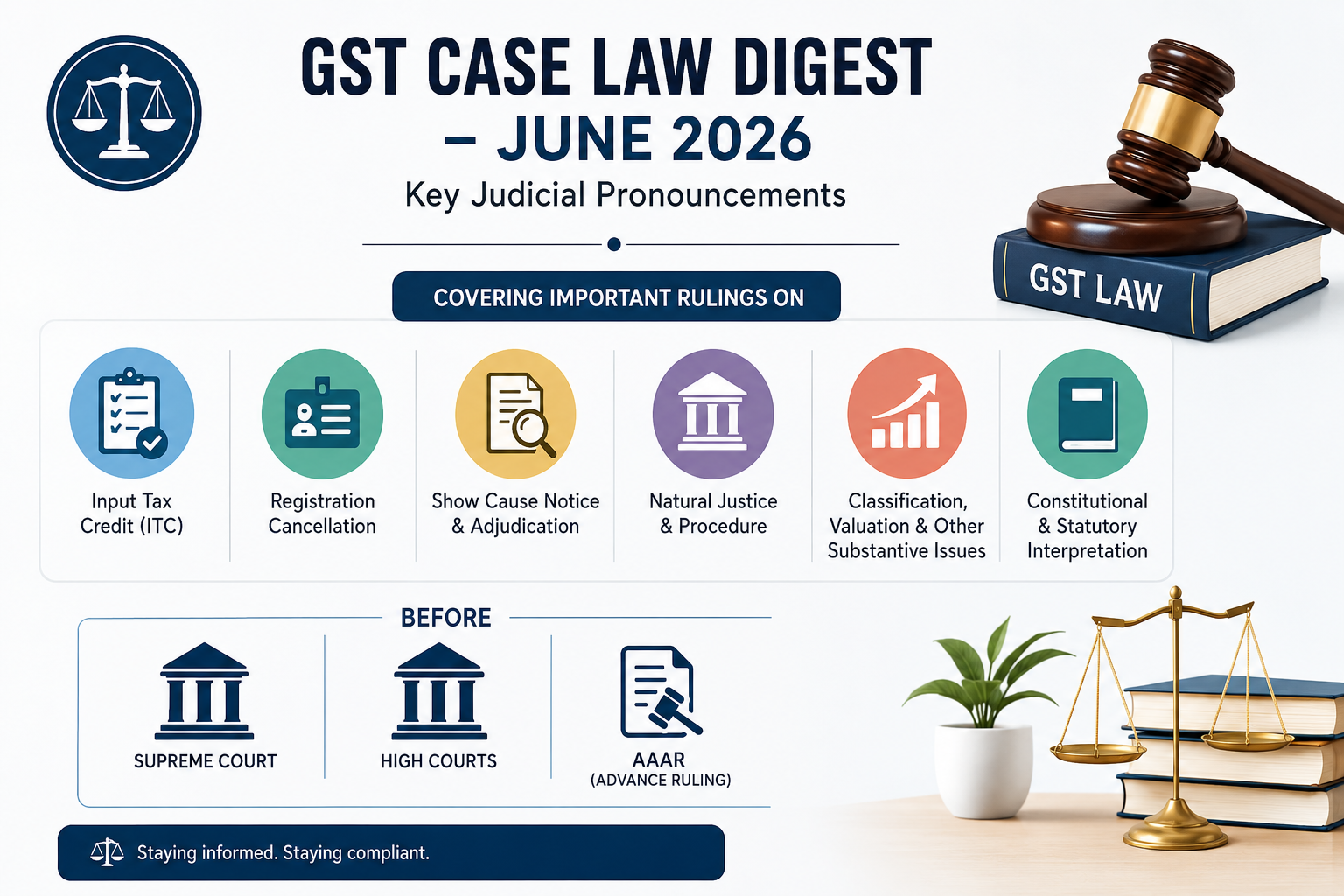
GST Case Law Digest-June 2026
Significant Judicial Pronouncements under GST: High Courts, Supreme Court and AAAR
Introduction
The Goods and Services Tax (GST) regime continues to witness extensive judicial scrutiny as taxpayers and tax authorities grapple with issues relating to input tax credit, registration cancellation, procedural compliance, adjudication proceedings, classification disputes, valuation, and constitutional interpretation of GST provisions. The month of June 2026 has been particularly significant, with several landmark rulings delivered by the Supreme Court, various High Courts, and the Appellate Authority for Advance Ruling (AAAR).
These decisions reaffirm important principles governing GST administration, including the necessity of adherence to natural justice, the requirement of reasoned decision-making by tax authorities, the limits of departmental powers in blocking or recovering input tax credit, and the constitutional significance of the GST Council's recommendations. At the same time, courts have continued to adopt a strict approach against wrongful availment and utilization of input tax credit, tax evasion, and procedural non-compliance by taxpayers.
The present digest provides a concise analysis of the important GST rulings reported during June 2026. Each case has been summarized with reference to its facts, issues involved, judicial observations, final decision, and practical implications for taxpayers, professionals, and tax administrators. These rulings collectively offer valuable guidance on the evolving interpretation of GST laws and their practical application in day-to-day compliance and litigation matters.
Case Law Digest
| Citation | Facts of the Case | Issue Before Court | Court's Observations | Decision | Key Takeaway |
|---|---|---|---|---|---|
| TS-457-HC(MAD)-2026-GST | Taxpayer claimed ITC in GSTR-3B exceeding credit reflected in GSTR-2A/2B and utilized the same for payment of GST liability. | Whether excess ITC claimed and utilized constitutes wrongful availment attracting interest under Section 50. | The Court observed that once inadmissible credit is utilized, the Government suffers deprivation of legitimate revenue. Mere reversal at a later stage cannot erase the consequences of utilization. | In favour of Revenue. | Excess ITC which is both availed and utilized attracts interest liability. Taxpayers must undertake periodic reconciliation between books, GSTR-2B and GSTR-3B. |
| TS-456-HC(KAR)-2026-GST | GST registration was cancelled on the basis of a verification report alleging irregularities in business activities. | Whether defective verification reports can form the basis for cancellation of registration. | The Court emphasized that statutory authorities must possess genuine "reasons to believe" supported by objective material. Mechanical reliance on vague reports is impermissible. | In favour of Petitioner. | Registration cannot be cancelled merely on suspicion. Verification reports must disclose concrete findings. |
| TS-1113-SC-2025-GST | GMR challenged a show cause notice proposing GST demand on BOT annuity payments. HC refused to interfere. | Whether Supreme Court should interfere at SCN stage. | The Supreme Court reiterated that courts ordinarily do not interfere with show cause notices unless they are without jurisdiction or patently illegal. | SLP dismissed. | Taxpayers should normally contest proceedings before adjudicating authorities rather than invoking writ jurisdiction prematurely. |
| TS-455-HC(KER)-2026-GST | Department issued a common SCN covering multiple financial years. | Whether a composite SCN for different tax periods is legally sustainable. | Court noted that each financial year constitutes a separate cause of action requiring independent determination of tax liability. | In favour of Petitioner. | Separate financial years require separate proceedings and reasoned determination. |
| TS-440-HC(MAD)-2026-GST | Dispute concerned classification of processed tobacco products. | Whether product falls under manufactured tobacco or unmanufactured tobacco category. | Classification depends upon extent of processing and whether a distinct commercial product emerges. | In favour of Petitioner. | Mere cleaning, drying or grading may not amount to manufacture. |
| TS-445-HC(BOM)-2026-GST | Challenge regarding distribution of common credits through ISD mechanism. | Impact of recent Reliance Jio Infocomm ruling on pending disputes. | Court found that the controversy required reconsideration in light of recent judicial developments. | Matter remanded. | ISD disputes continue to evolve and must be examined in light of emerging precedents. |
| TS-454-HC(ALL)-2026-GST | Registration was cancelled and subsequent notices were not physically served. | Whether adjudication order passed without effective service violates natural justice. | Electronic service alone may not be sufficient in certain circumstances, particularly after registration cancellation. | In favour of Petitioner. | Proper opportunity of hearing remains a fundamental requirement. |
| TS-453-HC(KAR)-2026-GST | Contractor sought reimbursement of additional GST burden arising after implementation of GST. | Whether State Government must bear post-transition tax burden. | Court examined contractual clauses and held liability must be determined from contractual framework. | In favour of Appellant. | Additional GST burden is recoverable from contracting employer if contract so permits. |
| TS-452-HC(ALL)-2026-GST | Appeal was rejected as time-barred. | From which date limitation should be calculated. | Limitation generally commences from date of communication of order to taxpayer and not merely from order date. | In favour of Petitioner. | Revenue must establish actual communication of order. |
| TS-451-HC(MAD)-2026-GST | Notifications affecting taxation of unregistered-brand pulses were retrospectively validated. | Whether retrospective legislative validation can bypass GST Council recommendation. | GST Council occupies a constitutional role in GST framework. Executive notifications cannot replace constitutional requirements. | In favour of Petitioner. | GST Council recommendations remain a critical constitutional safeguard. |
| TS-450-HC(MAD)-2026-GST | Authorities found discrepancy between seigniorage fee and declared value of supplies. | Whether Section 74 proceedings alleging suppression were justified. | Material discrepancies may constitute sufficient basis for invoking extended limitation and fraud provisions. | In favour of Revenue. | Significant valuation mismatches can justify proceedings under Section 74. |
| TS-449-SC-2026-GST | Revenue challenged HC decision on negative blocking of ITC. | Whether authorities can block ITC that is not available in electronic credit ledger. | Supreme Court found no reason to interfere with HC view. | In favour of Petitioner. | Credit must first exist before it can be blocked. |
| TS-1112-HC(P&H)-2025-GST | Authorities blocked credit despite absence of balance in electronic credit ledger. | Legality of negative ITC blocking. | Blocking provisions are preventive in nature and cannot operate upon non-existent credit. | In favour of Petitioner. | Determination of wrongful availment must occur through Sections 73 or 74 proceedings. |
| TS-448-HC(AP)-2026-GST | Demand order was generated through unsigned DRC-07. | Whether unsigned order is legally enforceable. | Signature reflects application of mind and authenticity of administrative action. | In favour of Petitioner. | Unsigned DRC-07 is invalid and unenforceable. |
| TS-447-HC(CHAT)-2026-GST | Accused sought bail in fake ITC fraud investigation. | Whether custodial interrogation was necessary. | Court noted investigation was substantially complete and documentary evidence already secured. | Bail granted. | Arrest should not become punitive when investigation can proceed without custody. |
| TS-439-HC(DEL)-2026-GST | Revenue challenged protection granted under D.K. Basu-type safeguards in GST investigations. | Whether 7-day pre-arrest notice grants blanket immunity. | Court clarified that notice requirement cannot obstruct legitimate investigation. | Petition dismissed. | Safeguards against arrest do not extinguish investigative powers. |
| TS-438-HC(GAUH)-2026-GST | Registration cancelled through cryptic order lacking reasons. | Whether non-speaking order satisfies legal standards. | Recording reasons is a core element of fairness and transparency. | In favour of Petitioner. | Every cancellation order must disclose reasons and evidence relied upon. |
| TS-446-HC(KAR)-2026-GST | Taxpayer sought waiver/reduction of statutory interest on delayed tax payment. | Whether courts can reduce statutory interest. | Interest is compensatory and arises automatically upon delayed payment of tax. | In favour of Revenue. | Courts ordinarily cannot waive statutory interest unless statute specifically permits. |
| TS-443-AAAR(RAJ)-2026-GST | Taxpayer installed solar power plant and claimed ITC on capital goods and services. | Whether ITC is available when output electricity is exempt/nil rated. | Since electricity attracts nil rate and constitutes exempt supply, credit restrictions apply. | In favour of Revenue. | ITC attributable to exempt electricity generation is not admissible. |
| TS-444-AAAR(HAR)-2026-GST | Company incurred expenses for raising funds through Qualified Institutional Placement (QIP). | Whether GST paid on QIP-related services is eligible for ITC. | Fund-raising activities were held integrally connected with business operations and expansion. | In favour of Appellant. | GST paid on QIP-related professional services may qualify for ITC as business expenditure. |
Conclusion
The GST jurisprudence emerging from June 2026 reflects a balanced judicial approach aimed at protecting both revenue interests and taxpayer rights. While courts have consistently upheld departmental action in cases involving wrongful availment and utilization of input tax credit, they have equally emphasized the importance of procedural fairness, transparency, and adherence to statutory safeguards.
A notable trend across several decisions is the judiciary's insistence that administrative and adjudicatory actions must be supported by valid reasons, proper service of notices, and compliance with principles of natural justice. Orders lacking signatures, reasons, or proper jurisdictional foundation have not been permitted to survive judicial scrutiny. Simultaneously, taxpayers have been reminded that statutory obligations concerning ITC reconciliation, timely payment of taxes, and accurate disclosures cannot be taken lightly.
The decisions also highlight the growing importance of constitutional principles within the GST framework, particularly regarding the role of the GST Council and the limits of executive and legislative intervention. Furthermore, the Supreme Court's continued reluctance to interfere at the show-cause notice stage reinforces the need for taxpayers to exhaust statutory remedies before invoking writ jurisdiction.
Overall, these rulings provide valuable guidance for businesses, tax professionals, consultants, and revenue authorities. A careful study of these precedents will assist stakeholders in strengthening GST compliance, mitigating litigation risks, and understanding the evolving contours of indirect tax law in India.
Disclaimer
Every effort has been made to ensure accuracy in this material. However, inadvertent errors or omissions may occur. Any discrepancies brought to the author’s notice will be rectified in subsequent editions. The author shall not be liable for any direct, indirect, incidental, or consequential damages arising from the use of this material. This article is based on various sources including statutory enactments, judicial decisions, academic research papers, professional journals, and publicly available legal materials.
Mayank Garg