
Forget Password

View News
FERA Complaint Cognisance Vitiated If Mandatory Opportunity Notice Was Not Served to the Accused
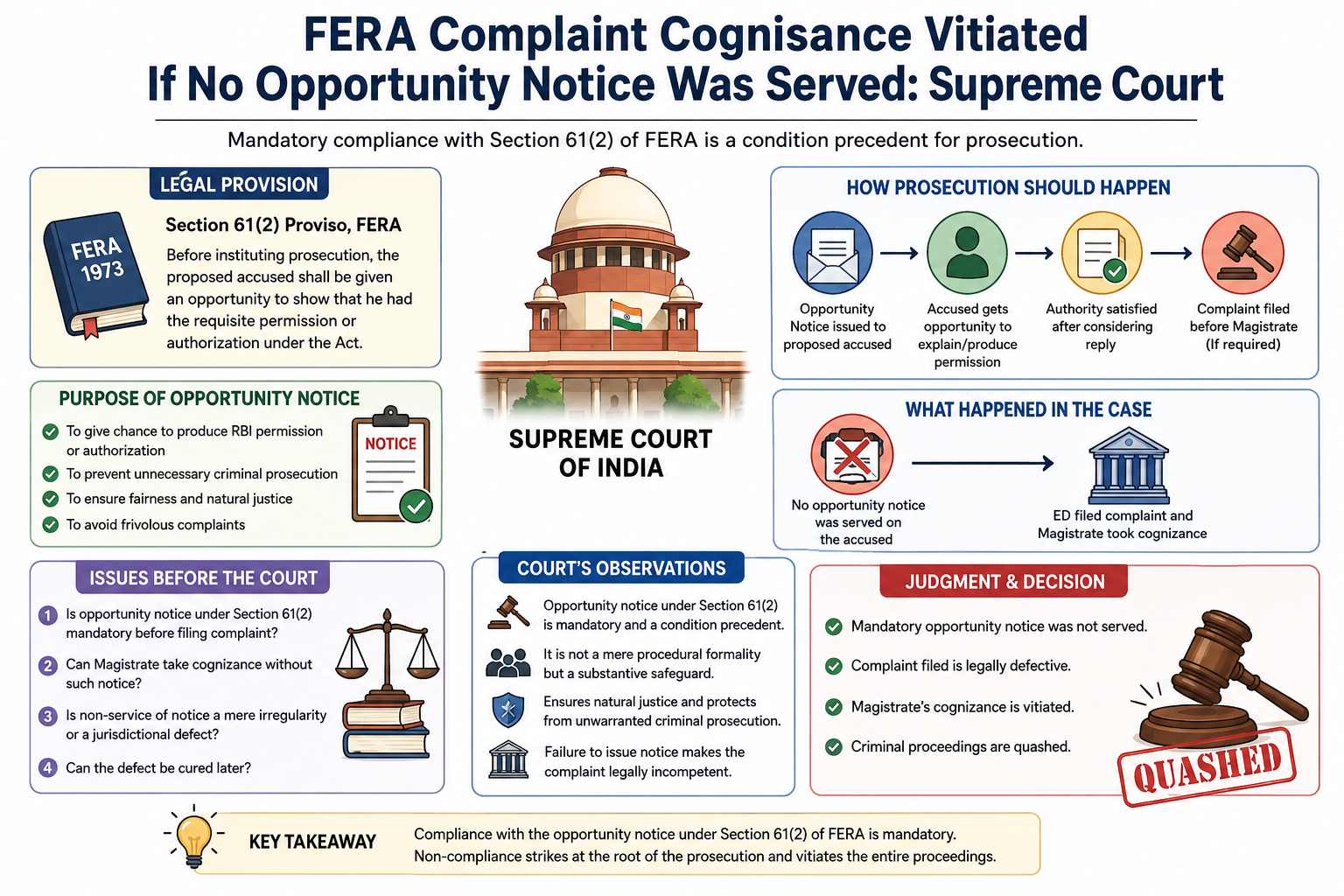
FERA Complaint Cognisance Vitiated If Mandatory Opportunity Notice Was Not Served to the Accused
|
Particulars |
Details |
|
Case Title |
FERA Complaint Cognisance Vitiated If There Was No Notice To Accused : Supreme Court |
|
Court |
Supreme Court of India |
|
Subject Matter |
Validity of criminal prosecution under the Foreign Exchange Regulation Act, 1973 (FERA) in the absence of the mandatory opportunity notice under Section 61(2). |
|
Relevant Law |
Foreign Exchange Regulation Act, 1973 (FERA) (since repealed by FEMA, 1999, but applicable to pending proceedings through saving provisions). |
|
Legal Provision Involved |
Section 61(2), FERA and its Proviso, which mandates that before instituting prosecution, the proposed accused must be given an opportunity to show that the alleged act was undertaken with the requisite permission or authorization under the Act. |
|
Purpose of Section 61(2) Proviso |
To ensure that an individual is not unnecessarily subjected to criminal prosecution without first being afforded an opportunity to produce valid RBI approvals, permissions, or statutory authorizations. It embodies the principles of natural justice and procedural fairness. |
Facts of the Case
|
Particulars |
Details |
|
Investigation |
The Enforcement Directorate (ED) investigated alleged violations of FERA involving foreign exchange transactions. |
|
Complaint Filed |
Based on the investigation, a criminal complaint was filed before the competent Magistrate seeking prosecution of the accused. |
|
Challenge by Accused |
The accused contended that no opportunity notice under the proviso to Section 61(2) had been served before the filing of the complaint. |
|
Ground of Challenge |
Since the mandatory statutory notice was never issued, the complaint itself was invalid and the Magistrate lacked jurisdiction to take cognizance. |
Issues Before the Supreme Court
|
Issue No. |
Legal Issue |
|
1 |
Whether service of the opportunity notice under the proviso to Section 61(2) of FERA is mandatory before instituting criminal prosecution? |
|
2 |
Whether a Magistrate can validly take cognizance of a complaint filed without complying with the mandatory statutory requirement? |
|
3 |
Whether non-service of the opportunity notice is merely a procedural irregularity or a jurisdictional defect? |
|
4 |
Whether the defect can be cured by issuing notice after institution of prosecution? |
Arguments of the Parties
|
Party |
Submissions |
|
Accused |
• Section 61(2) expressly mandates service of opportunity notice before prosecution. • The proviso is mandatory and not directory. • Non-compliance violates statutory safeguards and principles of natural justice. • Consequently, the complaint and cognizance are void. |
|
Enforcement Directorate (ED) |
• Failure to issue notice is merely a procedural lapse. • The accused could defend themselves during trial. • The omission should not invalidate the prosecution already initiated. |
Supreme Court's Analysis
|
Aspect |
Court's Findings |
|
Nature of Opportunity Notice |
The notice is a statutory safeguard intended to prevent unnecessary criminal prosecution. |
|
Legislative Intent |
Parliament deliberately incorporated the proviso to ensure that persons having lawful permission are not prosecuted unnecessarily. |
|
Mandatory or Directory |
The requirement is mandatory and not merely directory. |
|
Condition Precedent |
Service of notice is a condition precedent for filing a criminal complaint under FERA. |
|
Natural Justice |
The proviso reinforces the principles of natural justice by allowing the proposed accused an opportunity to explain or justify the alleged contravention before prosecution. |
|
Effect of Non-Compliance |
Failure to issue notice renders the complaint legally incompetent. |
Court's Key Observations
|
Observation |
Explanation |
|
Mandatory Compliance |
Compliance with Section 61(2) is obligatory and cannot be ignored. |
|
Jurisdictional Requirement |
The requirement directly affects the jurisdiction to initiate prosecution. |
|
Not a Mere Procedural Formality |
The opportunity notice is a substantive statutory safeguard rather than a technical procedural step. |
|
Fair Opportunity |
The accused must be given a genuine opportunity to demonstrate that the transaction was lawfully authorized. |
|
Protection Against Arbitrary Prosecution |
The provision prevents mechanical institution of criminal complaints by enforcement authorities. |
Effect on Magistrate's Cognizance
|
Aspect |
Finding |
|
Power of Magistrate |
A Magistrate can take cognizance only upon a legally valid complaint. |
|
Complaint Without Notice |
A complaint filed without complying with Section 61(2) is legally defective. |
|
Validity of Cognizance |
Cognizance taken on such defective complaint is vitiated and unsustainable in law. |
|
Jurisdiction |
The Magistrate lacks jurisdiction to proceed on an invalid complaint. |
Whether the Defect Can Be Cured?
|
Question |
Supreme Court's Answer |
|
Can notice be issued after filing the complaint? |
No. |
|
Can subsequent compliance validate earlier prosecution? |
No. |
|
Is the defect curable? |
No. It is a jurisdictional defect affecting the validity of prosecution itself. |
Decision of the Supreme Court
|
Particulars |
Decision |
|
Appeal |
Allowed. |
|
Finding |
Mandatory opportunity notice under Section 61(2) was not served. |
|
Result |
Criminal complaint was held to be legally incompetent. |
|
Cognizance |
Magistrate's order taking cognizance was declared invalid. |
|
Outcome |
Criminal proceedings arising from the complaint were quashed. |
Ratio Decidendi (Legal Principle Established)
|
Legal Principle |
Explanation |
|
Mandatory Nature of Section 61(2) |
Service of opportunity notice under the proviso to Section 61(2) of FERA is a mandatory precondition for prosecution. |
|
Jurisdictional Requirement |
Non-compliance strikes at the root of the complaint and deprives the Magistrate of jurisdiction to take cognizance. |
|
Natural Justice |
The statutory opportunity safeguards fairness and protects individuals from unwarranted criminal prosecution. |
|
No Retrospective Cure |
Subsequent issuance of notice cannot validate an otherwise defective prosecution. |
Significance of the Judgment
|
Aspect |
Importance |
|
Procedural Fairness |
Reaffirms that statutory procedural safeguards are mandatory and cannot be diluted. |
|
Natural Justice |
Strengthens the right of an accused to be heard before criminal prosecution under special statutes. |
|
Criminal Jurisprudence |
Clarifies that jurisdiction to prosecute depends upon compliance with statutory preconditions. |
|
Legacy FERA Cases |
Although FERA stands repealed by FEMA, the ruling remains applicable to pending prosecutions initiated under FERA. |
|
Guidance for Enforcement Agencies |
Enforcement authorities must strictly comply with statutory requirements before initiating criminal proceedings. |
Key Takeaways
|
Point |
Summary |
|
1 |
Opportunity notice under the proviso to Section 61(2) of FERA is mandatory. |
|
2 |
It is a condition precedent for instituting criminal prosecution. |
|
3 |
Non-service of the notice renders the complaint legally invalid. |
|
4 |
A Magistrate cannot validly take cognizance of such a defective complaint. |
|
5 |
The defect is jurisdictional and cannot be cured by subsequent compliance. |
|
6 |
The judgment reinforces strict statutory compliance, procedural fairness, and the principles of natural justicein prosecutions under special economic laws. |
Disclaimer
Every effort has been made to ensure accuracy in this material. However, inadvertent errors or omissions may occur. Any discrepancies brought to the author’s notice will be rectified in subsequent editions. The author shall not be liable for any direct, indirect, incidental, or consequential damages arising from the use of this material. This article is based on various sources including statutory enactments, judicial decisions, academic research papers, professional journals, and publicly available legal materials.
Anshul Goel