
Forget Password

View News
E-Commerce Consumer Protection: A Legal Perspective in the Digital Age
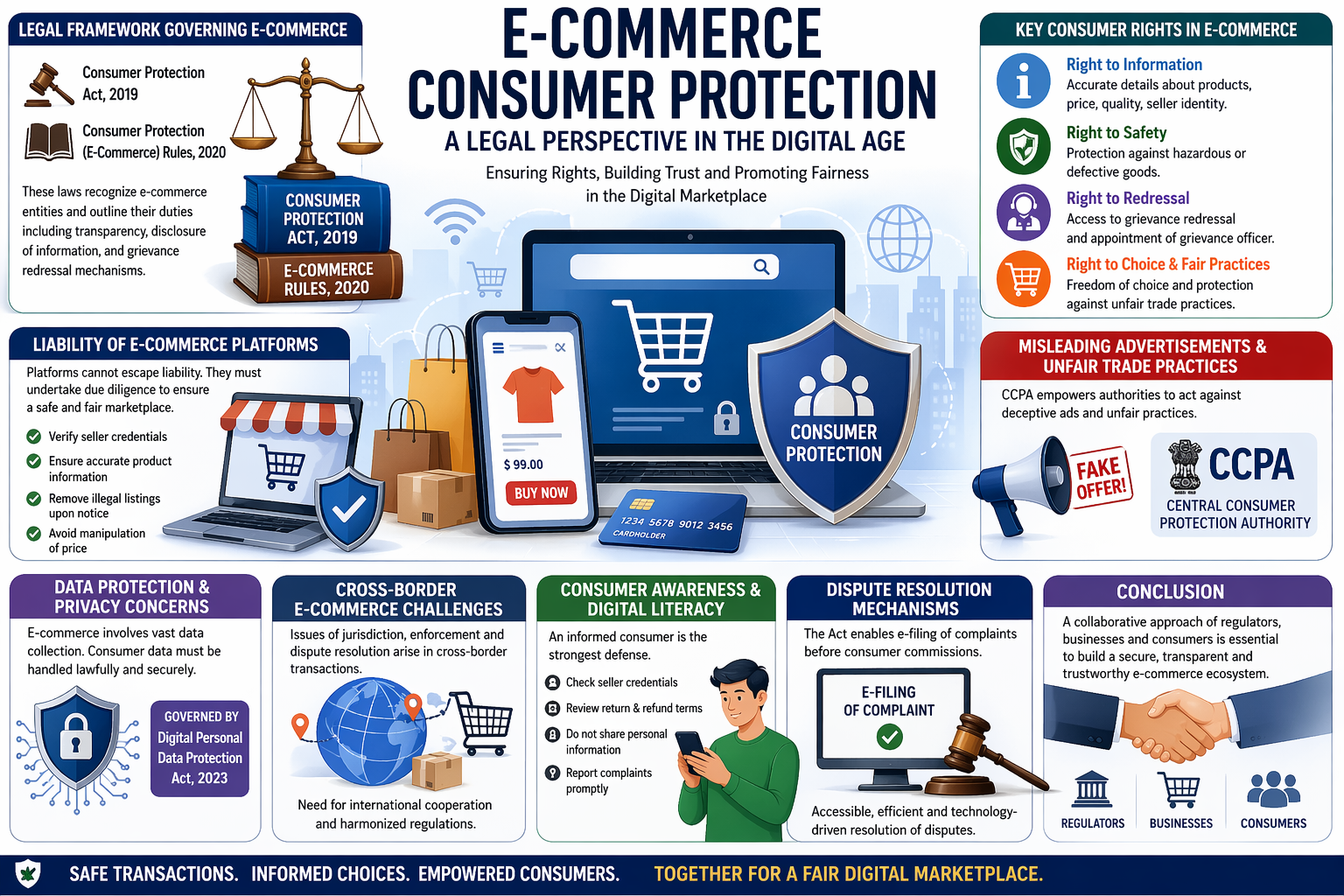
E-Commerce Consumer Protection: A Legal Perspective in the Digital Age
Introduction
The exponential growth of e-commerce has fundamentally transformed the manner in which consumers engage in commercial transactions. With the integration of digital payment systems, algorithm-driven recommendations, and efficient logistics networks, online marketplaces have created an ecosystem defined by convenience, accessibility, and global reach. However, this rapid digital expansion has simultaneously exposed consumers to a wide array of risks, including fraudulent sellers, misleading advertisements, counterfeit or defective goods, and misuse of personal data. This evolving risk landscape necessitates a strong and adaptive legal framework to ensure that consumer rights remain protected in the digital marketplace.
Legal Framework Governing E-Commerce
In India, the regulation of e-commerce is primarily governed by the Consumer Protection Act, 2019, read in conjunction with the Consumer Protection (E-Commerce) Rules, 2020. These laws represent a significant shift from traditional consumer protection regimes by explicitly recognizing e-commerce as a distinct commercial domain requiring specialized regulation.
The Act introduces the concept of “e-commerce entities” and categorizes them into inventory-based and marketplace models. Inventory-based entities directly sell goods or services to consumers, whereas marketplace entities function as intermediaries connecting buyers and sellers. This classification is critical in determining the scope of liability and regulatory obligations.
The E-Commerce Rules, 2020 further strengthen consumer protection by mandating transparency in disclosures, including seller details, product descriptions, pricing, return policies, and grievance redressal mechanisms.
Key Insight: Regulatory clarity in classification ensures that liability is not diluted in complex digital transaction chains.
Key Consumer Rights in E-Commerce
Consumers participating in online transactions are entitled to several fundamental rights that have evolved to suit the digital environment. The right to information ensures that platforms disclose accurate and complete product details, thereby preventing misleading representations. The right to safety protects consumers against hazardous and substandard goods, placing a responsibility on platforms to exercise due diligence.
Further, the right to redressal mandates the establishment of accessible grievance mechanisms, including the appointment of grievance officers. The right to choice and protection against unfair trade practices addresses concerns such as price manipulation, fake discounts, and exploitative flash sales.
Key Insight: Traditional consumer rights have expanded into enforceable digital rights, reflecting the complexities of online commerce.
Liability of E-Commerce Platforms
One of the most debated issues in e-commerce regulation is the extent of platform liability. Marketplace platforms often claim intermediary status to limit their responsibility for seller misconduct. However, Indian law imposes due diligence obligations to prevent misuse of this defense.
E-commerce entities are required to verify seller credentials, ensure accuracy of product listings, and remove unlawful content upon receiving notice. Non-compliance can result in liability for unfair trade practices or deficiency in service.
Key Insight: The legal framework seeks to balance innovation with accountability, ensuring platforms cannot evade responsibility under the guise of being intermediaries.
Misleading Advertisements and Unfair Trade Practices
The rise of influencer marketing and targeted digital advertising has increased the risk of deceptive practices. The law addresses this issue by imposing liability not only on sellers but also on endorsers and advertisers.
In this context, the Central Consumer Protection Authority plays a crucial role by investigating violations, ordering product recalls, and imposing penalties for misleading advertisements.
Key Insight: Accountability in digital advertising extends beyond manufacturers to include influencers and intermediaries.
Data Protection and Privacy Concerns
E-commerce platforms handle vast volumes of consumer data, raising concerns regarding privacy and data security. Risks such as identity theft, unauthorized data sharing, and cyber fraud have become increasingly prevalent.
While the Consumer Protection Act addresses certain unfair practices, comprehensive regulation of data privacy is governed by the Digital Personal Data Protection Act, 2023. This law mandates informed consent, lawful processing, and implementation of adequate security safeguards.
Key Insight: Data protection is now central to consumer protection, as personal data has become a critical economic asset in digital markets.
Cross-Border E-Commerce Challenges
The global nature of e-commerce enables consumers to transact with international sellers, but this also creates legal complexities related to jurisdiction, enforcement, and dispute resolution. Consumers often face difficulties in pursuing remedies against foreign entities.
Indian regulations attempt to mitigate these challenges by requiring foreign e-commerce platforms operating in India to comply with domestic laws. However, enforcement remains a challenge due to the transnational nature of digital trade.
Key Insight: Effective cross-border consumer protection requires international regulatory cooperation and harmonization.
Consumer Awareness and Digital Literacy
Legal safeguards alone are insufficient without consumer awareness. Many consumers remain unaware of their rights and the remedies available to them in case of disputes.
Digital literacy plays a crucial role in empowering consumers to make informed decisions, verify seller authenticity, and avoid fraudulent practices. Prompt reporting of grievances further strengthens the enforcement mechanism.
Key Insight: Informed consumers act as active participants in ensuring market discipline and fairness.
Dispute Resolution Mechanisms
The Consumer Protection Act, 2019 introduces a technology-driven approach to dispute resolution through e-filing of complaints. Consumers can approach District, State, or National Consumer Commissions based on the value of the claim.
This digital dispute resolution system enhances accessibility, reduces procedural delays, and aligns with the nature of e-commerce transactions.
Key Insight: Digitization of dispute resolution bridges the gap between legal rights and practical accessibility.
Conclusion
E-commerce has revolutionized the commercial landscape by offering unparalleled convenience and access to global markets. However, it has also introduced unique legal challenges that necessitate a robust and evolving regulatory framework. The Consumer Protection Act, 2019 and the E-Commerce Rules, 2020 represent significant steps toward ensuring transparency, accountability, and fairness in the digital marketplace.
As technology continues to evolve, the legal framework must adapt to address emerging challenges such as algorithmic pricing, artificial intelligence-driven decision-making, and cross-border enforcement issues. A balanced approach that promotes innovation while safeguarding consumer rights is essential for sustainable growth.
Ultimately, effective e-commerce consumer protection depends on a collaborative effort between regulators, businesses, and informed consumers, ensuring that the digital economy operates within a framework of trust, security, and equity.
Unlock the Potential of Legal Expertise with LegalMantra.net – Your Trusted Legal Consultancy Partner
Disclaimer
Every effort has been made to ensure accuracy in this material. However, inadvertent errors or omissions may occur. Any discrepancies brought to the author’s notice will be rectified in subsequent editions. The author shall not be liable for any direct, indirect, incidental, or consequential damages arising from the use of this material. This article is based on various sources including statutory enactments, judicial decisions, academic research papers, professional journals, and publicly available legal materials.
Prerna Yadav
LegalMantra.net Team