
Forget Password

View News
e-AOA of Section Company applicability and Modification of Standard Clauses
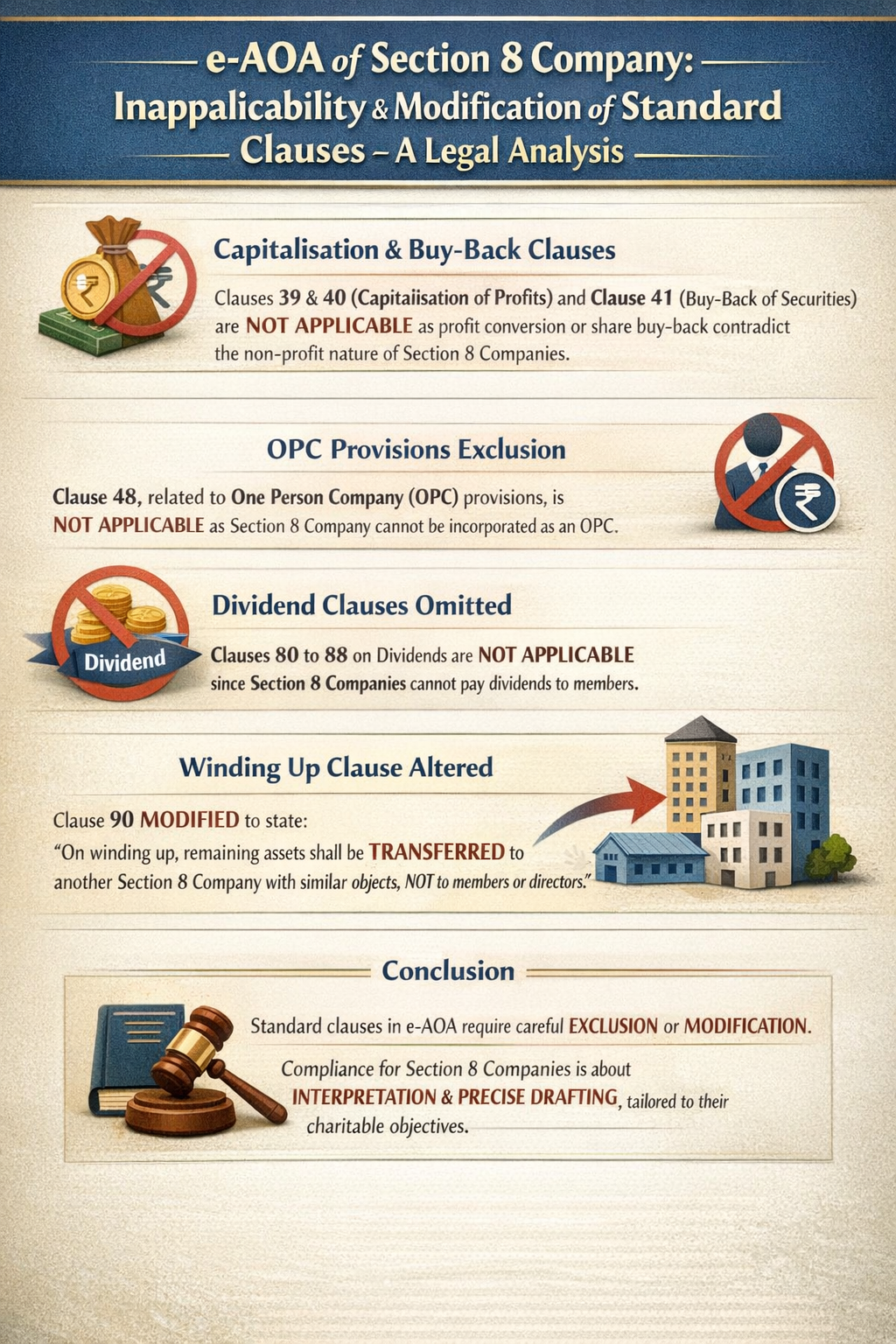
e-AOA of Section 8 Company: Inapplicability and Modification of Standard Clauses – A Legal Analysis
Introduction
The electronic Articles of Association (e-AOA) prescribed under the Companies Act, 2013 provide a standardized structure for companies at the time of incorporation. However, in the case of a Section 8 Company, which is formed for charitable or not-for-profit purposes, this standardized format cannot be adopted in its entirety. The very foundation of a Section 8 Company lies in the application of its income towards its objects and the prohibition on distribution of profits to its members. This fundamental distinction necessitates a careful examination of each clause of the e-AOA to determine its applicability, relevance, and need for modification.
The process of drafting or reviewing the e-AOA for such companies therefore becomes an exercise in legal interpretation rather than mere form filling. Certain clauses become completely inapplicable due to the nature of the entity, while others require substantial alteration to align with statutory provisions and regulatory intent.
Inapplicability of Clauses Relating to Capitalisation and Member Benefits
Clauses 39 and 40 of the e-AOA, which generally deal with the capitalisation of profits, are not applicable in the context of a Section 8 Company. These clauses typically provide for conversion of accumulated profits into share capital, such as through the issuance of bonus shares. However, since a Section 8 Company is prohibited from distributing its profits in any form, whether directly or indirectly, the concept of capitalisation becomes inconsistent with its governing principles. The conversion of profits into share capital ultimately benefits members and therefore contradicts the statutory mandate that income must be applied solely towards the objects of the company. As a result, these clauses are treated as not applicable and are excluded from the Articles.
Similarly, Clause 41, which deals with buy-back of securities, is also not applicable. Buy-back provisions allow a company to repurchase its own shares, thereby returning capital to its members. In the case of a Section 8 Company, such a mechanism would amount to distribution of funds to members, which is expressly prohibited under the Companies Act, 2013. The absence of any profit motive and the restriction on financial return to members make buy-back provisions legally untenable in such entities. Accordingly, this clause is omitted to ensure that the Articles remain compliant with the non-profit character of the company.
Exclusion of OPC-related and Other Irrelevant Provisions
Clause 48, which pertains to provisions applicable to a One Person Company (OPC), is not applicable to a Section 8 Company. The law does not permit incorporation of a Section 8 Company as an OPC, as such companies are required to have a broader membership base and governance structure. The OPC framework is designed for single-member control, whereas Section 8 Companies function on principles of collective governance and public interest. Therefore, inclusion of OPC-related provisions would be structurally and legally inappropriate, and such clauses are excluded from the e-AOA.
Further, Clause 76 is also treated as not applicable, particularly where its contents relate to aspects that are inconsistent with the operational and financial restrictions imposed on Section 8 Companies. In many cases, such clauses may indirectly relate to profit-oriented activities or member entitlements, which are not permissible in a not-for-profit entity. Hence, a cautious approach is adopted, and such provisions are excluded to avoid any potential conflict with the statutory framework.
Non-Applicability of Dividend-related Clauses
Clauses 80 to 88 of the e-AOA, which deal with declaration and payment of dividends, reserves, and related matters, are entirely inapplicable to Section 8 Companies. The Companies Act, 2013 clearly prohibits payment of dividends by such companies to their members. The essence of a Section 8 Company lies in the reinvestment of its income towards its stated objectives, rather than distribution among shareholders.
In light of this restriction, these clauses are omitted in their entirety. Instead, the Articles must implicitly and explicitly reinforce that all income and profits shall be utilized solely for the promotion of the company’s objects, and no portion shall be paid or transferred, directly or indirectly, to any member. This exclusion is fundamental to preserving the legal identity and compliance status of the entity.
Modification of Winding Up Provisions
Clause 90, which relates to winding up of the company, requires significant modification in the case of a Section 8 Company. In standard company structures, this clause allows for distribution of residual assets among shareholders after settlement of liabilities. However, such a provision is not permissible for Section 8 Companies.
Accordingly, Clause 90 must be altered to explicitly provide that no assets of the company shall be distributed to its members, directors, or officers upon winding up. Instead, any remaining assets must be transferred to another Section 8 Company having similar objects, subject to compliance with applicable legal provisions and approvals. This modification is not merely procedural but is a statutory requirement, ensuring that the assets continue to be utilized for charitable or not-for-profit purposes even after the dissolution of the company.
Conclusion
The drafting of the e-AOA for a Section 8 Company clearly demonstrates that standardized legal formats cannot be applied uniformly across all types of entities. The unique nature of such companies, characterized by absence of profit motive and restrictions on distribution, necessitates exclusion or modification of several clauses that are otherwise common in the e-AOA.
Clauses relating to capitalisation of profits, buy-back of securities, OPC provisions, dividend distribution, and certain operational aspects are rendered inapplicable due to statutory restrictions. At the same time, provisions relating to winding up must be carefully altered to ensure compliance with legal requirements.
This exercise highlights a crucial aspect of corporate law practice, namely that compliance is not limited to procedural adherence but extends to thoughtful interpretation and precise drafting. The true value lies in understanding the intent of the law and ensuring that every clause of the Articles reflects that intent in both letter and spirit.
Unlock the Potential of Legal Expertise with LegalMantra.net – Your Trusted Legal Consultancy Partner
Disclaimer
Every effort has been made to ensure accuracy in this material. However, inadvertent errors or omissions may occur. Any discrepancies brought to the author’s notice will be rectified in subsequent editions. The author shall not be liable for any direct, indirect, incidental, or consequential damages arising from the use of this material. This article is based on various sources including statutory enactments, judicial decisions, academic research papers, professional journals, and publicly available legal materials.
Anshul Goel