
Forget Password

View News
DISCLOSURE REQUIREMENTS UNDER REGULATION 30 OF SEBI LODR, 2015 FOR ACTIONS TAKEN OR ORDER PASSED
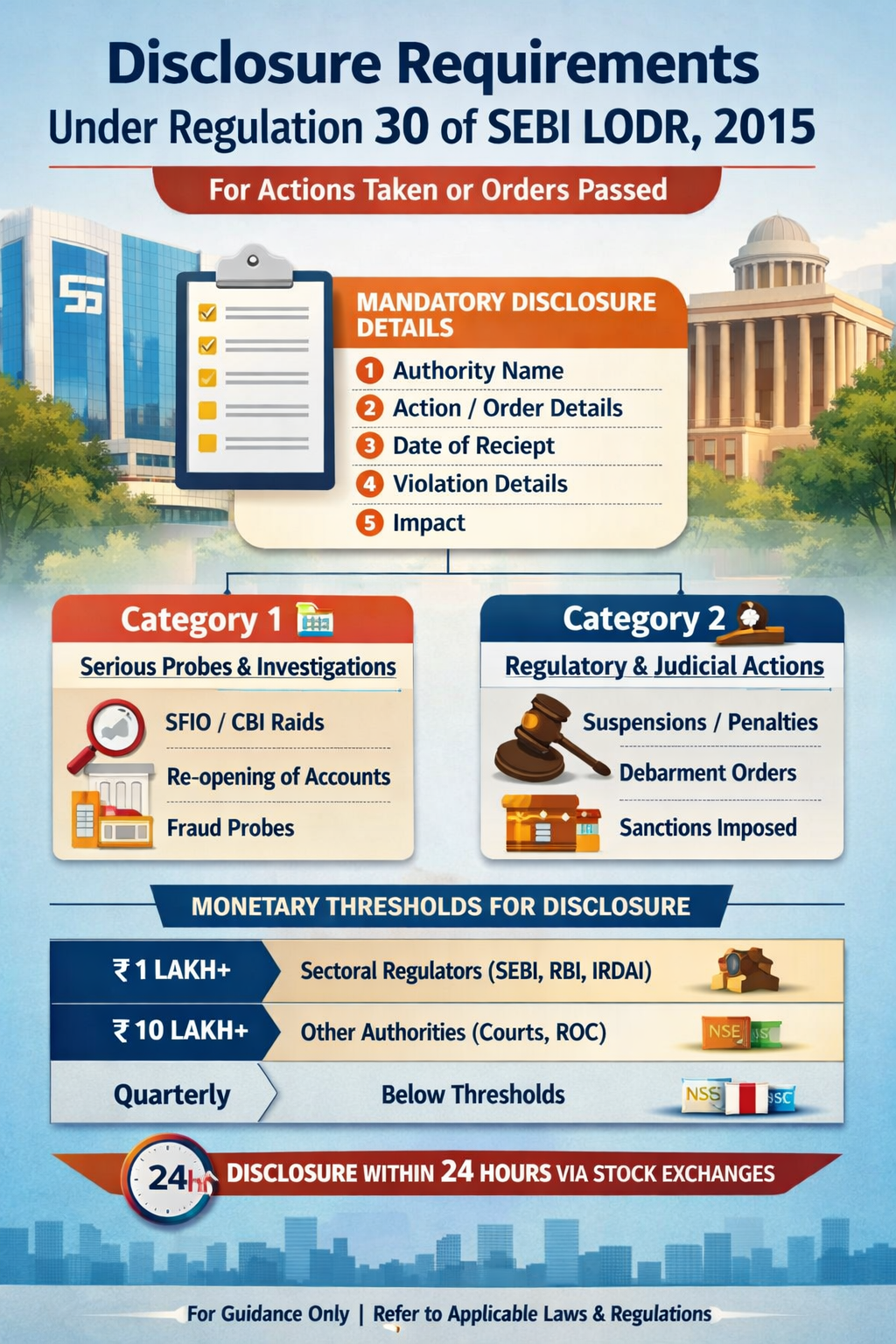
Disclosure Requirements under Regulation 30 of SEBI (LODR), 2015 for Actions Taken or Orders Passed
1. Introduction
The SEBI (Listing Obligations and Disclosure Requirements) Regulations, 2015 (“LODR Regulations”) lay down comprehensive disclosure norms for listed entities to ensure transparency, accountability, and timely dissemination of material information to investors.
Regulation 30 specifically mandates disclosure of certain events or information that are deemed material. Notably, certain events—particularly regulatory, judicial, or enforcement actions—require mandatory disclosure without applying the materiality criteria under Regulation 30(4).
This ensures that stakeholders are promptly informed of any significant actions taken against the listed entity or its key stakeholders.
2. Applicability of Disclosure Requirement
The disclosure requirement applies when any action is taken against:
- The listed entity
- Promoters or promoter group
- Directors
- Key Managerial Personnel (KMP)
- Senior management
- Subsidiaries (to the extent relevant to the listed entity)
3. Mandatory Disclosure Details
For every such event, the listed entity must disclose the following five essential elements:
| S. No. | Particulars | Description |
|---|---|---|
| (i) | Name of the Authority | Name of regulatory, statutory, enforcement, or judicial authority (e.g., SEBI, ROC, NCLT). |
| (ii) | Nature and Details of Action/Order | Brief description of the action taken or order passed (e.g., investigation initiated, penalty imposed). |
| (iii) | Date of Receipt | Date on which the order, direction, or communication is received. |
| (iv) | Details of Violation/Contravention | Nature of default, including relevant legal provisions violated. |
| (v) | Impact | Financial, operational, or reputational impact; to be quantified in monetary terms, wherever possible. |
4. Timeline for Disclosure
All disclosures under Regulation 30 must be made:
- Within 24 hours from the occurrence of the event or receipt of information
- Through stock exchange platforms (BSE/NSE)
5. Categories of Disclosable Events
Category 1: Serious Probes and Investigative Actions
These involve high-impact regulatory scrutiny and must be disclosed immediately:
| Event | Illustrative Examples |
|---|---|
| Search or Seizure | Raids conducted by authorities such as SFIO, CBI, or Income Tax Department |
| Re-opening of Accounts | Under Section 130 of the Companies Act, 2013 |
| Investigation | Investigations initiated under Chapter XIV of the Companies Act, including fraud probes |
Category 2: Regulatory, Judicial, and Enforcement Actions
These include adverse actions or penalties imposed by authorities:
| Event | Examples / Description |
|---|---|
| Suspension | Suspension of trading, licenses, or business operations |
| Fine or Penalty | Monetary penalties imposed by regulatory authorities |
| Settlement of Proceedings | Consent orders or settlement agreements with regulators |
| Debarment | Restriction from accessing capital markets or holding office |
| Disqualification | Disqualification of directors or KMP |
| Closure of Operations | Regulatory orders requiring shutdown of business activities |
| Sanctions Imposed | Export/import bans or other restrictions |
| Warning or Caution | Advisory notices or warning letters |
| Other Similar Actions | Any analogous action, irrespective of nomenclature |
6. Monetary Thresholds for Disclosure
The requirement for disclosure also depends on the quantum of penalty or fine, as detailed below:
| Threshold Amount | Authority Type | Disclosure Timeline |
|---|---|---|
| Rs 1,00,000 or more | Sectoral regulators or enforcement agencies (e.g., SEBI, RBI, IRDAI) | Within 24 hours |
| Rs 10,00,000 or more | Other authorities (e.g., Courts, ROC) | Within 24 hours |
| Below prescribed limits | Any authority | Quarterly disclosure in specified format |
7. Practical Significance
Timely disclosure under Regulation 30 ensures:
- Enhanced investor confidence through transparency
- Reduction in information asymmetry
- Regulatory compliance and avoidance of penalties
- Better corporate governance practices
Non-compliance may attract penalties under the LODR Regulations and other applicable laws.
8. Conclusion
Regulation 30 of the LODR Regulations plays a crucial role in maintaining market integrity and investor protection by mandating immediate disclosure of significant regulatory and judicial actions.
Listed entities must establish robust internal systems to ensure real-time tracking and reporting of such events, thereby aligning with the principles of transparency and good governance.
Disclaimer
The contents of this document are based on current legal provisions and information available as on date. While due care has been taken to ensure accuracy and reliability, no responsibility is assumed for any errors or omissions. Readers are advised to refer to the applicable laws and regulations or seek professional advice before acting on the basis of this information. This document does not constitute legal advice, and no liability is accepted for any consequences arising from its use.
From the Desk of CS Sharath