
Forget Password

View News
Disclosure of Encumbered Shares under SEBI Regulations: A Comprehensive Compliance Guide
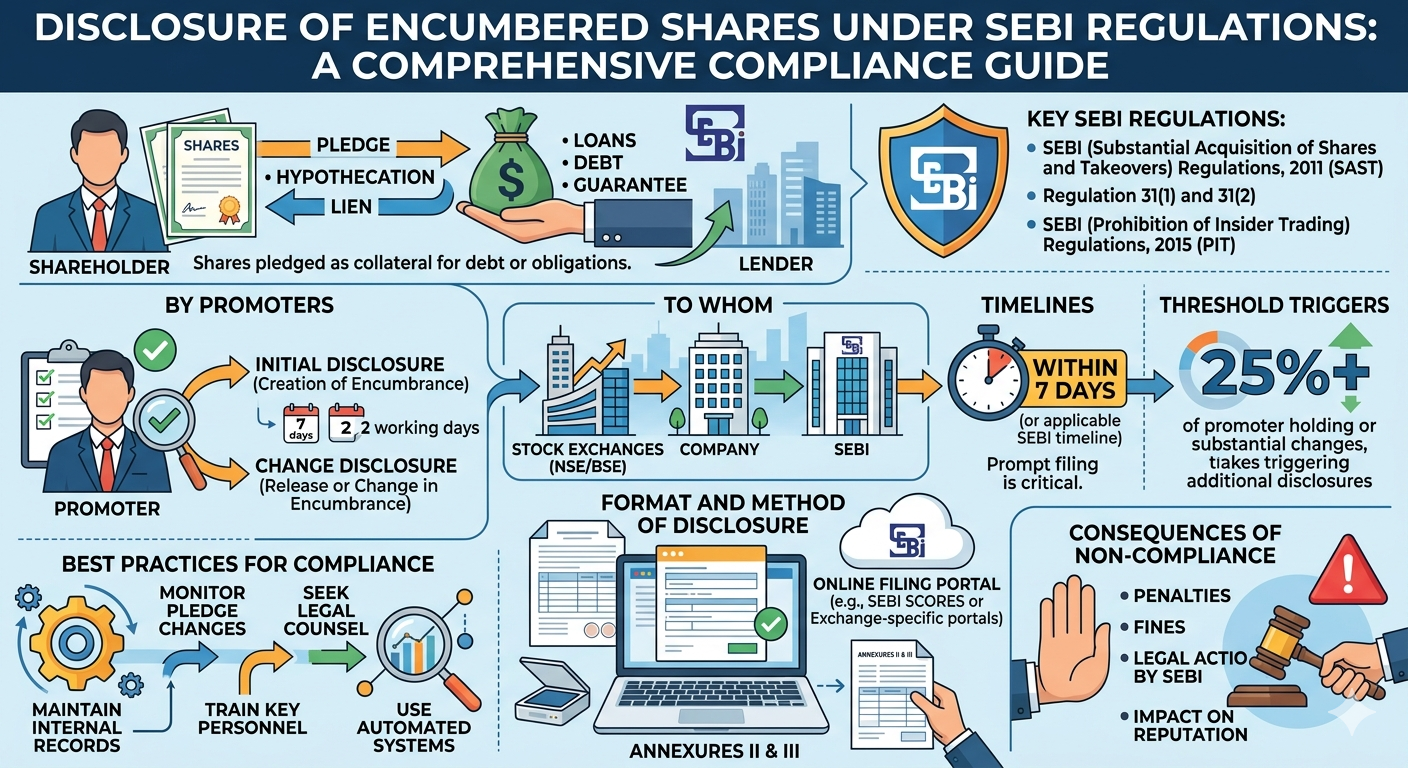
Disclosure of Encumbered Shares under SEBI Regulations: A Comprehensive Compliance Guide
1. Introduction
In the Indian securities market, transparency in shareholding structures—especially those involving promoters—is of paramount importance. One critical aspect of such transparency is the disclosure of encumbered shares, which may indicate financial obligations or risk exposure of promoters.
The Securities and Exchange Board of India (SEBI) has laid down specific provisions under the SEBI (Substantial Acquisition of Shares and Takeovers) Regulations, 2011 (“SAST Regulations”) to regulate such disclosures. These provisions ensure that investors are informed about any encumbrances on promoter holdings that may impact control or financial stability of the company.
2. Meaning of Encumbrance
The term encumbrance has been broadly defined under Regulation 28(3) of the SAST Regulations to include:
- Pledge, lien, or any such transaction
- Any covenant, transaction, or condition restricting transferability
- Any arrangement that indirectly secures an obligation
Thus, even indirect restrictions or structured financing arrangements may qualify as encumbrance.
3. Regulatory Framework: Regulation 31
3.1 Disclosure of Encumbered Shares – Regulation 31(1)
Promoters and persons acting in concert (PAC) are required to disclose details of encumbrances created on their shareholding.
| Particulars | Requirement |
|---|---|
| Trigger Event | Creation of encumbrance |
| Obligation | Disclosure of details of encumbered shares |
| Timeline | Within 7 working days |
| Applicable To | Promoter / PAC |
| Mode | Filing with Stock Exchanges and Target Company |
Key Insight:
This disclosure ensures that stakeholders are aware of promoter-level financing arrangements that could impact control or ownership.
3.2 Invocation or Release – Regulation 31(2)
Any invocation or release of encumbrance must also be disclosed.
| Particulars | Requirement |
|---|---|
| Trigger Event | Invocation or release of encumbrance |
| Timeline | Within 7 working days |
| Applicable To | Promoter / PAC |
| Scope | Includes partial or full release |
Practical Note:
Invocation may indicate financial stress, making this disclosure particularly sensitive for investors.
3.3 Mode of Disclosure – Regulation 31(3)
The regulation prescribes a dual disclosure mechanism:
| Recipient | Purpose |
|---|---|
| Stock Exchanges | Public dissemination |
| Target Company | Internal governance and compliance |
Important Point:
Failure to comply with either leg of the disclosure may be treated as non-compliance.
3.4 Annual Declaration – Regulation 31(4)
Promoters are required to submit an annual declaration confirming:
- No encumbrance exists, OR
- No additional encumbrance has been created beyond those already disclosed
| Particulars | Requirement |
|---|---|
| Nature | Annual declaration |
| Coverage | Direct & indirect encumbrances |
| Applicability | Promoter / PAC |
3.5 Submission of Annual Declaration – Regulation 31(5)
| Particulars | Requirement |
|---|---|
| Timeline | Within 7 working days from end of financial year |
| Submission To | (a) Stock Exchanges (b) Audit Committee |
Compliance Tip:
This serves as an annual compliance checkpoint, often verified during secretarial audits.
4. Exemption: Depository-Based Encumbrance
A significant practical exemption exists:
- If encumbrance is created through the depository system, separate disclosure may not be required in certain cases.
Rationale:
- Depositories already capture and reflect such encumbrances in real-time
- Reduces duplication of compliance
However, professionals should exercise caution and verify whether the exemption is applicable in each case.
5. Regulatory Sandbox under Regulation 31A
5.1 Concept of Regulatory Sandbox – Regulation 31A (Explanation)
The regulatory sandbox is a controlled testing environment that allows entities to experiment with innovative financial products or services.
| Feature | Description |
|---|---|
| Nature | Live testing framework |
| Scope | Limited users |
| Duration | Restricted timeframe |
| Objective | Promote innovation |
5.2 Grant of Exemption – Regulation 31A(1)
SEBI may grant exemptions from certain regulatory provisions:
| Particulars | Details |
|---|---|
| Authority | SEBI |
| Duration | Up to 12 months |
| Eligible Applicants | Any person or class of persons |
| Purpose | Innovation in securities market |
5.3 Conditions for Exemption – Regulation 31A(2)
Entities operating under sandbox must comply with conditions imposed by SEBI:
- Continuous compliance obligations
- Reporting requirements
- Risk mitigation measures
| Aspect | Requirement |
|---|---|
| Compliance Nature | Ongoing |
| Monitoring | By SEBI |
| Flexibility | Conditional |
6. Practical Compliance Checklist
| Compliance Event | Timeline | Action Required |
|---|---|---|
| Creation of encumbrance | 7 working days | Disclosure |
| Invocation / Release | 7 working days | Disclosure |
| Annual declaration | End of FY + 7 working days | Filing |
| Sandbox exemption | Case-specific | Application to SEBI |
7. Key Compliance Risks
- Non-disclosure or delayed disclosure ? SEBI penalties
- Incorrect classification of encumbrance
- Failure in dual filing (Stock Exchange + Company)
- Overlooking indirect encumbrances
8. Role of Company Secretary
A Company Secretary plays a crucial role in:
- Monitoring promoter shareholding changes
- Coordinating disclosures with promoters
- Ensuring timely filings with stock exchanges
- Reporting to Audit Committee
- Supporting secretarial audit compliance
9. Conclusion
The disclosure framework for encumbered shares under SEBI regulations reflects a strong emphasis on transparency, investor protection, and market integrity. While the procedural requirements may appear routine, their implications are significant—especially in assessing promoter credibility and financial stability.
Further, the introduction of the regulatory sandbox demonstrates SEBI’s progressive approach in balancing regulation with innovation.
Disclaimer
The contents of this document are based on the current legal framework and available information. While reasonable care has been taken to ensure accuracy, readers are advised to refer to the applicable provisions of law and seek professional advice where necessary. This document is not intended to be a substitute for legal opinion, and no liability is assumed for reliance placed on it.
From the desk of CS Sharath