
Forget Password

View News
Corporate Governance Exemptions for SME Exchange Listed Companies under SEBI LODR
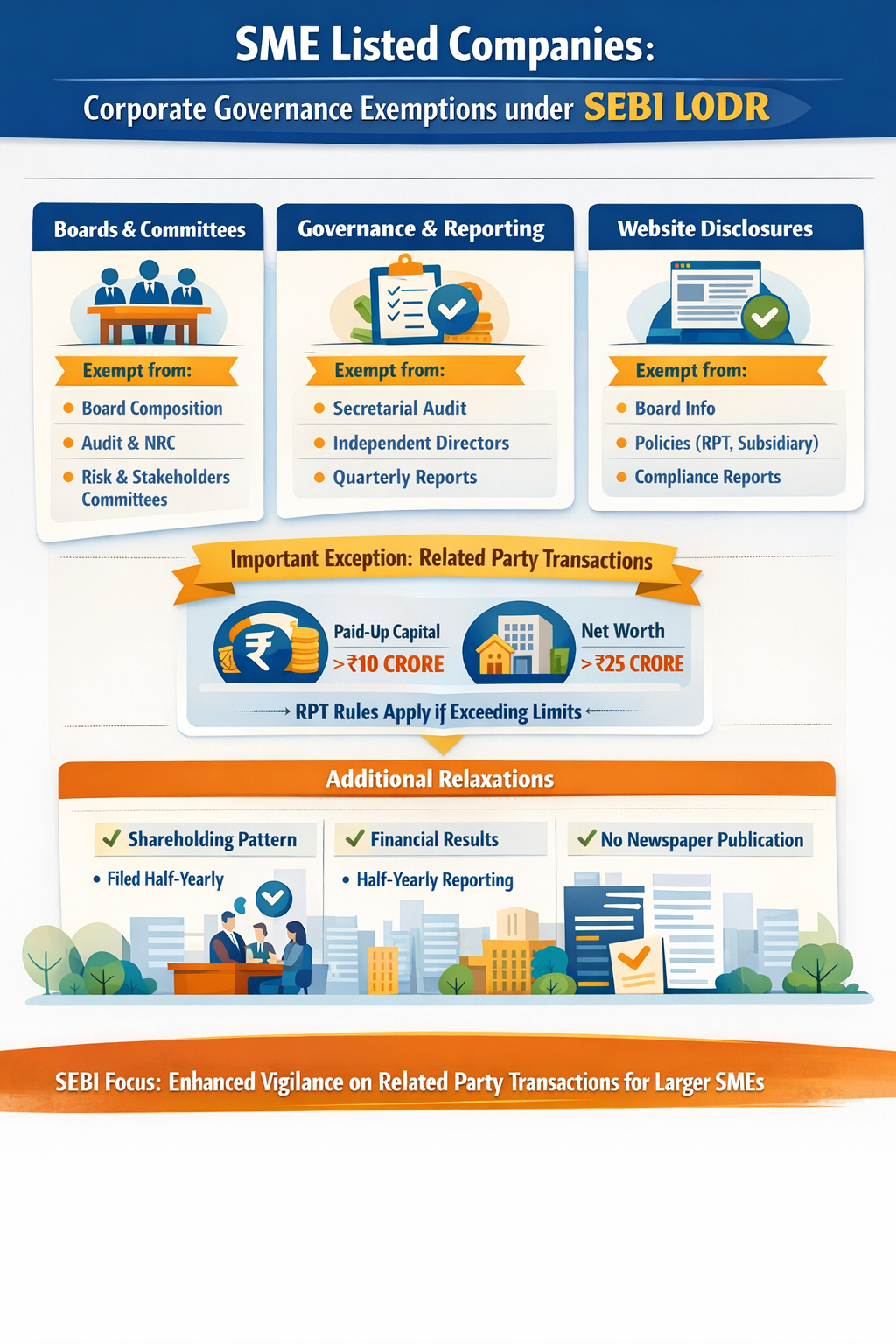
Corporate Governance Exemptions for SME Exchange Listed Companies under SEBI LODR
Introduction
The Securities and Exchange Board of India (SEBI) has established a comprehensive regulatory framework to ensure transparency, accountability, and protection of investor interests in listed companies. The SEBI (Listing Obligations and Disclosure Requirements) Regulations, 2015 (LODR) set out detailed provisions relating to corporate governance, reporting, board composition, and disclosures.
However, recognizing the distinct operational and financial profile of Small and Medium Enterprises (SMEs), SEBI has provided certain relaxations to entities listed on the SME Exchange. These exemptions are designed to reduce regulatory burden while still ensuring key governance standards.
As per Regulation 15(2) of SEBI LODR, the corporate governance provisions specified under the regulations do not apply to entities listed on the SME Exchange, unless SEBI explicitly mandates compliance in specific cases. This framework allows SME listed companies to focus on growth and operational scalability without being unduly constrained by certain compliance obligations that are more suited to larger listed entities.
Corporate Governance Exemptions for SME Listed Companies
The corporate governance exemptions for SME listed entities can be summarized in the following table:
| Category | Regulation / Provision | Exemption Details | Explanation |
|---|---|---|---|
| Board & Committees | Regulation 17 – Board Composition | Not bound by minimum board composition requirements | Recognizes limited scale and simplifies board management |
| Regulation 17A – Maximum Directorships | Relaxation on the limit of directorships per director | Suitable for SMEs with fewer directors | |
| Regulation 18 – Audit Committee | Not mandatory | Reduces administrative and procedural burden | |
| Regulation 19 – Nomination & Remuneration Committee (NRC) | Not mandatory | Simplifies governance structure | |
| Regulation 20 – Stakeholders Relationship Committee | Not mandatory | Fewer formalities for smaller companies | |
| Regulation 21 – Risk Management Committee | Not mandatory | Less critical for SMEs without complex operations | |
| Regulation 22 – Vigil Mechanism | Not mandatory | Optional due to limited scale | |
| Governance & Reporting | Regulation 24 – Subsidiary Governance | Exempt | SME may not have complex subsidiaries requiring oversight |
| Regulation 24A – Secretarial Audit / Compliance Report | Exempt | Reduces costs of statutory compliance | |
| Regulation 25 – Independent Directors | Exempt | Optional appointment for SMEs | |
| Regulation 26 & 26A – KMP obligations & vacancies | Exempt | Flexible management structure | |
| Regulation 27 – Quarterly Corporate Governance Reporting | Exempt | Reporting simplification | |
| Website Disclosures | Regulation 46(2)(b)-(i) & (t) | Exempt from publishing: - Board profiles - Committee composition - Policies (RPT, material subsidiary, vigil) - Director familiarisation programs - Secretarial compliance reports |
SMEs may have limited resources for extensive website disclosures |
| Schedule V | Para C – Corporate Governance Report | Exempt | Reporting simplification |
| Para D – CEO Declaration on Code of Conduct | Exempt | Optional for smaller entities | |
| Para E – Auditor / PCS Compliance Certificate | Exempt | Not required for SMEs | |
| Related Party Transactions (RPTs) | Regulation 23 | Applicable only if: - Paid-up equity share capital > Rs 10 Cr OR - Net worth > Rs 25 Cr |
Ensures transparency and minority shareholder protection. Compliance required within 6 months if thresholds exceeded, and continues until thresholds remain below limits for 3 consecutive FYs |
| Procedural Relaxations | Regulation 31 – Shareholding Pattern | Can be filed half-yearly(within 21 days of half-year end) instead of quarterly | Reduces frequency of filings |
| Regulation 33 – Financial Results | Half-yearly results permitted; Year-to-date results not required | Simplifies reporting obligations | |
| Regulation 47 – Newspaper Advertisements | Publication of results and disclosures in newspapers not required | Reduces costs for SMEs |
Conclusion
SEBI has designed a pragmatic framework for SME listed entities that balances the need for transparency and investor protection with the operational realities of smaller companies. SME listed companies enjoy significant exemptions in board composition, committees, reporting, and website disclosures, allowing them to focus on business growth.
However, SEBI has retained key safeguards, particularly concerning Related Party Transactions, to ensure that governance lapses do not compromise investor interests. Moreover, as SMEs grow and cross specified financial thresholds, they become gradually subject to the broader corporate governance framework, ensuring a smooth transition to stricter compliance standards.
In essence, while SMEs benefit from regulatory reliefs, they must maintain internal governance discipline and adopt good practices wherever feasible to build investor confidence and facilitate sustainable growth.
"Unlock the Potential of Legal Expertise with LegalMantra.net - Your Trusted Legal Consultancy Partner”
Disclaimer: Every effort has been made to avoid errors or omissions in this material in spite of this, errors may creep in. Any mistake, error or discrepancy noted may be brought to our notice which shall be taken care of in the next edition In no event the author shall be liable for any direct indirect, special or incidental damage resulting from or arising out of or in connection with the use of this information Many sources have been considered including Newspapers, Journals, Bare Acts, Case Materials , Charted Secretary, Research Papers etc
Mayank Garg
LegalMantra.net team