
Forget Password

View News
Compensation for Non-Performance Not Taxable as “Supply” under GST: Delhi High Court Grants Interim Relief to InterGlobe Aviation Ltd.
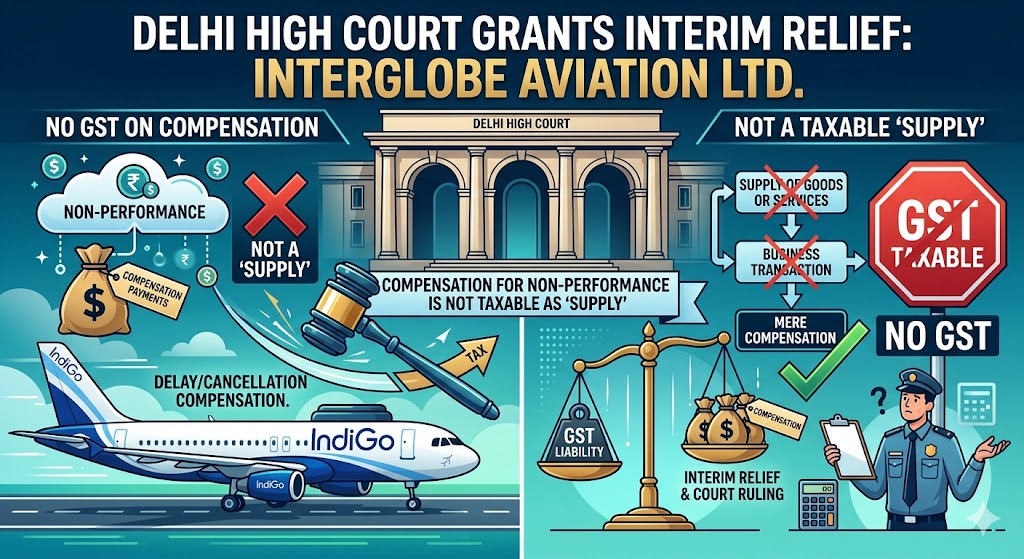
Compensation for Non-Performance Not Taxable as “Supply” under GST: Delhi High Court Grants Interim Relief to InterGlobe Aviation Ltd.
The recent interim order passed by the Delhi High Court in InterGlobe Aviation Limited v. Additional Commissioner CGST South Commissionerate & Ors., W.P.(C) 7271/2026, dated 22 May 2026, has once again reignited the debate regarding the taxability of compensation, damages, and liquidated damages under the Goods and Services Tax (“GST”) regime.
The Court prima facie observed that compensation received for non-performance leading to business loss may not qualify as a “supply” under Section 7 of the Central Goods and Services Tax Act, 2017 (“CGST Act”), especially in light of the CBIC Circular dated 03 August 2022. Consequently, the Court granted interim protection against coercive action.
This order is significant because disputes concerning liquidated damages, cancellation charges, compensation for breach of contract, and forfeiture amounts have been one of the most litigated issues under GST law.
Background of the Case
The petitioner, InterGlobe Aviation Limited, challenged the GST demand proceedings initiated by the department on compensation amounts received due to non-performance of contractual obligations.
The core issue before the Court was:
Whether compensation received for non-performance resulting in business loss can be regarded as “supply” under Section 7 of the CGST Act, 2017 and thereby attract GST?
The petitioner relied heavily upon the CBIC Circular dated 03.08.2022, particularly Clauses 7 and 7.1, which clarify that compensation for breach of contract generally does not constitute consideration for supply.
The Court observed prima facie that:
- the compensation was towards business loss,
- the amount was compensatory in nature,
- there was no positive act of supply,
- therefore, such amount may fall outside the scope of taxable supply.
Accordingly, the Court restrained coercive action till the next date of hearing.
Relevant Legal Framework under GST
1. Meaning of “Supply” under Section 7 of CGST Act
Section 7(1)(a) of the CGST Act provides:
“Supply” includes all forms of supply of goods or services or both such as sale, transfer, barter, exchange, license, rental, lease or disposal made or agreed to be made for a consideration in the course or furtherance of business.
Thus, for GST to apply, the following ingredients must generally exist:
| Essential Element | Requirement |
|---|---|
| Supply | There must be a positive act of supply |
| Consideration | Payment must be linked to such supply |
| Business Nexus | Transaction should be in course or furtherance of business |
The controversy arises where money is paid merely as damages or compensation for breach.
Compensation vs Consideration
The distinction between “consideration” and “compensation” becomes crucial.
Consideration
Consideration is paid:
- for a reciprocal obligation,
- for rendering a service,
- for tolerating an act,
- for agreeing to refrain from an act.
Compensation
Compensation is paid:
- due to breach,
- for loss suffered,
- to indemnify damages,
- without existence of reciprocal performance.
The legal question therefore becomes:
Does receipt of compensation automatically imply that a taxable service has been rendered?
The Delhi High Court appears to have answered this negatively, at least prima facie.
Schedule II and the Concept of “Agreeing to Tolerate an Act”
One of the most frequently invoked provisions by GST authorities in such disputes is Entry 5(e) of Schedule II to the CGST Act.
Entry 5(e) of Schedule II
The following is treated as supply of services:
“agreeing to the obligation to refrain from an act, or to tolerate an act or a situation, or to do an act.”
Departments often argue that:
- acceptance of compensation,
- liquidated damages,
- cancellation charges,
- forfeiture amounts,
amount to “tolerating an act” and therefore constitute taxable services.
However, courts have increasingly rejected this expansive interpretation.
CBIC Circular Dated 03 August 2022
The CBIC issued Circular No. 178/10/2022-GST dated 03.08.2022 to clarify the taxability of various transactions involving damages, penalties, and compensation.
Clause 7 of the Circular
The Circular clarified that:
- mere payment of damages for breach of contract,
- compensation for non-performance,
- liquidated damages,
would not automatically qualify as consideration for a supply.
Clause 7.1
The Circular specifically states that:
where the payment is merely a flow of money consequent to breach of contract and there is no agreement to tolerate the breach, GST may not apply.
This clarification significantly narrows the scope of Entry 5(e) of Schedule II.
The Delhi High Court relied prima facie upon these clauses while granting interim protection.
Judicial Trend on Liquidated Damages and GST
The present order aligns with several judicial precedents under both GST and Service Tax regimes.
Important Judicial Precedents
1. Maharashtra Authority for Advance Ruling in Maharashtra State Power Generation Co. Ltd.
The AAR held that liquidated damages recovered for delay constituted consideration for tolerating an act and hence taxable.
This ruling triggered widespread controversy.
2. Customs, Excise and Service Tax Appellate Tribunal in South Eastern Coalfields Ltd.
The Tribunal held that penalty for breach cannot automatically be treated as consideration for tolerating an act.
There must exist:
- a conscious agreement,
- contractual reciprocity,
- intention to supply a service.
3. Madras High Court in GE T&D India Ltd.
The Court observed that damages for breach are compensatory and not contractual consideration for any independent service.
4. Gujarat High Court in Gujarat State Fertilizers
The Court emphasized that every compensation clause cannot be artificially treated as a taxable service.
Key Legal Principles Emerging
From judicial precedents and the CBIC Circular, the following principles emerge:
| Principle | Position |
|---|---|
| Breach of contract | Not automatically taxable |
| Compensation for loss | Generally not taxable |
| Independent obligation to tolerate | Necessary for GST applicability |
| Mere flow of money | Insufficient to constitute supply |
| Reciprocity | Essential element |
| Intention to supply service | Must exist |
Why This Delhi High Court Order is Significant
The interim order is important for several reasons.
1. Recognition of Compensatory Nature
The Court recognized that compensation for business loss may not amount to supply.
This is crucial because GST authorities often mechanically invoke Schedule II.
2. Reliance on CBIC Circular
The Court gave persuasive value to the CBIC Circular dated 03.08.2022.
This strengthens taxpayer reliance on departmental clarifications.
3. Protection Against Coercive Recovery
The Court restrained coercive action, which is important considering aggressive GST recovery mechanisms.
4. Potential Industry-Wide Impact
If the final judgment follows the interim reasoning, it may impact:
- aviation industry,
- infrastructure contracts,
- EPC agreements,
- commercial lease arrangements,
- supply contracts,
- logistics and shipping sectors.
Practical Implications for Businesses
Businesses receiving damages or compensation should carefully evaluate:
Documentation
Contracts should clearly demonstrate:
- compensation is for breach,
- payment is indemnificatory,
- no independent service is intended.
Avoid Ambiguous Drafting
Clauses suggesting:
- “tolerance,”
- “permission,”
- “allowance,”
may strengthen the department’s case.
GST Risk Review
Companies should reassess GST positions on:
- liquidated damages,
- cancellation charges,
- forfeiture income,
- termination compensation,
- delay penalties.
Distinction Between Taxable and Non-Taxable Scenarios
| Scenario | GST Position |
|---|---|
| Compensation for breach causing loss | Generally non-taxable |
| Independent agreement to tolerate an act | Taxable |
| Non-compete agreement | Taxable |
| Cancellation fee for optional cancellation facility | Potentially taxable |
| Pure damages without reciprocal obligation | Generally non-taxable |
Analysis of the Court’s Prima Facie View
The Delhi High Court appears to have adopted the following reasoning:
- There must be an identifiable supply.
- Compensation for breach is not necessarily consideration.
- Mere occurrence of breach does not create a taxable service.
- Entry 5(e) cannot be interpreted expansively.
- Circular dated 03.08.2022 supports the taxpayer’s position.
This approach aligns with settled contractual jurisprudence where damages are restorative rather than remunerative.
Possible Future Impact on GST Litigation
The final outcome of this case may significantly influence pending disputes involving:
- liquidated damages,
- delay compensation,
- contract termination payments,
- forfeiture of deposits,
- settlement compensation.
It may also restrict overbroad departmental interpretation of “tolerating an act.”
Conclusion
The interim order of the Delhi High Court in InterGlobe Aviation Limited v. Additional Commissioner CGST South Commissionerate & Ors. marks another important judicial development in GST jurisprudence concerning compensation and liquidated damages.
The Court’s prima facie observation that compensation for non-performance resulting in business loss may not amount to “supply” under Section 7 of the CGST Act reinforces the principle that:
GST is leviable on commercial supplies and not on every monetary flow arising from contractual disputes.
The matter will now be closely watched by taxpayers, legal professionals, and revenue authorities alike, as the final decision may shape the future taxability framework for compensation-related transactions under GST law.
Unlock the Potential of Legal Expertise with LegalMantra.net – Your Trusted Legal Consultancy Partner
Disclaimer
Every effort has been made to ensure accuracy in this material. However, inadvertent errors or omissions may occur. Any discrepancies brought to the author’s notice will be rectified in subsequent editions. The author shall not be liable for any direct, indirect, incidental, or consequential damages arising from the use of this material. This article is based on various sources including statutory enactments, judicial decisions, academic research papers, professional journals, and publicly available legal materials.
Mayank Garg