
Forget Password

View News
Bhagheeratha Engineering Ltd. v. State of Kerala
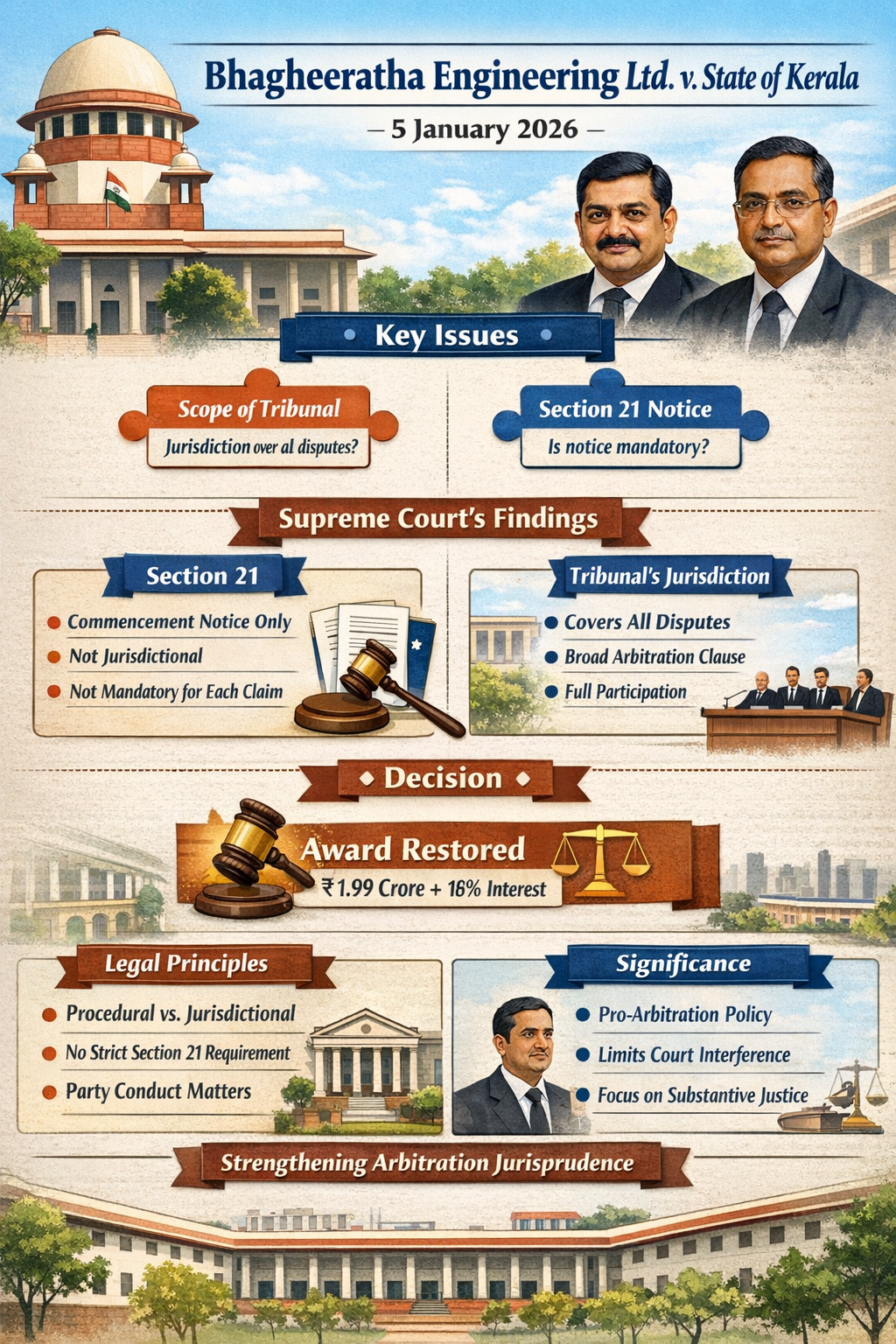
Bhagheeratha Engineering Ltd. v. State of Kerala (2026 SCC OnLine SC 5)
Decided on: 5 January 2026
Bench: J.B. Pardiwala and K.V. Viswanathan, JJ.
Coram Opinion Author: Justice K.V. Viswanathan
1. Introduction
The Supreme Court in Bhagheeratha Engineering Ltd. v. State of Kerala delivered a significant ruling clarifying the scope and object of Section 21 of the Arbitration and Conciliation Act, 1996 (“A&C Act”). The judgment settles an important procedural controversy—whether non-issuance of a separate notice under Section 21 for each dispute is fatal to arbitration proceedings.
The Court held that Section 21 is procedural in nature, meant only to determine the commencement of arbitral proceedings, and that failure to issue such notice does not invalidate otherwise arbitrable claims.
2. Factual Matrix
The dispute arose out of road development contracts under the Kerala State Transport Project (KSTP). The appellant contractor was awarded four packages of Road Maintenance Contracts by the State of Kerala.
2.1 Contractual Dispute Resolution Mechanism
The General Conditions of Contract provided a tiered dispute resolution mechanism:
| Clause | Provision | Legal Effect |
|---|---|---|
| Clause 24.1 | Reference to Adjudicator within 14 days of Engineer’s decision | Mandatory first stage |
| Clause 25.1 | Adjudicator to decide within 28 days | Time-bound adjudication |
| Clause 25.2 | Either party may refer to arbitration within 28 days; otherwise decision becomes final | Arbitration trigger clause |
2.2 Disputes Before the Adjudicator
The appellant approached the Adjudicator classifying claims into Disputes 1 to 4.
| Dispute No. | Adjudicator’s Decision |
|---|---|
| Dispute 1 | In favour of appellant |
| Dispute 2 | Against appellant |
| Dispute 3 | In favour of appellant |
| Dispute 4 | Against appellant |
The respondent-State expressed dissatisfaction with the Adjudicator’s findings, particularly on Dispute 1, and indicated its intention to refer the matter to arbitration.
3. Arbitral Proceedings
An Arbitral Tribunal was constituted on 11 January 2005.
3.1 Tribunal’s Findings
The Tribunal observed that:
-
The arbitration clause was broad and covered all disputes arising out of the agreement.
-
The respondent’s prayer to declare the Adjudicator’s decision null and void reflected its intention to reopen all four disputes.
Award (29 June 2006)
The Tribunal:
-
Decided all four disputes in favour of the appellant.
-
Awarded Rs. 1,99,90,777.
-
Granted post-award interest at 18% per annum.
4. Proceedings Before the High Court
The award was challenged under Section 34 of the A&C Act.
The Kerala High Court upheld the District Judge’s order setting aside the arbitral award on two primary grounds:
| High Court Finding | Reasoning |
|---|---|
| Tribunal had jurisdiction only over Dispute 1 | Only respondent issued Section 21 notice for Dispute 1 |
| Non-issuance of Section 21 notice for Disputes 2–4 was fatal | Separate invocation required |
| Clause 25.2 time-limit invalid | Violative of Section 28(b) of Contract Act |
However, the High Court restored the Adjudicator’s decision.
5. Issues Before the Supreme Court
The Supreme Court examined two central questions:
| Issue | Legal Question |
|---|---|
| Issue 1 | Whether the Tribunal was appointed to adjudicate only Dispute 1? |
| Issue 2 | Whether non-issuance of Section 21 notice by the appellant for Disputes 2–4 was fatal? |
6. Supreme Court’s Analysis
6.1 Scope and Object of Section 21
Section 21 states that arbitral proceedings commence on the date when a request for reference to arbitration is received by the respondent.
The Court clarified:
-
Section 21 is meant only to determine the commencement of arbitral proceedings.
-
It is not a jurisdictional condition precedent.
-
It does not mandate separate notices for every claim.
Key Holding:
Failure to issue notice under Section 21 does not invalidate arbitration if:
-
The disputes are arbitrable.
-
The claims are otherwise valid.
-
The tribunal is properly constituted.
6.2 On Tribunal’s Jurisdiction
The Court held that:
-
The arbitration clause was wide and comprehensive.
-
Parties by conduct had thrown the entire dispute open before the Tribunal.
-
Both sides participated without objection to jurisdiction.
-
The Tribunal did not exceed its mandate.
The High Court erred in restricting jurisdiction to Dispute 1.
6.3 Interpretation of Section 23 of A&C Act
The Court referred to Section 23 regarding filing of statements of claim and defence.
| Provision | Interpretation by Court |
|---|---|
| Filing of Statement of Claim | Claimant may raise all claims |
| Counterclaim | Respondent entitled to raise counterclaims |
| Terminology | “Claimant” and “Respondent” are procedural conveniences |
The Court rejected the argument that the appellant could not be treated as claimant due to absence of Section 21 notice.
7. Legal Principles Evolved
| Principle | Clarification |
|---|---|
| Nature of Section 21 | Procedural, not jurisdictional |
| Separate Notice Requirement | Not mandatory for each dispute |
| Tribunal’s Jurisdiction | Determined by arbitration clause & conduct |
| Section 34 Interference | Courts cannot adopt hyper-technical approach |
| Party Conduct | Waiver possible through participation |
8. Distinction Between Procedural and Jurisdictional Defects
The judgment draws a crucial distinction:
| Procedural Defect | Jurisdictional Defect |
|---|---|
| Non-issuance of Section 21 notice | Absence of arbitration agreement |
| Curable / Waivable | Goes to root of authority |
| Does not invalidate award per se | Renders award void |
The Court categorized Section 21 lapse as procedural.
9. Final Decision
The Supreme Court:
-
Set aside the High Court’s judgment.
-
Restored the arbitral award dated 29 June 2006.
-
Upheld the grant of Rs 1.99 crore with 18% post-award interest.
10. Significance of the Judgment
10.1 Strengthening Arbitration Jurisprudence
This ruling:
-
Prevents technical objections from defeating substantive justice.
-
Reinforces pro-arbitration stance of Indian judiciary.
-
Clarifies commencement vs jurisdiction distinction.
-
Limits judicial interference under Section 34.
10.2 Practical Impact
For practitioners:
-
Separate Section 21 notices for every claim are not mandatory.
-
Once tribunal is constituted, full claim adjudication is permissible.
-
Party conduct plays a crucial role in determining scope.
For government contracts:
-
Strict contractual timelines may be diluted if parties proceed without objection.
-
Courts will prioritize substantive resolution over procedural lapses.
11. Comparative Insight
This judgment aligns with the Supreme Court’s consistent approach of minimizing judicial intervention in arbitral matters and reinforcing party autonomy.
It also balances:
-
Procedural discipline
-
Substantive justice
-
Commercial practicality
12. Conclusion
The decision in Bhagheeratha Engineering Ltd. v. State of Kerala is a landmark clarification on the role of Section 21 of the A&C Act. By holding that non-issuance of a separate notice is not fatal, the Supreme Court has prevented procedural technicalities from undermining arbitral efficiency.
The ruling strengthens India’s arbitration framework by emphasizing that:
Arbitration is a forum for substantive dispute resolution, not a trap of procedural rigidity.
This judgment will serve as an important precedent in future challenges under Sections 21, 23, and 34 of the Arbitration and Conciliation Act, 1996.
Unlock the Potential of Legal Expertise with LegalMantra.net – Your Trusted Legal Consultancy Partner
Disclaimer
Every effort has been made to ensure accuracy in this material. However, inadvertent errors or omissions may occur. Any discrepancies brought to the author’s notice will be rectified in subsequent editions. The author shall not be liable for any direct, indirect, incidental, or consequential damages arising from the use of this material. This article is based on various sources including statutory enactments, judicial decisions, academic research papers, professional journals, and publicly available legal materials.
Mayank Garg