
Forget Password

View News
Audit Committee Ratification of Related Party Transactions under SEBI (LODR): A Detailed Analysis
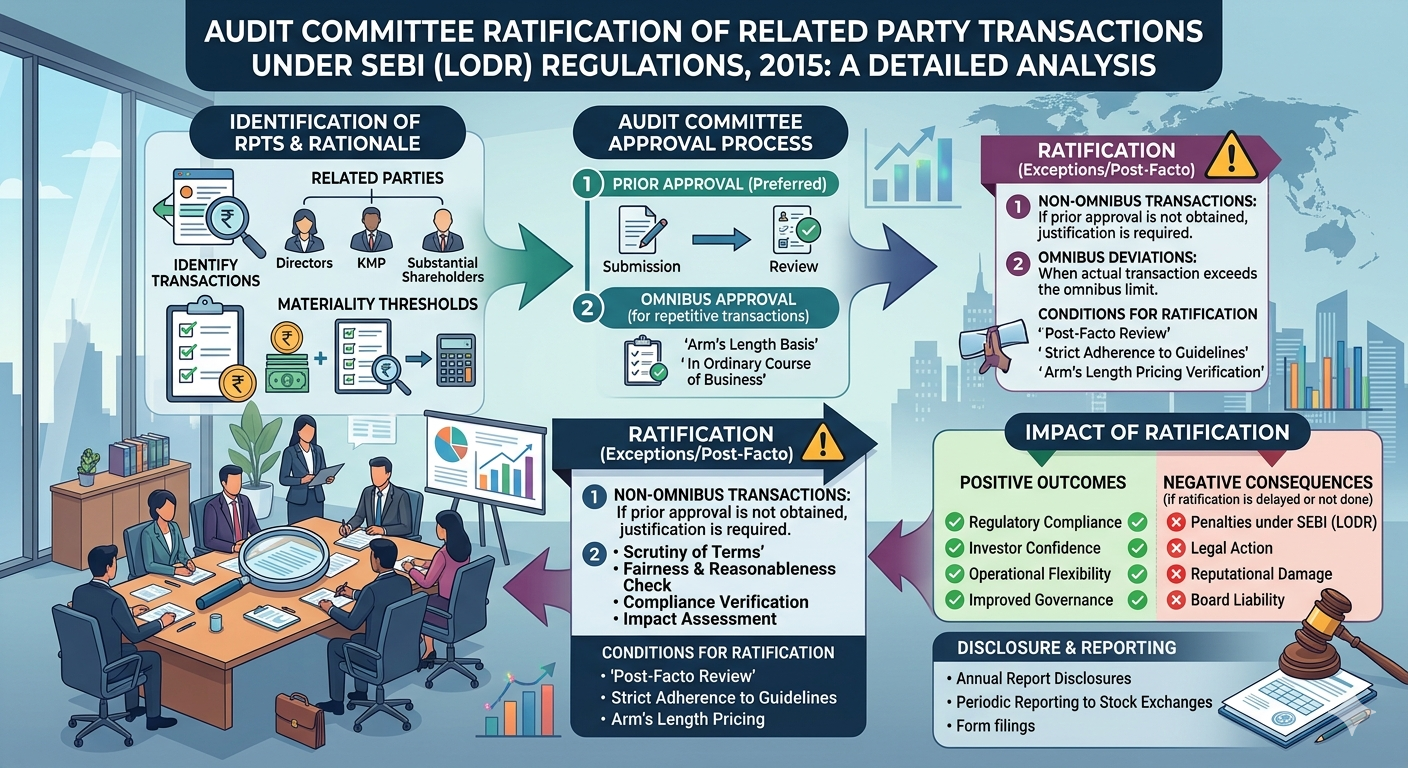
Audit Committee Ratification of Related Party Transactions under SEBI (LODR): A Detailed Analysis
1. Introduction
Related Party Transactions (RPTs) form a significant aspect of corporate governance for listed entities and are strictly regulated under the SEBI (Listing Obligations and Disclosure Requirements) Regulations, 2015. These transactions involve dealings between a company and its related parties and may give rise to potential conflicts of interest if not properly monitored.
To ensure transparency and accountability, the regulations mandate prior approval of the Audit Committee for all RPTs. However, in certain exceptional situations where such approval is not obtained due to inadvertent or unavoidable circumstances, the law permits post-facto ratification, subject to strict compliance conditions. This framework aims to strike a balance between regulatory discipline and practical business flexibility.
2. Concept and Legal Framework of Ratification
Ratification refers to the subsequent approval granted by the Audit Committee to a Related Party Transaction that was entered into without obtaining prior approval. Under the SEBI LODR framework, ratification is not intended to be a routine compliance mechanism but rather a limited exception designed to regularize genuine lapses.
The underlying principle is that prior approval remains the norm, and ratification is only a corrective measure. Therefore, companies must ensure that this provision is used sparingly and only in deserving cases where procedural delays or operational exigencies prevented prior approval.
3. Eligibility Conditions for Ratification
3.1 Nature of the Transaction
For a transaction to be eligible for ratification, it must qualify as a Related Party Transaction within the meaning of SEBI LODR. This includes any transaction involving transfer of resources, services, or obligations between the listed entity and a related party.
3.2 Absence of Prior Approval
Ratification becomes relevant only in cases where the Audit Committee’s prior approval was not obtained before entering into the transaction. If approval has already been granted, the question of ratification does not arise.
3.3 Non-Materiality Requirement
A crucial condition is that the transaction must not be material in nature. Material RPTs require prior approval of shareholders and cannot be validated through post-facto ratification. This ensures that significant transactions remain subject to higher levels of scrutiny.
3.4 Monetary Threshold for Ratification
The aggregate value of all transactions proposed to be ratified during a financial year must not exceed one crore rupees. This monetary cap serves as a safeguard to prevent misuse of the ratification route for high-value transactions.
4. Timeline for Ratification
4.1 Prescribed Time Limits
The SEBI LODR prescribes a strict timeline within which ratification must take place. The Audit Committee is required to ratify the transaction either within three months from the date of the transaction or at the immediately succeeding Audit Committee meeting, whichever is earlier.
4.2 Compliance Implications
This dual condition ensures that companies act promptly and do not delay ratification. It places an implicit obligation on the compliance function to identify such transactions in real time and ensure timely placement before the Audit Committee.
5. Documentation Requirements for Ratification
5.1 Transaction Details
The Audit Committee must be provided with complete particulars of the transaction, including its nature, the parties involved, the value, and the key contractual terms. This enables an informed evaluation of the transaction.
5.2 Relationship with the Related Party
A clear description of the relationship between the company and the related party must be disclosed to establish the applicability of RPT provisions.
5.3 Justification for Entering into the Transaction
The business rationale and necessity of the transaction must be explained in detail. This helps the Committee assess whether the transaction is commercially sound and aligned with the interests of the company.
5.4 Reason for Non-Obtaining Prior Approval
The company must provide a specific explanation for the failure to obtain prior approval. This is an essential requirement as it ensures accountability and helps prevent recurrence of such lapses.
5.5 Confirmation of Non-Materiality
A formal confirmation that the transaction does not qualify as a material RPT must be placed before the Committee.
5.6 Aggregate Value Disclosure
Details of the aggregate value of similar transactions undertaken during the financial year must also be presented to ensure compliance with the prescribed threshold limit.
6. Audit Committee Review and Decision-Making
6.1 Role of Independent Directors
The ratification process must be undertaken by the Audit Committee, with participation of Independent Directors. Their presence ensures objectivity and safeguards minority shareholder interests.
6.2 Evaluation of Commercial Justification
The Committee must carefully examine whether the transaction is in the ordinary course of business, conducted at arm’s length, and supported by sound commercial rationale.
6.3 Recording of Reasons for Ratification
It is mandatory for the Audit Committee to record specific reasons for granting ratification. This requirement ensures transparency and creates a documented audit trail.
6.4 Imposition of Conditions
The Committee may impose additional conditions while granting ratification, such as strengthening internal controls or modifying transaction terms. Compliance with such conditions is binding on the company.
7. Post-Ratification Compliance Requirements
7.1 Disclosure Obligations
Ratified transactions must be appropriately disclosed in periodic filings, including quarterly or half-yearly RPT disclosures, as applicable under SEBI LODR.
7.2 Maintenance of Minutes and Records
The proceedings of the Audit Committee meeting must be properly documented in the minutes, capturing discussions, rationale for ratification, and any conditions imposed.
7.3 Statutory Registers
The company is required to update its statutory registers, particularly the register of contracts and arrangements in which directors are interested, in accordance with the Companies Act, 2013.
8. Consequences of Non-Ratification
8.1 Voidability of the Transaction
If the Audit Committee refuses to ratify the transaction, it becomes voidable at the option of the Committee. This means the company may choose to rescind the transaction.
8.2 Liability of Directors
In cases where the transaction involves a director or has been authorized by a director, such individual may be required to indemnify the company for any losses arising from the transaction. This provision reinforces accountability and discourages non-compliance.
9. Good Governance Practices
9.1 Need for Preventive Controls
While ratification provides a corrective mechanism, reliance on it should be minimized through strong internal controls and governance practices.
9.2 Real-Time Monitoring Mechanisms
Companies should implement systems to track RPTs on a real-time basis to ensure timely identification and approval.
9.3 Internal Thresholds and Alerts
Setting internal thresholds below the regulatory limit can act as an early warning system and help prevent breaches.
9.4 Pre-Clearance Systems
A structured pre-clearance mechanism for all RPTs should be established to ensure that transactions are approved before execution.
9.5 Periodic Compliance Review
Regular review by the Company Secretary or Compliance Officer is essential to identify gaps, strengthen processes, and ensure adherence to regulatory requirements.
10. Conclusion
The ratification of Related Party Transactions under the SEBI (Listing Obligations and Disclosure Requirements) Regulations, 2015 is a carefully structured exception that allows companies to regularize genuine lapses while maintaining governance standards. However, it is not intended to replace the requirement of prior approval.
Companies must therefore adopt a proactive approach by strengthening internal controls, ensuring timely approvals, and fostering a culture of compliance. Effective implementation of these measures will not only ensure regulatory adherence but also enhance stakeholder confidence and corporate credibility.
Disclaimer
The contents of this document are based on the provisions of the SEBI (Listing Obligations and Disclosure Requirements) Regulations, 2015 and other applicable laws as on the date of writing. While every effort has been made to ensure accuracy and completeness, no responsibility is assumed for any errors or omissions. Readers are advised to refer to the relevant statutory provisions and seek professional advice before acting on the basis of this information. This document is not intended to constitute legal advice, and no liability is accepted for any consequences arising from its use.
From the desk of CS Sharath