
Forget Password

View News
Applicability of Form MGT-14 under the Companies Act, 2013
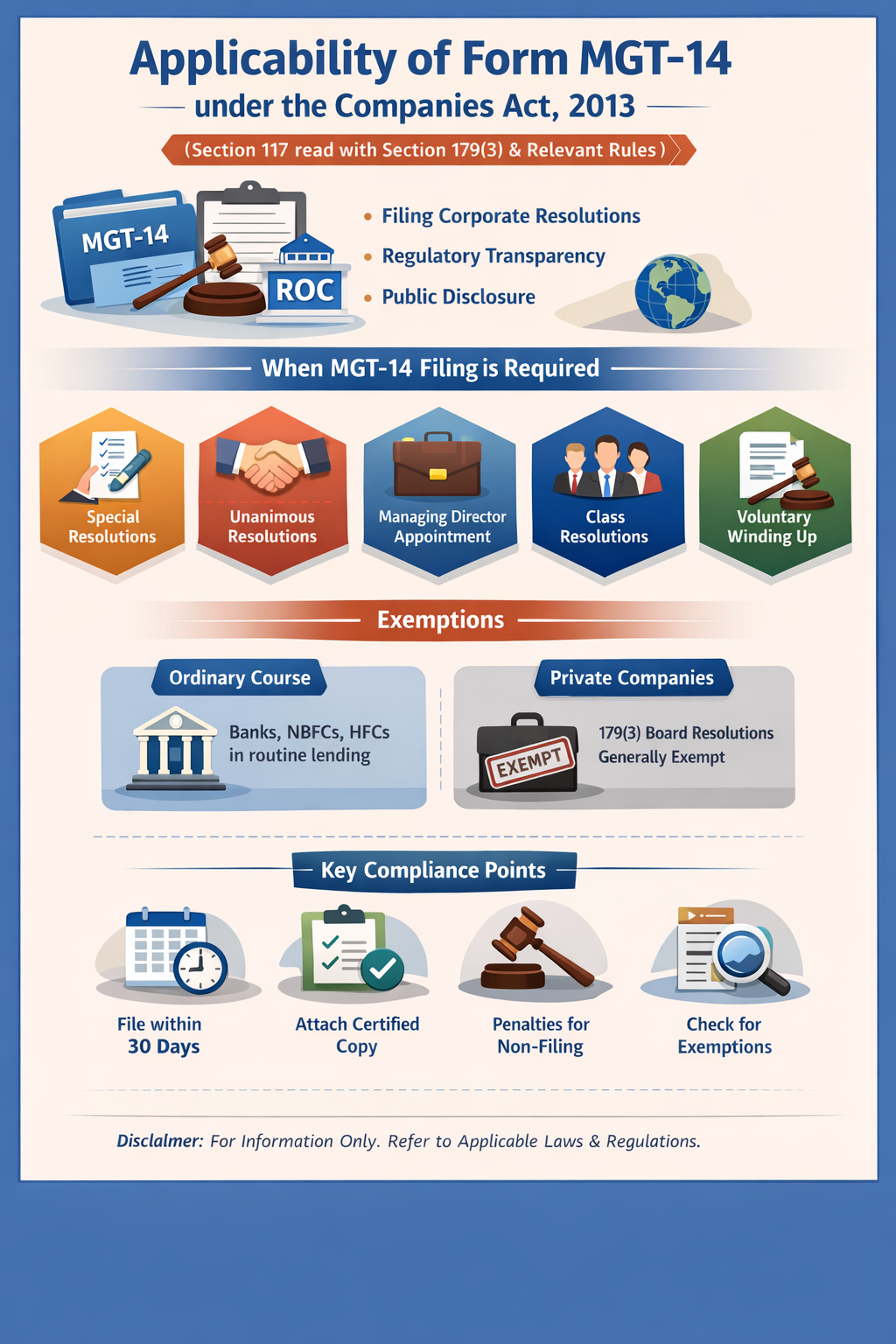
Applicability of Form MGT-14 under the Companies Act, 2013
(Section 117 read with Section 179(3) and relevant Rules)
1. Introduction
Form MGT-14 is one of the most critical compliance forms under the Companies Act, 2013. It is required to be filed with the Registrar of Companies (ROC) pursuant to Section 117, which mandates filing of certain resolutions and agreements passed by a company.
The primary objective of MGT-14 filing is to:
-
Ensure corporate transparency
-
Place significant decisions in the public domain
-
Enable regulatory authorities and stakeholders to track key governance actions
Failure to comply may attract penalties, making it essential for companies and professionals to clearly understand its applicability.
2. Legal Framework Governing MGT-14
The applicability of Form MGT-14 arises from the combined reading of:
-
Section 117 – Filing of resolutions and agreements
-
Section 179(3) – Powers of Board to be exercised by resolutions passed at Board Meetings
-
Companies (Management and Administration) Rules, 2014 – Procedural aspects and prescribed requirements
3. Resolutions Requiring Filing of Form MGT-14
Under Section 117(3), the following categories of resolutions and agreements must be filed with ROC:
(A) Special Resolutions
All special resolutions passed by shareholders are mandatorily required to be filed within 30 days.
Examples include:
-
Alteration of Memorandum or Articles of Association
-
Change of name
-
Reduction of share capital
-
Approval of related party transactions (where applicable)
(B) Unanimous Resolutions Equivalent to Special Resolutions
Even if a resolution is passed unanimously, it must be filed if:
-
The subject matter legally requires a special resolution
Key Principle:
Substance prevails over form — unanimity does not eliminate filing requirement.
(C) Appointment or Variation of Managing Director
MGT-14 is required for filing resolutions or agreements relating to:
-
Appointment of Managing Director
-
Re-appointment
-
Renewal of terms
-
Variation in terms and conditions
This ensures transparency in managerial remuneration and control structures.
(D) Class Resolutions
Resolutions passed by a specific class of shareholders must be filed where:
-
A specified majority is required
-
The resolution is binding on that class
(E) Voluntary Winding Up under IBC
Resolutions passed for voluntary liquidation under Section 59 of the
Insolvency and Bankruptcy Code, 2016 are required to be filed.
(F) Board Resolutions under Section 179(3)
One of the most practical and often misunderstood areas is filing of Board resolutions under Section 179(3).
These resolutions must:
-
Be passed at a duly convened Board Meeting
-
Be filed in MGT-14 (subject to exemptions)
4. Detailed Analysis of Section 179(3) Matters
(1) Financial & Capital Matters
The Board must pass resolutions (and file MGT-14) for:
-
Making calls on shareholders for unpaid capital
-
Authorising buy-back of securities
-
Issuance of securities, including debentures
-
Borrowing monies
-
Investing company funds
-
Granting loans, guarantees or securities
(2) Approval & Strategic Matters
MGT-14 is required for decisions relating to:
-
Approval of financial statements and Board’s report
-
Diversification of business activities
-
Approval of mergers, amalgamations, or reconstruction
-
Acquisition or takeover of another entity
(3) Additional Matters Prescribed under Rules
As per applicable rules, Board resolutions for the following must also be filed:
-
Political contributions
-
Appointment or removal of Key Managerial Personnel (KMP)
-
Appointment of Internal Auditor
-
Appointment of Secretarial Auditor
5. Exemptions from Filing Form MGT-14
Despite the wide scope, certain exemptions are available:
(A) Ordinary Course Exemption – Section 179(3)(f)
MGT-14 filing is not required where loans, guarantees, or securities are provided:
-
In the ordinary course of business, and
-
By:
-
Banking companies
-
Specified NBFCs
-
Housing Finance Companies
-
(B) Private Company Exemption
As per MCA notifications:
-
Private companies are exempt from filing MGT-14 for Board resolutions under Section 179(3)
-
However:
-
Special resolutions must still be filed
-
Certain specific cases may still require filing depending on facts
-
6. Important Practical & Compliance Considerations
(1) Timeline
-
Must be filed within 30 days of passing the resolution
(2) Attachments
-
Certified True Copy (CTC) of the resolution
-
Explanatory statement (if applicable)
(3) Additional Fees
-
Delay leads to additional filing fees on a graded basis
(4) Penalty for Non-Compliance
Under Section 117(2):
-
Company and officers may be liable to monetary penalties
7. Practical Interpretation Issues (Expert Insights)
(i) Overlapping Compliance Confusion
Many professionals face confusion regarding:
-
Whether every Board resolution requires filing ? Answer: No, only specified ones
(ii) Private Company Relief – Not Absolute
Though exemptions exist:
-
Banks and professionals often insist on MGT-14 as a governance practice
(iii) Secretarial Audit Impact
Non-filing of MGT-14 may lead to:
-
Qualifications in Secretarial Audit Report
-
Adverse remarks in compliance reporting
(iv) Litigation & Due Diligence Relevance
MGT-14 acts as:
-
Legal evidence of Board decisions
-
Critical document in due diligence and funding transactions
8. Summary Table
| Type of Resolution | MGT-14 Required? |
|---|---|
| Special Resolution | Yes |
| Unanimous resolution equivalent to special resolution | Yes |
| Appointment/variation of Managing Director | Yes |
| Class resolutions | Yes |
| Voluntary winding up under IBC | Yes |
| Section 179(3) Board resolutions | Yes |
| Loans/guarantees by banks/NBFCs/HFCs (ordinary course) | No |
| Private company – 179(3) resolutions | Generally Exempt |
9. Conclusion
Form MGT-14 is a cornerstone compliance mechanism ensuring transparency and accountability in corporate governance.
Before filing (or deciding not to file), companies must evaluate:
-
Whether the resolution falls under Section 117(3)
-
Whether it is covered under Section 179(3)
-
Whether any MCA exemption notification applies
A careful and informed approach helps avoid:
-
Penalties
-
Litigation risks
-
Governance lapses
DISCLAIMER
The contents of this document are based on current legal provisions and available information. While every effort has been made to ensure accuracy, no responsibility is assumed for errors or omissions. Readers are advised to refer to the applicable laws and consult professionals before taking any action. This document is not intended as legal advice, and no liability is accepted for consequences arising from its use.
From the desk of CS Sharath