
Forget Password

View News
Anti-Profiteering Obligations in the Restaurant Sector Following GST Rate Reduction
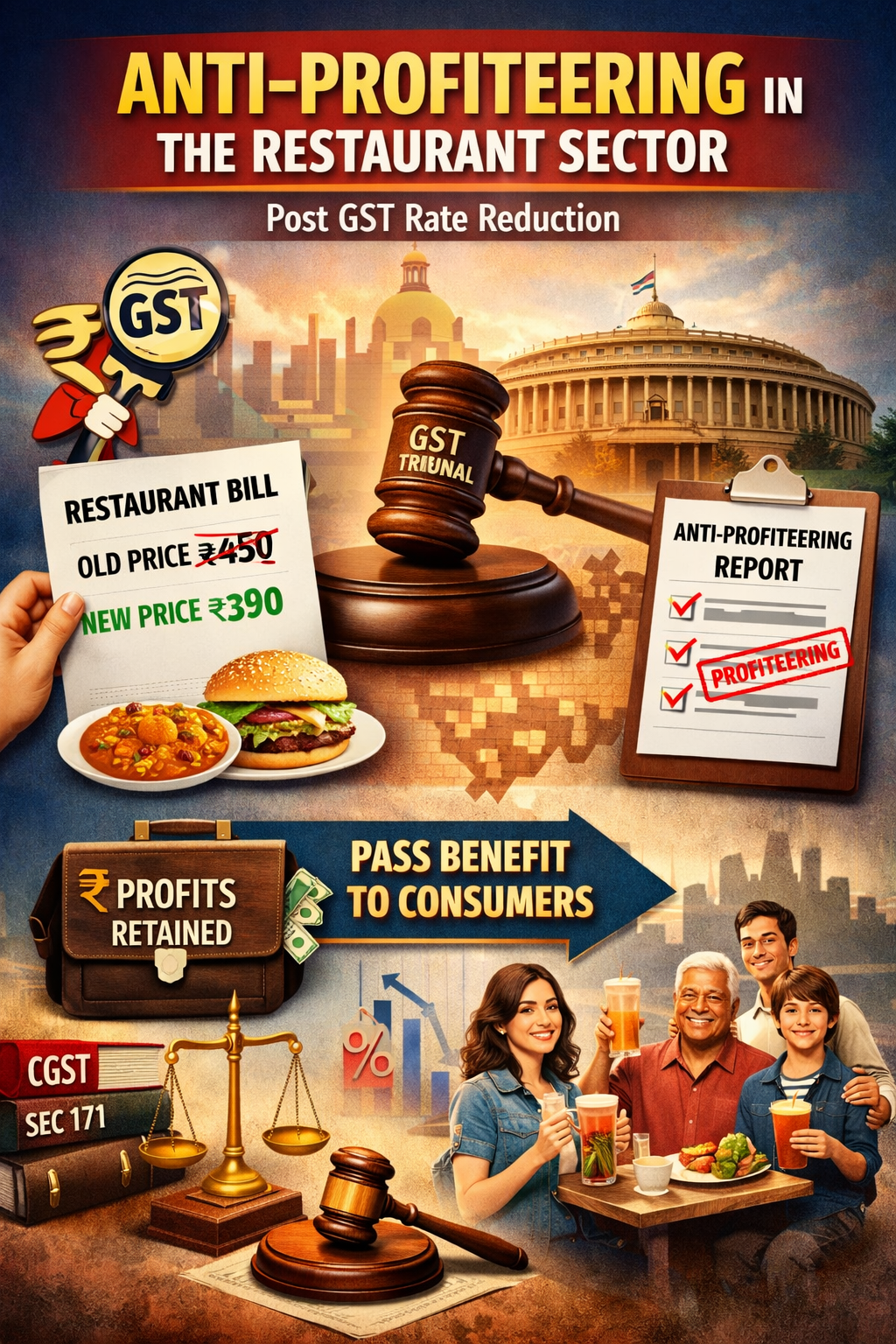
Anti-Profiteering Obligations in the Restaurant Sector Following GST Rate Reduction
Introduction
The anti-profiteering mechanism under the Goods and Services Tax regime is a consumer-centric measure designed to ensure that any benefit arising from a reduction in tax rates or availability of input tax credit is mandatorily passed on to consumers through a commensurate reduction in prices. Since the introduction of GST, the restaurant sector has been subject to continuous regulatory scrutiny due to frequent changes in applicable tax rates and input tax credit restrictions. The present decision delivered by the GST Appellate Tribunal further strengthens the jurisprudence governing anti-profiteering compliance in the restaurant industry.
Legislative Framework Governing Anti-Profiteering
Section 171 of the Central Goods and Services Tax Act, 2017 embodies the principle of anti-profiteering. The provision mandates that any reduction in the rate of tax on the supply of goods or services, or any benefit arising from input tax credit, must be passed on to the recipient by way of commensurate reduction in prices. The objective of this provision is not revenue generation but consumer welfare. To give effect to this mandate, an institutional mechanism was created empowering the Director General of Anti-Profiteering to conduct investigations and place findings before the adjudicating authority.
Factual Matrix and Genesis of the Dispute
The dispute arose pursuant to a reduction in the GST rate applicable to restaurant services. Following this rate reduction, a complaint was received alleging that the restaurant had failed to reduce the prices of food items proportionately. Despite the lower tax incidence, consumers were allegedly charged prices that were substantially similar to those prevailing prior to the rate cut. Acting upon the complaint, the Director General of Anti-Profiteering initiated a detailed investigation by examining menu prices, tax invoices, base prices, and comparative financial data for periods before and after the rate reduction.
Upon conclusion of the investigation, the DGAP observed that although the tax rate was reduced, the restaurant had either maintained or increased its base prices, thereby nullifying the intended benefit of the tax reduction. This conduct resulted in the retention of tax benefit by the supplier, amounting to profiteering under Section 171 of the CGST Act.
Determination by the Director General of Anti-Profiteering
The DGAP’s analysis rested on a comparison between pre-rate-reduction and post-rate-reduction base prices. It was found that the restaurant had adjusted its pricing structure in a manner that ensured the final consumer price remained unchanged or marginally higher despite the reduced tax burden. The investigation further revealed that the tax benefit was not transparently or effectively passed on to consumers. Consequently, the DGAP quantified the profiteered amount and submitted its report recommending appropriate remedial directions.
Issues for Consideration Before the Tribunal
The primary question before the Tribunal was whether the restaurant had violated Section 171 by failing to pass on the benefit of GST rate reduction. Ancillary issues included the validity of the methodology adopted by the DGAP for computation of profiteering and whether the restaurant could justify its pricing decisions on the ground of increased operational and business costs.
Tribunal’s Analysis and Legal Reasoning
The Tribunal reaffirmed that the obligation under Section 171 is statutory and mandatory. It held that once a tax rate reduction is notified, the supplier is under a legal duty to pass on the benefit to consumers. The Tribunal rejected the contention that pricing autonomy or commercial discretion could override the statutory mandate of anti-profiteering provisions.
Addressing the argument relating to increased costs such as rent, wages, raw materials, and overheads, the Tribunal categorically held that Section 171 does not permit the offsetting of tax benefits against unrelated cost escalations. Any increase in operational costs must be independently justified and transparently reflected, but such factors cannot be used as a defence to deny the benefit of tax reduction to consumers.
The Tribunal also upheld the methodology adopted by the DGAP, observing that comparison of base prices before and after tax reduction is a reasonable and well-established approach. The purpose of such methodology is not to interfere with business decisions but to ensure that tax benefits are not neutralised through artificial price adjustments.
Final Decision and Directions
On the basis of the above reasoning, the Tribunal upheld the findings of profiteering against the restaurant. It confirmed that the restaurant had violated Section 171 of the CGST Act by retaining the benefit of GST rate reduction. The Tribunal directed that the profiteered amount be passed on to consumers in the manner prescribed under GST law, along with applicable interest. The decision underscored that anti-profiteering provisions are enacted in public interest and are integral to the GST framework.
Legal and Practical Significance of the Ruling
This ruling reiterates the strict and non-negotiable nature of anti-profiteering obligations under GST. It sends a clear message to restaurants and other consumer-facing businesses that tax rate reductions must be immediately and visibly reflected in consumer pricing. Commercial considerations, profit margins, or cost pressures cannot be invoked to defeat the statutory mandate of consumer benefit.
Conclusion
The decision reinforces the consumer-centric philosophy of the GST regime. Anti-profiteering provisions continue to be rigorously enforced, particularly in sectors such as restaurants where the impact on consumers is direct and immediate. Businesses must treat compliance with Section 171 as a continuing obligation and ensure transparent pricing practices to avoid financial liability, interest exposure, and reputational damage.
Disclaimer
Every effort has been made to ensure accuracy in this material. However, inadvertent errors or omissions may occur. Any discrepancies brought to the author’s notice will be rectified in subsequent editions. The author shall not be liable for any direct, indirect, incidental, or consequential damages arising from the use of this material. This article is based on various sources including statutory enactments, judicial decisions, academic research papers, professional journals, and publicly available legal materials.
Anshul Goel