
Forget Password

View News
Agricultural Subsidy Frameworks in Indian Union Territories: An Overview
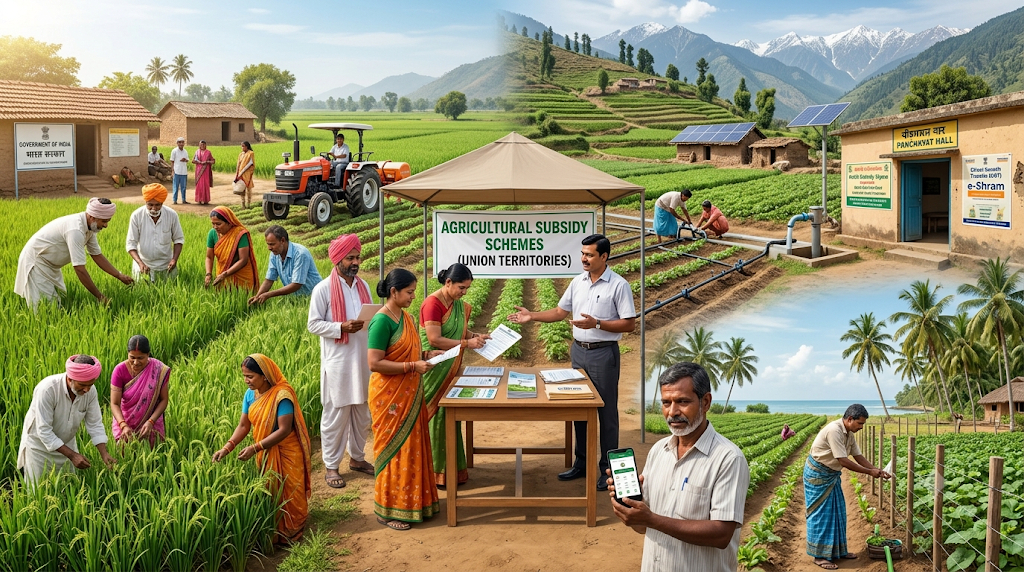
Agricultural Subsidy Frameworks in Indian Union Territories: An Overview
By Sura Anjana Srimayi
Introduction
Agriculture in India operates within a broad national policy framework, with the Union Government playing a significant role in formulating agricultural welfare programmes, providing financial assistance and promoting sustainable farming practices. However, the implementation of these initiatives largely depends on the administrative arrangements and institutional mechanisms of individual States and Union Territories (UTs).
Union Territories such as Delhi, Puducherry, Jammu and Kashmir, and the Andaman and Nicobar Islands have distinct geographical, administrative and agricultural characteristics. Consequently, although farmers in these territories may benefit from various centrally sponsored and central sector schemes, the availability, implementation and delivery of agricultural subsidies may differ depending on local requirements, scheme-specific eligibility conditions and administrative priorities.
Understanding the agricultural subsidy framework in Union Territories therefore requires an examination of both the national policy architecture and the role of UT administrations in translating central initiatives into practical benefits for farmers.
1. The Foundation of Agricultural Subsidies in India
Agricultural subsidies in India are designed to address the financial vulnerabilities of farmers, improve agricultural productivity, strengthen rural livelihoods and encourage the adoption of modern farming practices.
The Union Government provides support through various Central Sector Schemes and Centrally Sponsored Schemes. While Central Sector Schemes are generally financed and implemented by the Union Government, Centrally Sponsored Schemes involve financial participation and implementation responsibilities at the State or UT level, subject to the applicable funding pattern.
The principal mechanisms through which agricultural assistance is delivered include the following:
A. Direct Benefit Transfer (DBT)
The Pradhan Mantri Kisan Samman Nidhi (PM-KISAN) is a significant income-support initiative under which eligible landholding farmer families receive financial assistance directly into their bank accounts through the Direct Benefit Transfer mechanism.
The respective State and UT administrations play an important role in identifying beneficiaries, verifying landholding records, undertaking necessary validation and facilitating the transfer of benefits in accordance with the scheme's guidelines. This mechanism aims to improve transparency, minimise intermediaries and ensure timely delivery of financial assistance.
B. Agricultural Credit and Interest Subvention
Access to affordable institutional credit is essential for meeting farmers' seasonal agricultural requirements. Under the Modified Interest Subvention Scheme (MISS), eligible farmers are provided concessional short-term agricultural credit through the Kisan Credit Card (KCC) framework.
The scheme seeks to reduce the cost of borrowing for agricultural activities, with additional interest benefits linked to the timely repayment of eligible loans, subject to prescribed conditions. It helps farmers manage expenditure on seeds, fertilisers, pesticides and other agricultural inputs while reducing their dependence on informal sources of credit.
C. Crop Insurance and Risk Mitigation
The Pradhan Mantri Fasal Bima Yojana (PMFBY) provides a structured mechanism for protecting farmers against specified crop losses arising from notified natural calamities, adverse weather conditions, pests and diseases, subject to the scheme's operational guidelines.
The scheme is intended to provide financial protection, stabilise farmers' income and encourage continuity in agricultural activities despite unforeseen risks.
Its implementation requires coordination among the Union Government, participating State and UT administrations, financial institutions and empanelled insurance companies. The actual availability of coverage depends on the participation of the concerned administration, notified crops, geographical areas and applicable seasonal provisions.
D. Agricultural Inputs and Infrastructure Development
Agricultural development also requires sustained investment in infrastructure, technology and resource management.
Programmes such as the Rashtriya Krishi Vikas Yojana (RKVY) and Krishonnati Yojana support various interventions relating to agricultural development, horticulture, farm mechanisation, soil health, irrigation, technology adoption and productivity enhancement.
UT administrations play an important role in identifying local agricultural priorities, preparing development proposals and implementing approved interventions in accordance with the relevant scheme guidelines.
2. Implementation Dynamics in Union Territories
The constitutional and administrative distinction between States and Union Territories has a significant bearing on the governance and implementation of agricultural policies.
Unlike States, which generally exercise their own executive authority over subjects within their constitutional competence, Union Territories are administered under the constitutional framework applicable to them. Depending on their administrative status, they may function through an Administrator or Lieutenant Governor appointed by the President, while certain Union Territories also have elected legislatures and Council of Ministers.
Accordingly, the implementation of agricultural welfare schemes in Union Territories depends on their respective administrative structures, institutional capacities and the allocation of responsibilities between the Union Government and local administrations.
In this context, UT administrations perform several important functions, including:
-
Identifying eligible beneficiaries and maintaining agricultural and landholding records.
-
Coordinating the implementation of centrally funded and centrally sponsored agricultural programmes.
-
Facilitating the delivery of subsidies and financial assistance through DBT mechanisms.
-
Preparing agricultural development plans based on local geographical and climatic conditions.
-
Monitoring the utilisation of funds and assessing the effectiveness of welfare interventions.
An important consideration is that the availability of a central scheme does not automatically guarantee its uniform implementation across every Union Territory. Participation, funding arrangements and eligibility conditions must be examined with reference to the relevant scheme guidelines and administrative notifications.
For instance, agricultural priorities may differ considerably across territories. While horticulture and specialised crop cultivation may be important in Jammu and Kashmir, fisheries, coconut cultivation and other coastal agricultural activities may receive greater attention in the Andaman and Nicobar Islands and Puducherry.
Thus, the effectiveness of agricultural subsidies in Union Territories depends not merely on the availability of central financial assistance but also on the capacity of local administrations to identify regional requirements and ensure effective implementation.
3. The Shift Towards Technology-Driven and Outcome-Oriented Agricultural Support
India's agricultural policy is increasingly emphasising technological integration, productivity enhancement, resource efficiency and sustainable farming practices. The policy direction reflects a gradual move towards complementing conventional input-based assistance with interventions that improve measurable agricultural outcomes.
The Union Budget 2026–27 also highlights this approach through initiatives such as Bharat-VISTAAR and targeted support for high-value agriculture.
For farmers in Union Territories, this evolving policy framework has particular significance in the following areas:
A. Digital Integration and Agricultural Information Systems
Digital infrastructure is increasingly becoming an important component of agricultural governance.
Initiatives involving AgriStack and the Farmer ID framework seek to strengthen the integration of agricultural information, beneficiary identification and service delivery. These developments can facilitate more efficient verification, improve access to government services and reduce administrative difficulties.
The proposed Bharat-VISTAAR initiative (Bharat-Virtually Integrated System to Access Agricultural Resources) is another important development. It seeks to integrate agricultural information systems with the Indian Council of Agricultural Research's agricultural practices database through artificial intelligence-enabled tools.
Such digital interventions have the potential to improve access to agricultural information, advisory services and relevant government programmes, including for farmers in geographically remote Union Territories.
B. Precision Farming and Agricultural Mechanisation
The increasing use of technology in agriculture is creating opportunities for more efficient farming practices.
Government initiatives promoting agricultural mechanisation, drone-based applications and precision farming seek to improve productivity, reduce operational costs and optimise the utilisation of agricultural resources.
The Namo Drone Didi Scheme, for example, aims to empower women Self-Help Groups by providing access to drones and encouraging the delivery of agricultural services through drone-based applications.
These interventions may be particularly beneficial in areas where access to modern agricultural equipment, technical expertise and efficient farming infrastructure remains limited.
C. Sustainability and Resource Efficiency
Sustainable agricultural practices are receiving increasing attention in the formulation of agricultural policies.
The emphasis is gradually expanding towards efficient water management, balanced fertiliser usage, soil conservation, climate-resilient agriculture and environmentally sustainable farming methods.
For Union Territories with limited cultivable land, water constraints or fragile ecological conditions, such interventions can play an important role in ensuring long-term agricultural viability.
Accordingly, agricultural support is increasingly expected to contribute not only to immediate financial relief but also to improved productivity, resource conservation and environmental sustainability.
Conclusion
The agricultural subsidy framework in Indian Union Territories forms an integral part of the country's broader agricultural welfare and development policy. Although the constitutional and administrative structures of Union Territories differ from those of States, farmers may access various national agricultural support programmes, subject to the applicable eligibility requirements, scheme guidelines and UT-specific implementation arrangements.
Initiatives such as PM-KISAN, the Modified Interest Subvention Scheme, PMFBY, RKVY and Krishonnati Yojana provide important mechanisms for income support, affordable credit, risk protection and agricultural infrastructure development.
However, the effectiveness of these initiatives ultimately depends on their implementation at the local level. Accurate beneficiary identification, efficient administrative coordination, digital infrastructure and region-specific agricultural planning remain essential for ensuring that financial assistance reaches its intended beneficiaries.
As India's agricultural policy increasingly embraces technology, sustainability and outcome-oriented interventions, Union Territories have an important role in translating these national priorities into meaningful local outcomes. The ultimate objective should be to ensure that small and marginal farmers, irrespective of their geographical location or administrative jurisdiction, have access to appropriate institutional support, modern agricultural resources and sustainable livelihood opportunities.
Disclaimer
Every effort has been made to ensure accuracy in this material. However, inadvertent errors or omissions may occur. Any discrepancies brought to the author’s notice will be rectified in subsequent editions. The author shall not be liable for any direct, indirect, incidental, or consequential damages arising from the use of this material. This article is based on various sources including statutory enactments, judicial decisions, academic research papers, professional journals, and publicly available legal materials.