
Forget Password

View News
Affirmative Action in India: Constitutional Framework, Judicial Evolution, Contemporary Challenges, and the Way Forward
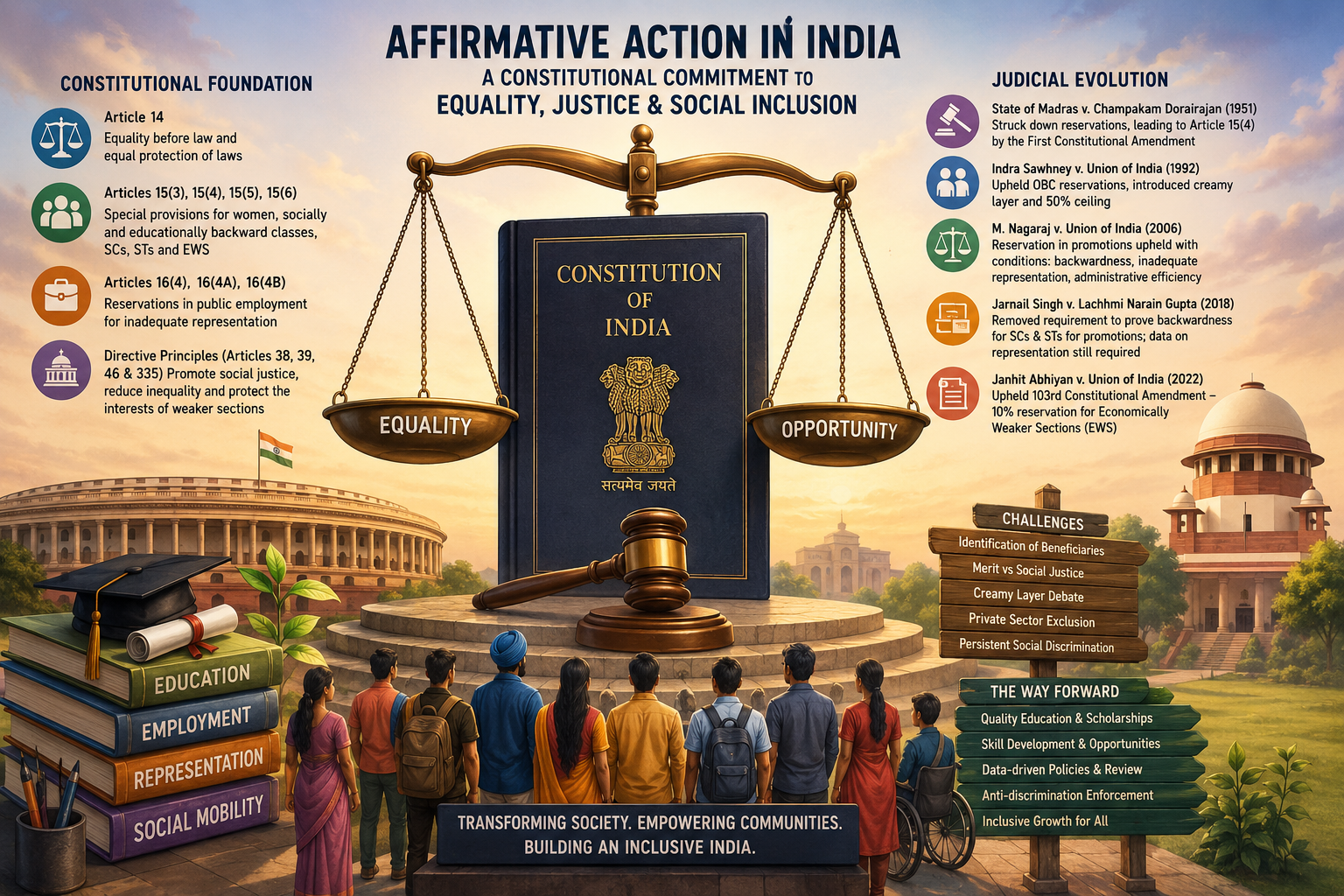
Affirmative Action in India: Constitutional Framework, Judicial Evolution, Contemporary Challenges, and the Way Forward
Constitutional Foundation of Affirmative Action in India
The Indian Constitution embraces both formal equality and substantive equality. The framers of the Constitution recognized that merely guaranteeing equal treatment before the law would not be sufficient to eliminate centuries of systemic discrimination and social exclusion rooted in the caste system. Consequently, the Constitution incorporates affirmative action as a mechanism to achieve genuine equality by enabling disadvantaged communities to access opportunities that were historically denied to them.
Article 14 guarantees equality before the law and equal protection of the laws. However, the Constitution also acknowledges that treating unequal groups equally may perpetuate inequality. Therefore, Articles 15(3), 15(4), 15(5), and 15(6) empower the State to make special provisions for women, socially and educationally backward classes, Scheduled Castes (SCs), Scheduled Tribes (STs), and Economically Weaker Sections (EWS). Likewise, Articles 16(4), 16(4A), and 16(4B) authorize reservations in public employment to ensure adequate representation of communities that remain underrepresented in government services.
The constitutional commitment to affirmative action is further reinforced by the Directive Principles of State Policy (DPSPs). Articles 38 and 39 require the State to promote social justice and reduce inequalities in status, income, and opportunity, while Article 46 directs it to safeguard the educational and economic interests of Scheduled Castes, Scheduled Tribes, and other weaker sections. Additionally, Article 335 emphasizes that the claims of SCs and STs in public services should be balanced with the maintenance of administrative efficiency.
Thus, affirmative action is not an exception to the constitutional guarantee of equality. Rather, it represents an integral component of India's vision of transformative constitutionalism, aimed at correcting historical injustices and creating conditions for substantive equality.
Judicial Evolution of Affirmative Action
The Supreme Court of India has played a decisive role in defining the constitutional contours of affirmative action through a series of landmark judgments.
The journey began with State of Madras v. Champakam Dorairajan (1951), where the Supreme Court struck down caste-based reservations as violative of the right to equality. This decision prompted Parliament to enact the First Constitutional Amendment, 1951, introducing Article 15(4), which expressly empowered the State to make special provisions for socially and educationally backward classes, Scheduled Castes, and Scheduled Tribes.
A significant turning point came with Indra Sawhney v. Union of India (1992), popularly known as the Mandal Commission Case. The Court upheld reservations for Other Backward Classes (OBCs), introduced the "creamy layer" doctrine to exclude socially advanced members of backward classes from reservation benefits, and laid down the general rule that reservations should ordinarily not exceed 50%, except in extraordinary circumstances.
The jurisprudence further evolved through M. Nagaraj v. Union of India (2006), where the Supreme Court upheld reservation in promotions but required the State to establish three conditions before extending such benefits: the backwardness of the class, inadequate representation in public employment, and consistency with administrative efficiency.
This position was partially modified in Jarnail Singh v. Lachhmi Narain Gupta (2018). The Court held that States were no longer required to prove the backwardness of Scheduled Castes and Scheduled Tribes before granting reservation in promotions, while continuing to require quantifiable data demonstrating inadequate representation.
More recently, in Janhit Abhiyan v. Union of India (2022), the Supreme Court upheld the constitutional validity of the 103rd Constitutional Amendment, which introduced 10% reservation for Economically Weaker Sections (EWS). This judgment marked a significant shift in affirmative action jurisprudence by recognizing economic disadvantage as an independent basis for reservation, thereby expanding the traditional framework beyond caste-based deprivation.
Collectively, these judgments demonstrate the judiciary's effort to reconcile the constitutional principles of equality, merit, and social justice while adapting affirmative action to evolving social realities.
Measuring the Efficacy of Affirmative Action
The effectiveness of affirmative action may be assessed through indicators such as representation, educational access, employment opportunities, and social mobility.
Reservation policies have substantially increased the participation of historically marginalized communities in public employment, higher education, legislatures, and local self-government institutions. Scheduled Castes and Scheduled Tribes now occupy positions in public administration and educational institutions that were historically inaccessible. Likewise, reservation in educational institutions has enabled millions of students from disadvantaged backgrounds to pursue higher education, thereby facilitating intergenerational social mobility. Political reservations have also strengthened democratic participation by ensuring representation of marginalized communities in legislative bodies and local governance.
Despite these achievements, affirmative action has not completely eradicated structural inequalities. Social discrimination continues to persist in many forms, while representation of disadvantaged communities remains disproportionately low in the higher judiciary, premier research institutions, corporate leadership, and the private sector. Furthermore, reservations alone cannot address inequalities arising from unequal access to quality primary education, healthcare, nutrition, housing, and economic resources. These structural barriers continue to limit the full realization of substantive equality.
Contemporary Challenges
Affirmative action continues to face several complex legal, constitutional, and policy challenges in the twenty-first century.
One of the most debated issues concerns the identification of beneficiaries. Critics argue that relatively advanced members within reserved categories repeatedly benefit from reservation policies, while the most disadvantaged individuals remain excluded. Although the creamy layer principle addresses this concern for OBCs, its possible extension to other reserved categories continues to generate constitutional debate.
Another persistent challenge is balancing social justice with merit. Critics contend that excessive reservations may compromise competitiveness and administrative efficiency. However, constitutional jurisprudence increasingly recognizes that merit cannot be assessed in isolation from historical and structural disadvantages. Equal opportunity necessarily requires acknowledging unequal starting points, making substantive equality a more meaningful constitutional objective than formal equality alone.
The introduction of reservation for Economically Weaker Sections has also generated significant constitutional discourse. Supporters regard it as recognition that poverty constitutes an independent form of disadvantage deserving affirmative intervention. Conversely, critics argue that affirmative action was originally intended to remedy entrenched social discrimination arising from caste-based exclusion rather than economic deprivation alone.
Additionally, the rapid expansion of India's private sector economy has highlighted another limitation. Since constitutional reservations primarily apply to public employment and government-funded educational institutions, a substantial segment of employment opportunities remains outside the existing framework of affirmative action.
Comparative Perspective
Affirmative action policies across the world have evolved in diverse ways, reflecting different historical and social contexts.
Many countries have gradually shifted from rigid quota-based systems toward broader diversity and inclusion initiatives. In the United States, judicial decisions have significantly curtailed the use of race-conscious admissions in educational institutions. By contrast, South Africa continues to employ affirmative action measures to address the enduring socio-economic consequences of apartheid.
India's constitutional framework remains distinctive because caste-based discrimination has historically permeated multiple aspects of social life, including education, employment, housing, and social mobility. Consequently, affirmative action in India is justified not merely as a tool for promoting diversity but as a constitutional instrument for achieving social reform, distributive justice, and substantive equality.
The Way Forward
Affirmative action in the twenty-first century requires continuous refinement rather than abandonment.
Reservation policies should be complemented by broader measures aimed at addressing the root causes of inequality. These include improving access to quality education, scholarships, healthcare, nutrition, vocational training, entrepreneurship support, and robust anti-discrimination enforcement. Such complementary measures would enhance the long-term effectiveness of affirmative action by reducing structural disadvantages at their source.
Regular empirical evaluation of reservation policies is equally essential to ensure that benefits reach genuinely disadvantaged communities. Data-driven policymaking, transparent identification of beneficiaries, periodic review mechanisms, and greater institutional accountability can significantly improve both the legitimacy and effectiveness of affirmative action.
Simultaneously, policymakers must address discrimination in sectors beyond traditional reservations, particularly within the rapidly expanding private sector, where equal opportunity remains an important constitutional aspiration.
Conclusion
Affirmative action remains one of the most significant constitutional instruments for achieving substantive equality in India. It has substantially enhanced representation and expanded educational and employment opportunities for historically marginalized communities, although it has not completely eliminated deep-rooted structural inequalities.
Over the decades, the Supreme Court has progressively refined the constitutional framework governing affirmative action, seeking to maintain an appropriate balance between equality, merit, administrative efficiency, and social justice. The evolution of reservation jurisprudence demonstrates that affirmative action is not a static policy but a dynamic constitutional mechanism capable of responding to changing societal needs.
Ultimately, the success of affirmative action should not be measured solely by numerical representation. Its true effectiveness lies in its ability to dismantle structural barriers, expand equal opportunities, promote social mobility, and uphold the constitutional ideals of justice, equality, fraternity, and human dignity. As India progresses toward becoming a more inclusive and equitable society, affirmative action must continue to evolve through evidence-based reforms while remaining firmly anchored in the transformative vision of the Constitution.
Disclaimer
Every effort has been made to ensure accuracy in this material. However, inadvertent errors or omissions may occur. Any discrepancies brought to the author’s notice will be rectified in subsequent editions. The author shall not be liable for any direct, indirect, incidental, or consequential damages arising from the use of this material. This article is based on various sources including statutory enactments, judicial decisions, academic research papers, professional journals, and publicly available legal materials.
Prerna Yadav