
Forget Password

View News
A plain-language breakdown of Regulation 17(6) of SEBI LODR
|
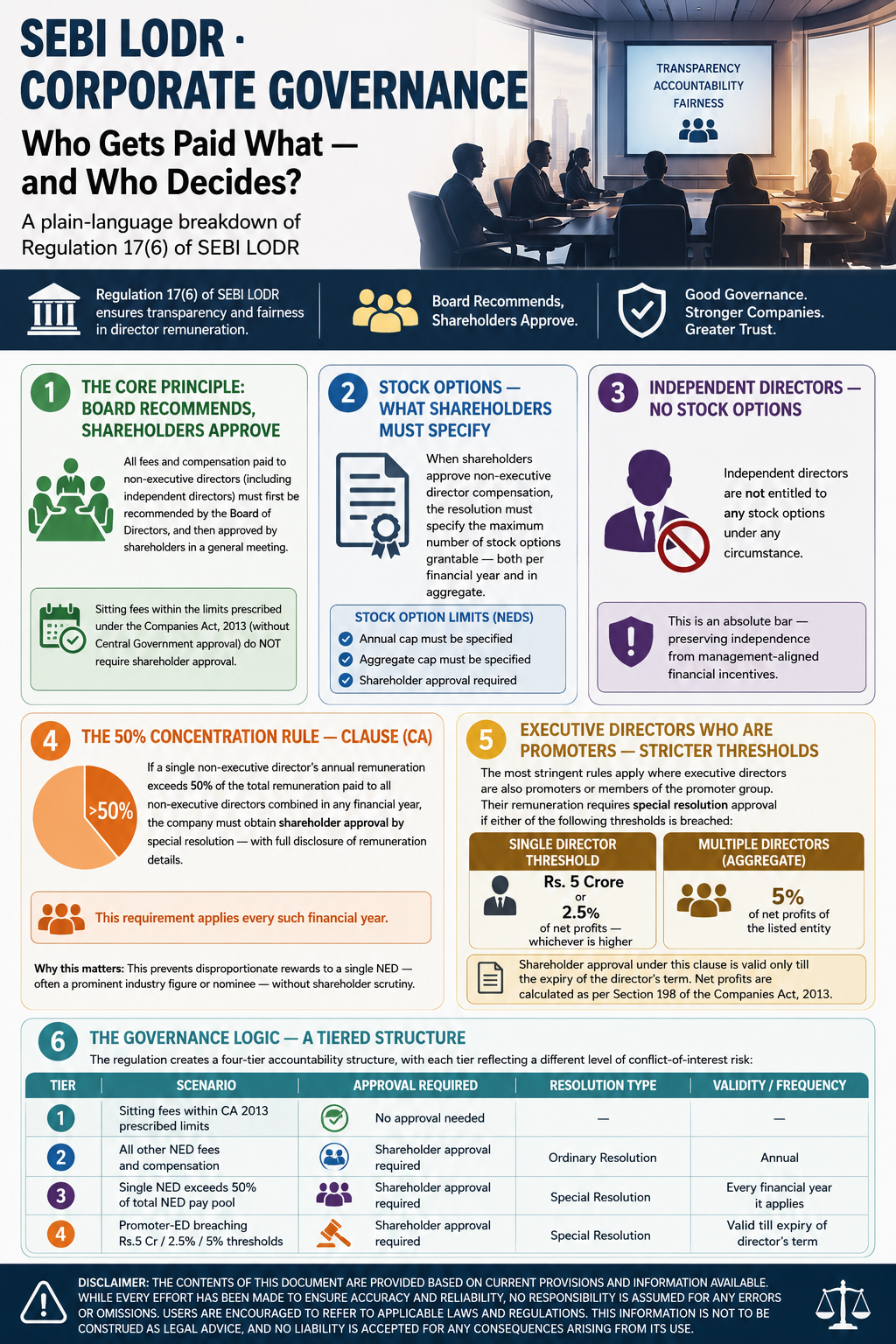
SEBI LODR · Corporate Governance Who Gets Paid What — and Who Decides? A plain-language breakdown of Regulation 17(6) of SEBI LODR Corporate Governance Desk | Listed Companies · Compliance · Board Advisory |
Director remuneration has always been a flashpoint in listed company governance. SEBI's Regulation 17(6) of the LODR Regulations draws a clear map — board recommends, shareholders decide. But the rules differ sharply depending on who the director is and how much they earn. Here is what every compliance officer, investor, and board member should know.
1. The Core Principle: Board Recommends, Shareholders Approve
All fees and compensation paid to non-executive directors (including independent directors) must first be recommended by the Board of Directors, and then approved by shareholders in a general meeting. This ensures remuneration decisions do not rest solely with insiders.
|
|
One practical carve-out: Sitting fees paid within the limits prescribed under the Companies Act, 2013 (without needing Central Government approval) do NOT require shareholder approval. Routine attendance fees keep boards functional without triggering formal resolutions. |
2. Stock Options — What Shareholders Must Specify
When shareholders approve non-executive director compensation, the resolution must specify the maximum number of stock options grantable — both per financial year and in aggregate. Vague resolutions will not meet the regulatory requirement.
|
Stock Option Limits (NEDs)
|
Independent Directors — No Stock Options Independent directors are not entitled to any stock options under any circumstance. This is an absolute bar — preserving independence from management-aligned financial incentives. |
3. The 50% Concentration Rule — Clause (ca)
A significant addition: if a single non-executive director's annual remuneration exceeds 50% of the total remuneration paid to all non-executive directors combined in any financial year, the company must obtain shareholder approval by special resolution — with full disclosure of remuneration details. This requirement applies every such financial year.
|
|
Why this matters: This prevents disproportionate rewards to a single NED — often a prominent industry figure or nominee — without shareholder scrutiny. The annual requirement means the check is not a one-time formality. |
4. Executive Directors Who Are Promoters — Stricter Thresholds
The most stringent rules apply where executive directors are also promoters or members of the promoter group. Their remuneration requires special resolution approval if either of the following thresholds is breached:
|
Single Director Threshold Rs. 5 Crore or 2.5% of net profits — whichever is higher |
Multiple Directors (Aggregate) 5% of net profits of the listed entity |
|
|
Key note: Shareholder approval under this clause is valid only till the expiry of the director's term. Net profits are calculated as per Section 198 of the Companies Act, 2013. |
5. The Governance Logic — A Tiered Structure
The regulation creates a four-tier accountability structure, with each tier reflecting a different level of conflict-of-interest risk:
|
Tier |
Scenario |
Approval Required |
|
1 |
Sitting fees within CA 2013 prescribed limits |
No approval needed |
|
2 |
All other NED fees and compensation |
Ordinary resolution |
|
3 |
Single NED exceeds 50% of total NED pay pool |
Special resolution (every FY it applies) |
|
4 |
Promoter-ED breaching Rs.5 Cr / 2.5% / 5% thresholds |
Special resolution (valid for director's term only) |
DISCLAIMER: THE CONTENTS OF THIS DOCUMENT ARE PROVIDED BASED ON CURRENT PROVISIONS AND INFORMATION AVAILABLE. WHILE EVERY EFFORT HAS BEEN MADE TO ENSURE ACCURACY AND RELIABILITY, NO RESPONSIBILITY IS ASSUMED FOR ANY ERRORS OR OMISSIONS. USERS ARE ENCOURAGED TO REFER TO APPLICABLE LAWS AND REGULATIONS. THIS INFORMATION IS NOT TO BE CONSTRUED AS LEGAL ADVICE, AND NO LIABILITY IS ACCEPTED FOR ANY CONSEQUENCES ARISING FROM ITS USE.